How to teach your child to love reading
Books can unlock the world, but accessing them is about far more than learning to decode letters
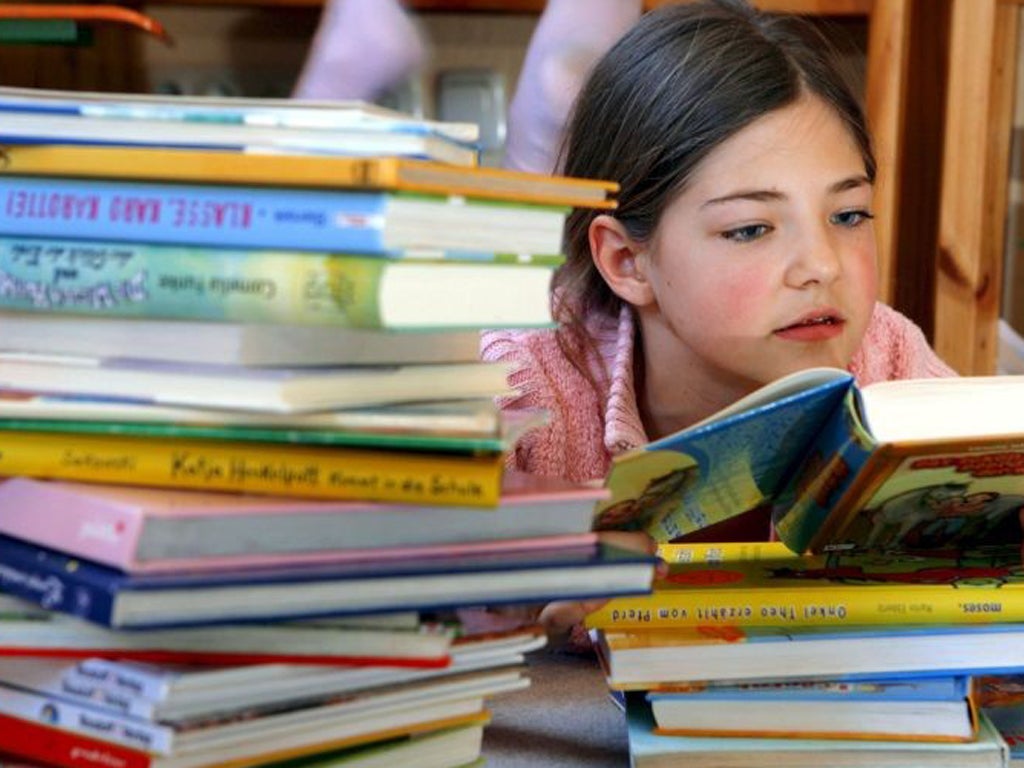
As tens of thousands of children returned to school earlier this month, the National Literacy Trust's report Children's and Young People's Reading Today informed us that only 30 per cent of children and teenagers read books daily in their own time. In 2005, the figure was 40 per cent.
That alarming decline lies at the heart of everything that is wrong with education today. Children who read a lot of books fast, ably and with high levels of comprehension achieve more in every area of the curriculum than those who don't.
It is all too easy – as hand-wringing commentators usually do – to blame television, computer games and other distractions that have instant appeal. Actually, the root cause lies in the way children are taught to read and the failure to develop them as readers.
The Government insists that all children in maintained-sector schools are taught the basics of reading using a c-a-t phonics programme. I have no argument with that – as long as the authorities accept that you also need whole-word recognition to read everyday non-phonetic words such as Charlotte, George, theatre and knife. But the operative word is "basics". It's what happens next that is crucial.
Phonics teaches children decoding skills. No one can read unless they can decode, so this is an essential first stage, but that is all it is.
Nearly all children eventually learn to turn the squiggles on the page into words. They may not be very fluent but when they see "Danger!" or "menu" they know what it means. And, by the age of seven, most can stumble through a passage from some sort of book while an adult listens. But that is not reading. Real reading comes next and parents can do a lot to help.
Reading is like swimming. Getting your 10-metre certificate is not the end of your swimming career. It's the beginning. Once you can use a stroke or two to propel yourself along, you can strike out, build up your swimming stamina and enjoy the water. Perhaps in time you'll swim the Channel or compete in the Olympics. The possibilities are endless but not if you hardly ever go in the water.
To become confident deep-end readers, children have to practise all the time. Otherwise they will slip backwards and even the decoding skills will dull. Real readers go on getting better at it throughout their lives. I know, for example, that although I've always been a good reader, I read more quickly and capably now than I did in my twenties. I've done nothing to bring that about – except read thousands of books.
It is also important that children learn not to subvocalise because it holds them up. Subvocalisers painstakingly read every word aloud to themselves in their heads as we all do at the very beginning. It's a very slow process. A skilled reader reads for meaning without having to "translate" each word into a sound. The brain learns to convert signs seen by the eye into meaning without consciously passing though the medium of spoken or heard words.
Sadly, reading development is often neglected by busy teachers trying to teach a crowded national curriculum to a large class. It's all too easy to think that once Jack or Ella can "read" the job is done – tick the box and move on to the next thing.
The best place for a child to do that essential daily practice – which should quickly become a pleasure rather than a chore – is at home. That means taking children to libraries and/or buying them books. It means turning off (most) screens and certainly getting television sets, laptops, phones, games consoles and the like out of children's bedrooms – or, better still, don't put them in there in the first place.
It has been shown, by the way, that flickering TV and computer screens can damage the brains of very small children. Dr Aric Sigman, a tireless campaigner on this issue, presented yet more evidence to a conference of the Royal College of Paediatrics and Child Health in May this year. So a toddler's bedroom is no place for them, anyway.
The only screen that should be permitted in a child's bedroom, once he or she can decode, is an e-book reader – preferably one of the simple ones that allows the user to read books but not to access other distractions. They are relatively cheap. E-readers have a number of advantages over traditional books. For a start, hundreds of books can be accommodated in one small unit, which is good for tidy bedrooms. Second, several members of the family can read the same books at the same time on their individual devices. Third, many books can be downloaded free and others at low cost.
Fourth – and probably most importantly – you can adjust the font size. Beginner readers can often manage quite complex text if they don't have to grapple with off-puttingly tiny print. Similarly, if there's only a paragraph or two to view on a page and the child isn't holding a daunting "big" book, he or she is more likely to sail on with it.
The most useful thing parents can do to encourage children and teenagers to read is to be seen reading a lot themselves. Parents who say they are "too busy to read" simply convey the message that reading is beneath the attention of important grown-ups. "Do as I say but not as I do" cuts no ice with children. They will quickly stop reading because not reading will be seen as "cool" and "adult".
Somehow we have to reverse the trend if we want our kids to do well at school – and, of course, to access the life-long pleasure of books.
Susan Elkin is the author of 'Unlocking the Reader in Every Child' (Ransom, 2010) and 'Encouraging Reading' (Continuum, 2007)
Unlocking the Reader in Every Child, By Susan Elkin
Ransom £19.99
'Some children – especially boys – don't "get on" with fiction, but can be converted to the reading habit by being introduced to good, entertaining non-fiction books on subjects which grab them. Many a small boy will read anything he can lay his hands on about dinosaurs, for example. Others who wouldn't dream of reading a "soppy" story will often happily read books about sports and sports people, too.'
Join our commenting forum
Join thought-provoking conversations, follow other Independent readers and see their replies
Comments
Bookmark popover
Removed from bookmarks