Ian Rankin: 'This is my Ocean's Eleven'
Ian Rankin's first post-Rebus novel is an art-theft caper that paints his Edinburgh in new colours. Boyd Tonkin talks to him
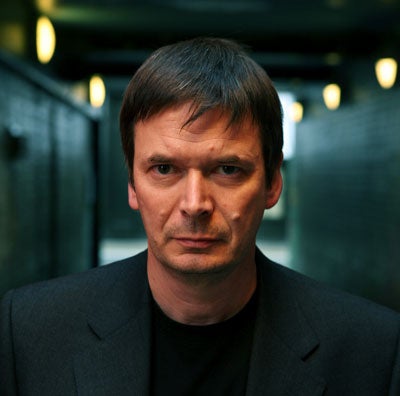
On the day that I discuss with Ian Rankin his new novel about art, risk and crime, Damien Hirst pulls off what sceptics might consider the steal of the century so far. "The timing is exemplary," chuckles the writer in the top-floor lounge of a West End hotel, fresh off a train from Edinburgh but as razor-witted and clued-up as ever. As venerable banking houses founder, their assets so much waste paper, Hirst the enfant terrible prepares to pocket £111m from his saleroom coup at Sotheby's. "I can't think of any commodity that compares to that," Rankin muses as we ponder the tens of millions per cent in added value that an illustrious signature might lend to "ten pence worth of oil and quid's worth of canvas and stretcher".
Last year, Rankin waved farewell to Inspector Rebus as Exit Music closed a cycle of 17 novels that not only sold in stupendous quantities but, in their richness of context and character, helped to re-draw the cultural map of Scotland. In fact, like all the fictional immortals, the downbeat detective has begun to mould as well as mirror his native city's face. "You can go for a walk in the footsteps of Scott and Stevenson and Spark," notes the anguished policeman's creator, drily reflecting on his own, belated stamps of civic approval. "Or you can go and walk in the footsteps of Begbie [from Trainspotting] and Rebus."
Now that Rankin has let his legend walk away, new chapters – and new dangers – beckon. Will Rebus haunt his maker as Sherlock Holmes did an earlier Edinburgh bestseller? "I don't think there's anything I can do about it, so I'll wait to see what happens. So far, so good. The next couple of years will be crucial, because it's going to depend on readers liking the non-Rebus stuff I produce."
Although Rankin will soon start work on "a brand new stand-alone novel of substance and stature", that second career begins with Doors Open (Orion, £18.99). Its fleet-footed but irony-laden plot pivots on an art-world heist planned by the kind of upright citizens that the Inspector might cross the street – or even flee the bar – to miss. "I wanted to write about a different side of Edinburgh from the side you see in the Rebus novels," Rankin reports. "So I wanted these to be successful professional people who get caught up in something that spirals out of control." Bored, boastful and bourgeois, his "Three Musketeers" – a software mogul, a banker who invests in art, and a professorial mastermind – plot to take advantage of a public-access day at a bleak warehouse that houses precious overflow from the city's museums.
The caper began as a 15-part serial for the New York Times Sunday magazine. Orion, his UK publisher, asked if the episodes might grow into a full-length novel. "So when I got the chance to let the characters breathe a little, and the heist breathe a little, I jumped at it." Yet the tale changed not just its dimensions, but its hue. "It just naturally grew darker – maybe that's just me; maybe I just couldn't sustain it as a light novel."
Rankin and a screenwriter friend had first conceived of the thrill-seeking amateur crooks and their raid as cinema material, "my Ocean's Eleven", with Sean Connery as the arrogant academic, Ewan McGregor as the gormless millionaire – and so, starrily, on. The finance never took shape (perhaps it will now?), but movie moods pervade the book as Ealing Comedy high spirits stumble – thanks to a local gangster and a Viking berserker with a drug-deal debt to collect – into the realm of Reservoir Dogs.
Much of the encroaching gloom stems from the grasp – by readers and characters alike – that disaster looms. Perhaps the trio plans to fail. In particular, Mike the idle new-tech plutocrat fears his money "has come too easily and feels kind of Presbyterian guilt about that". And the genre dictates that a heist "can't exactly have a happy ending. The characters are allowed to grow and change, but justice has to seen to be done, to a certain extent." It is – twice over.
Rankin's own entirely legal fascination with art and its collection goes back a long way. While a postgraduate student in 1980s Edinburgh, he took a train to London specifically to catch the previous Francis Bacon retrospective at the Tate. "It was part of putting out feelers – with music and art and literature and theatre – and trying to sense a little bit of everything." As a hard-up young writer in London, he and his wife nonetheless bought prints. Then, when he moved back north in 1996, "We had a new house with more walls to cover. And because I was suddenly earning money, instead of buying prints I could buy the original works". So he frequented the salerooms, to buy or just to watch: "That all drips into the book."
Although he owns works by favourite Scottish artists such as Robin Philipson and Alison Watt, even the begetter of Rebus can't afford a good piece by his Fifer friend, Jack Vettriano. "We've got a lot in common. We're kind of self-taught: he didn't go to art classes; I didn't go to creative-writing classes. We're from very similar working-class backgrounds in the same part of Scotland; and we are both commercial artists."
Rankin surely now commands the kind of respect in literary circles that Vettriano still fights to attain in art? Up to a point: "We're sitting here, and there's still no crime writer on the Booker shortlist." Yet "Almost everything literary authors write has a crime element to it. I accused Ian McEwan to his face of being a crime writer manqué." How did he reply? "He said 'I'm flattered that you think of me like that'. He uses the tenets of the thriller over and over again – he just does it in a very subtle way."
Multiple award-winner for crime fiction, holder of the OBE, deputy lieutenant of Edinburgh, honorary doctor of a handful of universities, Ian Rankin wears his distinctions with a graceful shrug but still seems rooted in quite another sort of attitude. He's a guest director at next month's Cheltenham literary festival, hosting events that explore the legacy of 1968 – a year when the eight-year-old Fife kid "was playing in the back garden with my Action Man."
That protest era might have passed him by, but the punk wave that struck the high-school rebel in the late 1970s has never lost its force for him. "Punk just seemed to happen everywhere. And it wasn't just about bands and music; it was about feeling that your background didn't matter... If you wanted to do something, just go and do it." Which, as a fledgling writer at Edinburgh University, Rankin most certainly did.
Despite his enthusiasm for new arrivals such as Glasvegas, he still reveres the music of that time (especially The Clash) – and the format that delivered it. "I've not really embraced the downloading ethos. I'm actually retreating to vinyl... Vinyl sounds better, if you can put up with the pops and the clicks. My favourite quote on that is from John Peel. He said, 'Life's got surface noise'."
In Edinburgh, Rankin appreciates the clamorous surface noise of Scotland more than ever, as the SNP-led government broaches the possible end of the Union. "If you've got uncertain times, that's always interesting for a writer." But he warns that "The road to independence would be long, because the negotiations about the break-up of the UK would be intense and would be lengthy. It would take years. Imagine having to divvy up the North Sea." Still, "If people decided that was what they wanted, I would do my best to make it work – and make it work for both sides of Hadrian's Wall." For all the excitement of his nation today, the chronicler of Rebus's divided city doesn't have a tartan trace of romantic nationalism.
When he frets about the funding battles that the arts in Scotland face, I ask if total autonomy might end such squabbles. "I think maybe you've got too good an impression of the Scottish character. I think the Scots could pick a fight with themselves, or with anybody. Just because you've got independence doesn't mean to say you're not going to feel trodden down, or hard done by."
"Picking a fight with themselves" seems a handy formula for the plight of Rankin's leading men, even in the swift and satirical pages of Doors Open. The paintings that his trio aim to lift come from both real and imaginary Scottish artists. Among the latter is a certain "Utterson" – the name of the friend who, in the classic tale of Scottish dualism that lurks around foggy tenement corners in much of Rankin's work, discovers the identity of Dr Jekyll and Mr Hyde.
In spite of its nods into the shadows, Doors Open counts as (almost) light relief. I wonder if the "cosmopolitan" city of art that Rankin loves may be putting its dark past of schism and strife behind it. No chance: "It's there physically – it's there in the stones, in the geography of the city. So it's hard to escape. And the more modern you make Edinburgh, the more the past peeps over modernity's shoulder – and gives a little wave."
Ian Rankin
Born in 1960, Ian Rankin grew up in the former mining town of Cardenden, Fife. After award-winning poetry and stories, he wrote three unpublished novels while a postgraduate at Edinburgh University. He worked as a civil servant and journalist; his first published novel was 'The Flood'. The best-selling series of Rebus detective novels began with 'Knots and Crosses' (1987) and closed with 'Exit Music' in 2007. The Rebus novels won four Crime Writers' Association awards, as well as French, German and US prizes; the ITV adaptations starred John Hannah and Ken Stott. Ian Rankin OBE's new novel is 'Doors Open' (Orion). He lives in Edinburgh with his family.
Join our commenting forum
Join thought-provoking conversations, follow other Independent readers and see their replies
Comments
Bookmark popover
Removed from bookmarks