Is literature turning colour blind?
In her new novel, Zadie Smith challenges the way people think about skin colour. She's not the only author trying to 'wake up' their readers
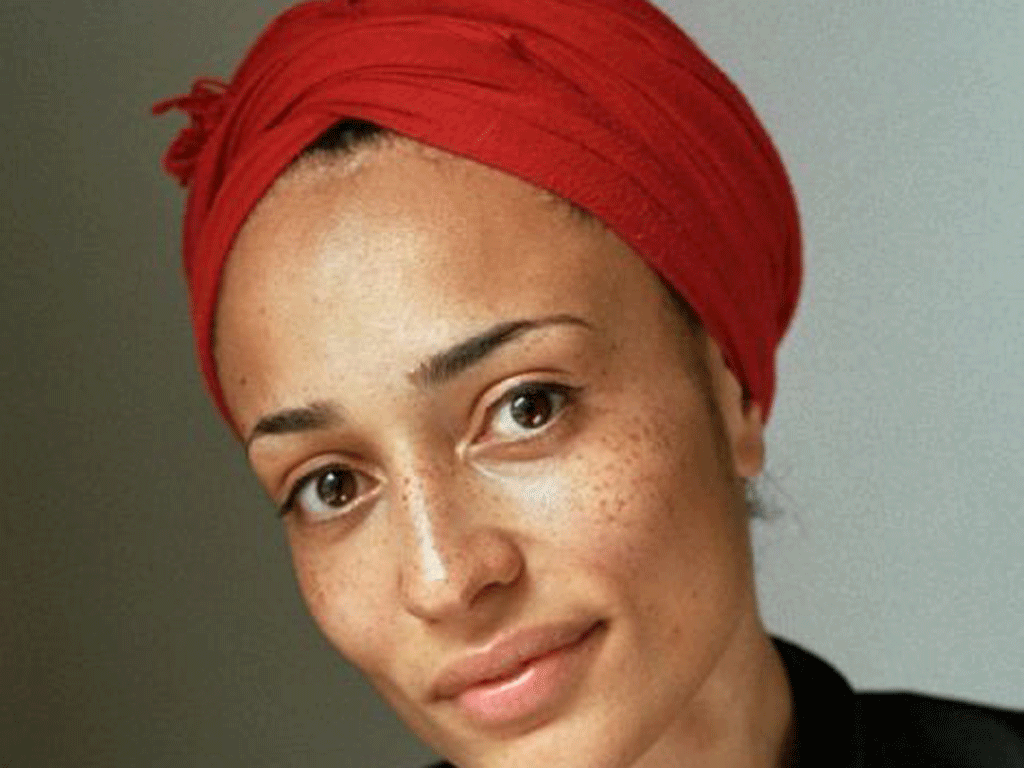
In fiction, as in anything else, it's hard to do anything new. It's hard to break rules that have never been broken. It's hard to find new styles, and new rhythms, and new ways of structuring a narrative that keeps the reader engaged, and the reading experience fresh. It's hard to find new plots. You can't, in a world where many critics think there are only seven, find new plots. But what's much, much harder than all of this is to change, or try to change, the way people think.
In her new novel, NW, Zadie Smith has a go. She writes, in singing, soaring, street-savvy prose, about a corner of North West London, and the people who call it home. She writes, in particular, about a group of people who grew up on the same council estate, the ones who seem to have survived and thrived, and the ones who seem to have sunk. She writes, in other words, about the hopes, and struggles, and successes, and disappointments of a group of people who were born and bred in London, but whose parents often weren't. And she does this without talking about, or by hardly ever talking about, the colour of anyone's skin.
"In novels where the characters are white," she said in a radio interview recently, "nobody thinks the race is being obscured. They just don't think the races exist, because of this idea of neutrality when it comes to white characters. It is," she said, "very difficult to find a way to get people out of that mindset, so that they can see that people of colour are not strange or exotic in themselves, or to themselves." She tried, she said, "many different ways of doing it," but couldn't seem "to find a technique".
In this, as in the fiercely critical review she wrote all those years ago of her own flawed-but-brilliant first novel, White Teeth, she's wrong. She has found a technique that works very well. She uses, for example, the rhythms of London street slang, the London street slang that's more Caribbean patois than Cockney, to show that what's often more important than race in a city of migrants, and children of migrants, is culture and class. Some readers might assume that the woman who knocks on the door of one of the characters at the start of the novel, and begs for money, and whose speech is peppered with "innit"s and "you get me"s, is black. Later, we find out she's Asian and that the woman whose door she has knocked on is white. Another character, we can guess from the fact that her friend calls her a "coconut" and refers to her "big Afro puff", is black. But skin colour is mostly only mentioned when it's white.
It was, said Smith in the same interview, one of the things she did to "amuse" herself. "I remember as a kid," she said, "reading Updike or Roth, writers I loved, but half way through the book you'd have to deal with the appearance of 'the black man', who would be described as 'the black man'. That can be quite exhausting to read, so I wanted to see if I could create that exhaustion the other way round."
Actually, she doesn't. There's nothing "exhausting" about reading about "a young white couple" crossing the road, or about reading about a character who "frowned absently at the nipples of the white woman in his newspaper", though there can be something a little bit tiring about the fragmented structure of this novel, and its clearly-inspired-by-high-modernism style. But there's a certainly a sense, for the reader, of being jolted out of a certain kind of laziness, a sense, you could say, of having to keep awake. And fiction, unless it's the kind of fiction you use to get to sleep, or to have the same S&M fantasies as 50 million other people, should keep you awake.
Smith is, in fact, following a path along which some other writers have walked. You could say that it was a path that started with Ralph Ellison's Invisible Man, which is narrated by an unnamed African-American who's trying to function in a society where he feels invisible. Twenty-odd years later, Toni Morrison set out, in the fiction that would win her a Nobel prize, to create whole towns and landscapes where the "blackness" of the characters was evident only in the style, the dialogue and the tone. She wrote, she said, for black readers. If white readers enjoyed her fiction, that was fine, but they might need to read with "black" eyes.
Black British writers have found other ways to wake their readers up. In her novel Blonde Roots, Bernardine Evaristo has "white Europanes" enslaved by "black Aphrikans" and shipped to far-away islands named (like the West Indies) on a whim. Parties of "blak" tourists take trips to "white" ghettoes. "Whyte" women spend hours in salons trying to get some oomph in their thin, lank hair. Malorie Blackman does something very similar in Noughts and Crosses. In this novel, for young adults, slavery has been abolished but there's still segregation between the black educated elite and their European former slaves. Blackman never wanted to write about race but she decided to write the novel, after writing 11 others that didn't talk about it, when she needed a plaster and realised that all plasters were pink.
"It's a really funny irony," the novelist and poet Jackie Kay told me, "to assume that all black writers are creating white characters unless they state they're black. It would be interesting if you did the whole process in reverse. If, every time a white writer created a white character, they had to talk about their skin colour within the first page of identifying them." Like Zadie Smith, she feels she's on a "quest" to educate her readers into reading differently, so they're "not assuming from the outset that, unless they're told otherwise, everyone's white". In her last book of short stories, Reality Reality, she gives only hints: the fact, for example, that one Glaswegian woman says she wants to have the figure of Michelle Obama; a mention in another one that the only thing two characters have in common is their "skin colour". People don't talk about shared "skin colour" if they're white.
They don't say it, because they continue to assume, even if they live in a city like London where 42 per cent of the population isn't white British, that white is the neutral norm. They also continue to assume that a writer will want to talk about race just because they happen to be black. "I think," said the award-winning crime writer, Dreda Say Mitchell, when I phoned her for her views, "that people still like to think with writers who are black that ethnicity's always at the back of their mind. It's not at the back of mine. It's such a straitjacket to keep putting writers who are black, or of mixed heritage, into that bracket of thinking of ethnicity or oppression. It's so stale and so boring."
Mitchell, like Kay, and like Smith, is currently writing a novel (with her writing partner Anthony Mason) where "some of the characters might be black, but we're not going to mention it". She's not going to mention it because what she's interested in, she says, is the story and the characters. Which, of course, is what fiction is about.
Join our commenting forum
Join thought-provoking conversations, follow other Independent readers and see their replies
Comments
Bookmark popover
Removed from bookmarks