John Connolly: 'All you have is language. It's an act of respect'
The Charlie Parker creator talks to James Kidd about introducing the otherworldly to the thriller
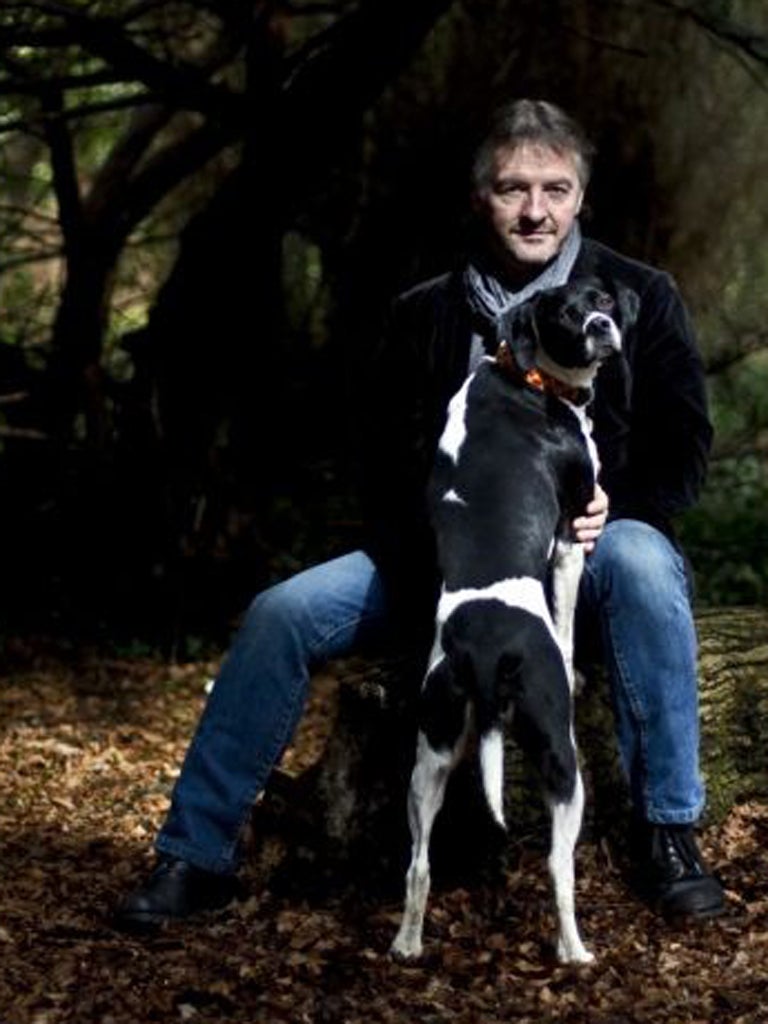
John Connolly is a slippery so and so. Born and bred in Dublin, he feels most at home when writing about America: his fictional hero, the private detective Charlie Parker, lives and works in Maine. Over the course of 13 years and 10 Parker novels, 44-year-old Connolly has weighed a desire for commercial success against the promptings of his ambitious and mercurial imagination. A passionate advocate of crime fiction, he nevertheless kicks constantly against the limitations of his genre: his hard-boiled detective stories are regularly cut with supernatural narratives and literary prose, and he takes regular sabbaticals to write fantasy fiction, horror stories, and children's books. Perhaps John Connolly is simply an artist squeezed into a populist's clothing. Or should that be the other way around?
We talk at the Theakston's Old Peculier Crime Festival in Harrogate. The day before, Connolly attended a now famous discussion about ebook self-publishing. When the thriller writer Stephen Leather argued that internet piracy was good for business, a well-known peer was heard to shout "Tosser" from the audience.
Connolly sees both sides of the story. He criticises publishers for selling their wares at a discount and then complaining when books become devalued by the culture. He understands the anger of those who feel neglected by mainstream publishing and decide to go it alone. But, he argues: "I think people are confusing the right to write with the right to be published. Anyone who wants bookstores to survive is portrayed as a Luddite who goes around smashing up Kindles."
He cites the US crime writer and self-publishing evangelist JA Konrath, who was recently photographed sipping cocktails besides a pyre of burning hardbacks. "Anyone who thinks it remotely amusing to sit beside a pyre of burning books has a very shallow sense of humour. You are aligning yourself with a whole lot of very unpleasant people."
What baffles Connolly above all is Konrath's elitism. "This is a first world argument. To read an ebook, you need to be able to afford a Kindle or iPad. You need access to the internet. And you need an electricity supply. It's like Bill Gates's idiotic comment that the world will be a better place once we span the digital divide. Most people don't have running water."
In conversation, Connolly speaks at length and with machine gun rapidity. A standard soliloquy alternates between levity and seriousness, between apparent self-confidence and a worrier's self-deprecation. "I look back on my career as a series of missteps," Connolly laughs. "What is good for you creatively is usually bad commercially. You thrive financially by sticking to a series and not fiddling about too much. You do yourself harm by moving away from the series and the genre. By trying things not based in that particular mode of writing, you will just lose readers."
He cites his 2005 breakthrough Parker novel The Black Angel, which he followed with The Book of Lost Things, an idiosyncratic book of fairy tales about a grief-stricken young boy's coming of age. "I love The Book of Lost Things. It was certainly the story I wanted to write at the time. But all my momentum dissipated. Those readers [of The Black Angel] didn't hang around. They moved onto something else."
Connolly's protean nature is well represented this month by two very different works. There is Books to Die For (Hodder and Stoughton, £25), an essay collection edited with Connolly's fellow Irish novelist Declan Burke, in which 120 of the world's finest crime writers extol their favourite crime novels. Connolly chooses The Chill by his hero Ross MacDonald, and Michael Connelly's The Black Echo – "one of the five greatest debut crime novels ever written".
Then there is The Wrath of Angels, the 10th of Charlie Parker's haunting, scary and addictive investigations – to my mind the finest crime series currently in existence. As always, the plot marries an ingenious, if recognisable, detective story with something wicked and otherworldly. The sinister and possibly demonic Collector makes a welcome reappearance. "The notion of fusing genres is still something the crime-writing establishment in England is uncomfortable with. There's a sense that it interferes with the purity of the form. It suggests a lack of faith in what I am doing."
Connolly's magpie imagination is not the only reason his books are an acquired taste. His lyrical prose is an oddity in the spartan milieu of contemporary crime writing, and betrays what seem suspiciously like literary aspirations. "There is sometimes a feeling in crime fiction that good writing gets in the way of story," Connolly says with a hint of defiance. "I have never felt that way. All you have is language. Why write beneath yourself? It's an act of respect for the reader as much as yourself."
Connolly is on a roll. He explains his welding together of "rational and irrational" forms by rewinding to his Irish Catholic upbringing. "Crime fiction was born from the idea that the world can be understood by the application of logic. Irish people have always been uncomfortable with this point of view. Possibly because we are a Catholic nation, we don't think rationality encompasses the entire world. We believe that human beings are far stranger than rational thought allows."
Nevertheless, it was a youthful frustration with Ireland in the 1970s and 1980s that inspired Connolly's literary wanderlust across the Atlantic. "We are only now examining issues like corruption, clerical abuse, and the Troubles. We forget what an insular, clerical-dominated, restricted society Ireland was. Unless you were John McGahern and were interested in examining the nature of Irishness, your natural inclination was to look elsewhere."
In 1999, America simply offered a "bigger, more entertaining stage" on which to explore ideas. Thirteen years on, not much is different. In The Wrath of Angels, Parker doesn't merely cross swords with the Collector, he contends with the most severe recession since the Great Depression. On his last visit to Maine, where he now owns a house, Connolly was struck by how many friends had taken a second job. "There's a TV station in Portland. One of their anchors was waitressing in the Cracker Barrel [restaurant]. A lot of people are scraping along right now."
Connolly argues that crime fiction is the perfect form to explore the economic wasteland. In the years following the banks' collapse, the harsh, prolonged Maine winter has literally become a matter of life and death. "If you have months of extreme temperature falls, as Maine does, in a country without welfare safety nets, then people die. America's an outrageous country in that sense. I find the idea that you would let the poor and weaker members of society drown immensely depressing."
Connolly's own future seems more assured – for the present, at least. "You are only two books away from disaster commercially," he says. "One failed experiment is acceptable. Two, and you have visions of your publisher examining the small print on your contract."
It seems entirely characteristic, then, that Connolly is shelving Charlie Parker for almost two years, and embarking upon three projects, none of which is a crime novel: there's a novella about a First World War veteran, a science fiction story for young women written in collaboration with his partner, and the third of his enjoyable Samuel Johnson books for young adults.
"I do wonder whether I can afford to do this. I have a mortgage. I support a family. Is my readership tolerant enough to wait?" He pauses. "It's a risky business." It is, but it seems John Connolly wouldn't have it any other way.
The Wrath of Angels, By John Connolly
(Hodder £17.99)
' Soon it would be Thanksgiving, although it seemed that there was little for which to be thankful ... People I met on the streets of Portland spoke of working second jobs ... of feeding their families with cheap cuts of meat while their savings dwindled and their safety nets fell away.'
Join our commenting forum
Join thought-provoking conversations, follow other Independent readers and see their replies
Comments