Life in a cold climate: How Sara Wheeler is shaking up Arctic exploration
The polar explorer Sara Wheeler is unimpressed by the 'frozen-beard' brigade. Instead, her interest lies in the harsh reality of those who make their home in the Arctic
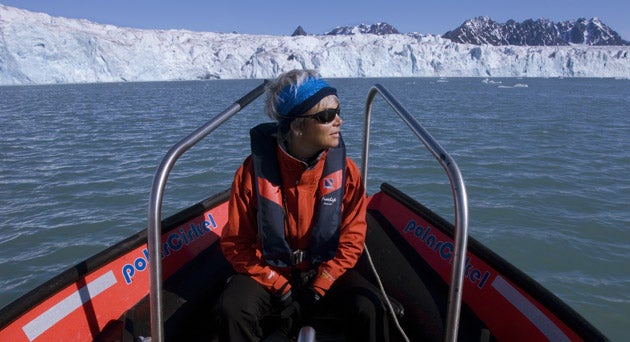
Adjusting a daringly short black velvet dress and looking down at the girlie pink socks she has folded over her black boots, Sara Wheeler pronounces, "I don't do any sledge-pulling and I'm not interested in sledge-pulling." For the glamorous polar travel writer, whose grey pixie hair, kohled eyes and shocking-pink lipstick make her look a million miles from her Gore-Tex-clad contemporaries, sledge-pulling is a distraction from the real business of describing the world's extremities. "I think that to a certain extent we've got used to using the Arctic and the Antarctic as testing grounds," she explains. "Once upon a time, they had to be, because we didn't know what was there, but now those times have gone and we've got to look for something else. I find most of today's frozen-beard endeavours quite stunt-ish."
The "frozen beards", as she has dubbed those male contemporaries who pit themselves against the elements before publishing a book whose cover shows them staring out with ice flecks in their facial fuzz, have been unsurprisingly huffy in their reception of this female interloper in their predominantly male club. But Wheeler is unperturbed. "In the exploration community, there's a great sense that places such as the Antarctic are private territory, and they don't want me going in and making it seem as if anyone can do it. There is a certain group of people who are never going to like what I do, but that's OK, it's a free country. They don't own it and nor do I."
Lighting a gas fire in her already hot north London home on a warm autumn morning, Wheeler has no desire to prove how tough she is. Researching her sixth and latest book, The Magnetic North, a tale of the people and landscapes contained within the Arctic Circle, she frequently camped in sub-zero temperatures and "shared her bathroom with a seal", but she says that for that to be the purpose to her trips would miss the point. "I want to say other things about those regions, because I think there are plenty of other things to be said. It's a pity if it's only about losing half your body weight and seeing how dead you can get. I want to write about the places, or people, or the universal experience, not about myself."
Every Christmas, the shelves of bookshops heave with accounts of authors' extreme polar journeys, but Wheeler has chosen to do something different. Part reportage, part investigative journalism and part biography of a land, her book takes in every aspect of life within the Arctic Circle, presenting it as a home, not a playground. From investigating pollution crimes in Chukotka – a post-Communist outpost of Russia the size of Turkey – and travelling with reindeer herders in Lapp country, to uncovering the tragic history of a monastery in the middle of the White Sea, Wheeler's interest lies in the communities which make their lives there.
It was Chukotka – whose inhabitants were ill-treated first by Communism and then by capitalism, and are living in a place that often resembles a nuclear wasteland – that most captured her imagination. "Chukotka is this region of a quarter-of-a-million square miles where there's no road and nothing grows. The indigenous people have been abandoned there and I saw some pretty grim sights. Nuclear waste is just dotted around all over the place. There were nuclear submarine carcasses lolling around like whales."
Wheeler's first experience of writing in the ice caps was at the opposite end of the globe. In 1995, she wrote her first and most successful book to date, Terra Incognita, about her seven-month stay in Antarctica as a writer-in-residence with the US National Science Foundation. She returned several times to the far south, but the more polluted and developed Arctic had not appealed until now. "I was attracted to the Antarctic because it was an un-owned continent, undefined and pure. It was a symbol of the world as it might be, so it fitted a youthful vision of purity and idealism.
"In contrast, I was very unnattracted to the Arctic because it was everything the Antarctic wasn't. It was owned, it was polluted, there was lots of oil and all sorts of miserable people, it was just not something that interested me. Years went by and I went to other places; I went to Africa and did this and that, and then I became middle aged – I'm almost 50 – and I started thinking about the Arctic. Of course, it is all those things, and that more suits the elegiac melancholy of middle age, where everything is fragmented. I'm not interested in idealism any more, I'm interested in reality."
Reality is what you get in The Magnetic North. Whether it is scenes of alcoholic fathers pushing buggies with holsters, where beer cans have replaced milk bottles, or seeing the sharp end of climate change while camping with scientists on the Greenland ice sheet, Wheeler never shirks from the ugly truth of the region. Many of these truths were discovered with her children in tow. Reggie, now aged six, and Wilf, 12, both accompanied her on various legs of the trip. Reggie, at the time an un-weaned baby, was enthroned in pelts and taken reindeer herding with the Lapps, while Wilf, at the age of 10, was introduced to some colourful Slavic vocabulary after being taken under the wing of the Russian crew of an ice-breaker.
Now, after years of combining travelling with bringing up her two sons, Wheeler is ready for some time at home with them and her partner. "I haven't had any time off for 25 years and I feel writers need a fallow time," she says. Just don't expect her to embrace domestic life. "People always say to me it must be a challenge when I take my children with me to strange places, but I always think it's more of a challenge being here. I'm not domestic; I feel more of an imposter at the school gate."
The extract
The Magnetic North, By Sara Wheeler (Cape £20)
'... Every nation devastates native cultures ... Russians did it with bureaucracy, Americans with money, Canadians (in the end) with kindness. And everyone did it with booze and syphilis.
Acculturation is a theme of "The Magnetic North". It's a grim story, but I was not looking for a pretty picture. I was looking to see beneath both beauty and ugliness; to see the boredom and the horror ...'
Join our commenting forum
Join thought-provoking conversations, follow other Independent readers and see their replies
Comments
Bookmark popover
Removed from bookmarks