Martin Amis: 'Men are terrible. We can't help it'
Martin Amis has written some of the funniest, cleverest novels of the late 20th century. He tells Christina Patterson about his new book, and how he wishes the world was run by women
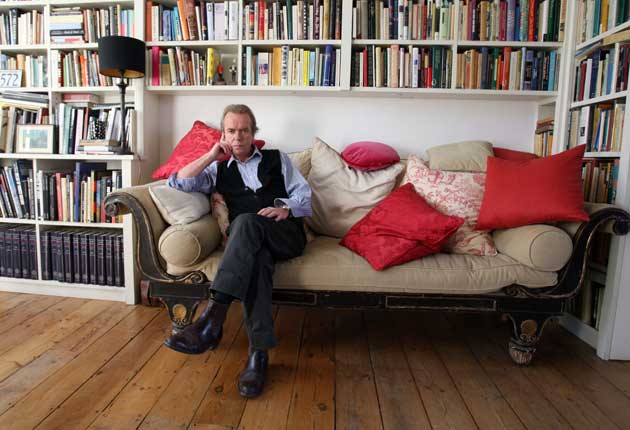
If Martin Amis is worried about security – about random visits, say, from Islamist nutters seeking revenge, or from latte-sipping liberals whose anti-torture instincts have, on reading recent Amis, been sorely tested – he clearly hasn't told his nine-year-old daughter. We've already had a nice chat about her day, and her lovely pink top, and the portrait on the wall, when I realise that this dark-eyed little girl, who pressed the buzzer on the outside gate, and opened the front door, and welcomed me in, hasn't actually told either of her parents that I'm there. She's delightful, of course, but I can feel the taxi-meter of precious interview time ticking away. So finally I crack and off she trots – serious, soulful, sweet – and here they are, Mummy and Daddy, one of the most glamorous literary couples in the world.
Mummy is Isabel Fonseca, the beautiful American heiress, writer, novelist, and second wife. And Daddy – well, we know who Daddy is. Amis fils, he used to be called, this writer of brilliant, glittering, savagely comic novels, this writer of coruscating, polysyllabic, look-at-me prose, this writer who is one of the most famous writers alive. Amis fils he used to be called to distinguish him from Amis père, angry young man turned grumpy old devil, poet, curmudgeon, pen pal of Larkin and creator of – yes – savagely cruel comic novels, and of one of the funniest books in the English language, Lucky Jim. If Kingsley was the colossus who loomed – a colossus who, famously, gave up reading his son's books – Martin was the sexy one, the hip one, the one who wrote the blistering satires on money and success, but did pretty well at garnering both.
And here, in this gracious Regency house, are the fruits of it: tasteful modern art, ethnic artefacts, artfully arranged antiques. In the corner, there's a pinball machine and the sofas are scarlet velvet. No "Martin Amis does Laura Ashley chintz" shock horror. No "Martin Amis does space, light and elegance with a funky twist", Goddamn him. Martin Amis does, by the looks of it, perfect happy families in massive, beautiful house. Martin Amis does brilliant, world-famous novelist and all this as well.
I am, it's clear, having the authentic Martin Amis experience. In the old days, it was young men who were sent to interview him: young men who would bask in the golden light of his glory, hoping perhaps that some of that precious, blessed stardust (pure testosterone, maybe, frozen into tiny, glittering crystals) might fall on their more slender shoulders and they too would open their mouths and issue forth searingly witty, searingly acerbic, searingly incisive pronouncements on literature and life. And they would go away and either write a homage to the master – one which, like "lucky" Jim, in his final, disastrous lecture to the faculty, unconsciously echoed the rhythms of the boss – or they would set about the arduous, but satisfying, process of dismembering him. If Making Cocoa for Kingsley Amis was an unlikely title for a best-selling poetry collection (one by Wendy Cope), Humiliating Martin Amis is surely one that would sell on its title alone.
They often sat in smoky pubs, these pugnacious young men, out-smoking and out-sneering the master. Sometimes, they even played tennis with him. Testosterone isn't just for the head, you know. You've got to show muscle. You've got to show fight. Luckily, I don't have to play tennis, or show muscle, or show fight. Luckily, I can sit on a nice, comfy sofa and sip white wine. And Marty doesn't play too much tennis these days either. Sorry, Martin Amis. It's tempting to slip into these matey diminutives when you're writing about Martin Amis. Tempting, perhaps, to indicate that you're on his level and can bring him down a peg or two should you feel the need. Well, I'm not on his level. I haven't written a handful of the funniest, cleverest novels of the late 20th century, and I'm not keen on pegs. Even though I'm a woman. But we'll get back to that later.
"The last time I played tennis," he says, "I did something to my leg and I sort of felt ancient. Suddenly when you do that, distances look enormous for a while. And stairs." Oh dear! The man still sometimes described as the enfant terrible of English literature has trouble with the stairs. But then the enfant terrible of English literature will be 60 in August. "The day," he adds, "seems much shorter now. And when you're finishing something, you're not really good to do other things. It's hard enough doing a plausible imitation of a husband and a father, let alone a tennis player."
Whoa! That's enough Big Themes for an opening paragraph: intimations of mortality, relations between the sexes, relations between fathers and their children, relations between the inner world of the artist and the outer world of doing the washing up and, not least, the New Novel. "At this stage," he continues, "there's a sort of great terror that you have to get it done. My father once said you really just want to stay up all night for a month until it's done." And his father, too! This could keep us going all day!
But first sleep. I'm obsessed with sleep. Does he sleep? Amis sips his beer and turns, as he often does, to Nabokov. "Nabokov said that the world divides between people who sleep well and people who don't. This novel is partly about this great attack of sleep I had. I've always slept well. Then I had a sort of weird kind of physical breakdown around 2002 or 2003, where the main symptom was needing a fantastic amount of sleep. It was sort of marvellous just lying there."
Well, this is certainly a different Martin Amis. A Martin Amis happily snuggled up under the duvet. A Martin Amis, apparently, who "couldn't write for a bit" because his "handwriting collapsed" and who had "a sore throat that lasted a year". A Martin Amis who was, in fact, grieving for his sister, Sally, who died of alcoholism in 2000. "I think we live all our lives in shock," he says, "and then some muffler comes off and you get it. There were lots of tearful episodes. Not really knowing what it was about. And then I finally intuited that it was four years after she died, and these things queue up on you."
It's certainly a reminder that, as Amis points out later in our conversation, while levels of suffering may be relative, actual suffering isn't. A reminder, too, that those who sneered at the idea of writing about suffering while flopping by the pool of your house in Uruguay, as Amis did while writing his novella about the gulag, House of Meetings, couldn't sneer at the authenticity of its depiction. "It was an awful business writing it because I felt so guilty," he says. "You know, there's a Posy Simmonds cartoon of someone sitting with a cocktail saying to a dictaphone, 'On the third day, the last child dies.' It was a bit like that. And I just did a lot of suffering, but writerly suffering. It all seemed dead and incredibly presumptuous."
The test, of course, is whether something works, and House of Meetings works triumphantly. It's a dazzling, sickening, chastening and, yes, beautiful, portrayal of life in a Stalinist slave camp in the Arctic Circle. The reviews were universally rapturous. Which must have been a relief after some of the critical responses to his work in the past few years. Wasn't it? "Yes," says Amis. "Absolutely. I was so shocked by the reviews of Yellow Dog."
Yellow Dog, Amis's satire on the Royal Family, tabloid newspapers and London hard-men, which came out in 2003, was widely regarded as – well, Amis's donkey. "Yellow Dog isn't bad as in not very good or slightly disappointing," said Tibor Fischer in The Daily Telegraph. "It's not-knowing-where-to-look bad... It's like your favourite uncle being caught in a school playground, masturbating." Amis responded by insisting that the novel was in his "top three" (which it absolutely isn't) and declared that "no one wants to read a difficult novel, or deal with a prose style which reminds them how thick they are". Does he stand by that?
Amis stares out at the window. "No," he says. "Probably not. But I think people are too fragile now. Humour is... you don't see much of it. You see it a lot on the sort of V C sub-surface, stand-up and TV and that. But the comic novel has more or less disappeared... Think of the range of what you can't joke about now. It's almost everything. I'm writing [in the new novel, The Pregnant Widow] about 1970, and I thought, well, I've got to be honest and put in the sort of jokes that people told. And I realised that it would just make everyone hate these characters so much – their jokes about Jews, about black people. It was actually a satire on prejudice and it was funny. But now the only political constituency of people you can sneer at are white South Africans, or white southerners in America, and up to a point, Israel. And Israel's the unusual one, because they have slightly darker skin. But our whole kind of paralysis about Islam is to do with that."
Islam. Deep breath. Well, there are PhDs to be written on Martin Amis and Islam, but a quick summary would go like this: After September 11, Amis wrote a number of pieces on the Islamist terror threat and the rise of the suicide bomber. The first, published in The Guardian a week later, and again in The Second Plane, a collection of essays and stories on the subject published at the beginning of last year, outlined the horror of "an irrationalist, agonistic, theocratic/ ideocratic system... unappeasably opposed to the West's existence" and the need for Americans to "absorb the fact that they are hated, and hated intelligibly". Amis later recanted on that "intelligibly", dismissing his first response as "rationalist naivety" in a sphere where the rational is, he argues, no longer relevant.
Liberals sniffed Islamophobia and blanched, but it was when Terry Eagleton, Professor of Cultural Theory at Manchester, where Amis now teaches literature to students of creative writing, unearthed some comments he made in an interview, that all hell broke loose: "There's a definite urge – don't you have it? – to say, 'The Muslim community will have to suffer until it gets its house in order.' What sort of suffering? Not let them travel. Deportation, further down the road. Curtailing of freedoms. Strip-searching people who look like they're from the Middle East or Pakistan... Discriminatory stuff, until it hurts the whole community and they start getting tough with their children." Amis, who later dismissed the comments as a "thought experiment" made in the heat of the foiled plot to blow up a series of jumbo jets, was widely accused of racism. In the pages of this newspaper, Yasmin Alibhai-Brown declared that he was "with the beasts", the "Muslim-baiters and haters". Amis responded with a letter in which he said that he longed for Alibhai-Brown's "soothing hand" on his brow.
"Yes, well," says Amis, who was clearly wounded by the row, "I said that sort of hypothetical thing about what a government might do, and of course the hypothesis was removed... The idea of hating someone because of the colour of their skin, or their religion – that's for the gutter. That's not part of serious debate. And racism is just the golden hand-grenade that you lob at anyone – you know it's going to stick."
OK, well, let's go back to where the fuss started, to what Amis has called his "political education". Up until about 2000, he had written mostly fiction and journalism about fiction. In 2002, he published Koba the Dread, an exploration, inspired by his father's early political leanings, of the indulgence of Western intellectuals towards communism and of the realities of life under Stalin. This was followed by a fictionalised exploration of the slave camps, House of Meetings, and then by The Second Plane. It was a "political education", in other words, which started when he was about 50. What took him so long?
"I wrote about nuclear weapons and I wrote about the Holocaust, but that was not political. I don't know. Hitch [his friend Christopher Hitchens] and James Fenton [the poet and another colleague at the New Statesman in the 1970s] were very left, and I just felt that I didn't want to belong to anything. And I think it was tremendously important for Christopher as a writer when he ceased to be ideological and he sort of bloomed."
And how did he respond when his best mate started writing polemic, too? Wasn't the deal that Hitch did the serious stuff and Amis did the funny stuff? "No," says Amis. "There's more that I can talk to him about. He used to complain in the 1970s that 'all Martin and I talk about is sex because he doesn't know anything about politics'."
"Geopolitics", says Amis in his introduction to The Second Plane, "may not be my natural subject, but masculinity is." You can say that again. Now, as well as the rogues gallery of hideous, solipsistic, sex-obsessed, success-craving males who people his fictional universe, there's a matching set of real-life equivalents: the Stalins, the camp commanders, the jihadist clerics, the constipated suicide bombers (fictionalised in a short story in The Second Plane) on their way, via the twin towers, to paradise. In the light of all this, perhaps his caricatures of appalling men were merely an accurate depiction of the essence of the male?
"I think so!" says Amis cheerily. "I was quoted by, I'm pleased to say, Germaine Greer, as saying that all men should be locked up until they're 28. Boot camp. That would knock some sense into them. We're terrible. We can't help it!" No wonder he now describes himself as a "gynocrat" who believes that the world would be better run by women. And no wonder his new novel, The Pregnant Widow, is about the sexual revolution. "My view is that they got it the wrong way round," he says, "in that what they should have absolutely nailed down as their only objective is that men should do 50-50 in the home. Instead, they went Napoleonic."
Uh, huh? And how much does he do? Amis makes a face. "I do a lot of driving," he says in the end. "And, in fact," he adds, "men get even more devious than you know. Men are so corruptive that some awful document arises and you go up and sort of stand near your wife looking helpless."
Do you. So, less delegation of "awful documents" to the wife. More washing up. More pegs, in fact. Anything else? "Well, there's another thing," says Amis, "but it's grim. It's to do with little boys and little girls. If a girl says, 'I want to marry daddy,' as they all do at some time, everyone goes 'ah'. If a little boy says, 'I want to marry mummy,' then he wakes up in hospital. The special status of the dad," he says emphatically "has to go."
Right. It sounds as though Martin Amis on the sexual revolution might be at least as controversial as Martin Amis on Islam. I'm not quite sure what to make of it. Eccentric is the word that springs to mind. A slightly peculiar extrapolation of the universal from what is clearly the particular. And this, from a man who rarely names a female intellectual influence. A man, indeed, who thinks the comic novel is dead, perhaps because people didn't think his last comic novel was funny. But you don't go to Tolstoy for haikus and you don't go to Muriel Spark for Dickensian breadth and you don't go to Jane Austen for analysis of the Napoleonic wars. And you probably don't go to Martin Amis for political solutions or the resolution of the sex war. You go to Martin Amis because he makes the English language sizzle and sing.
'The Pregnant Widow' will be published by Jonathan Cape in September. Martin Amis will be talking to Robert McCrum on Thursday 7 May at the Norwich Playhouse on behalf of Writers' Centre Norwich (www.writerscentrenorwich.org.uk), as part of the Norfolk & Norwich Festival. For event details, visit www.nnfestival.org.uk
Five Amis classics
House of Meetings (2006)
A devastating depiction, drawing on the history explored in 'Koba the Dread', of a Stalinist slave camp in the USSR, focusing on two brothers, their rivalry and their shared love of one woman.
Experience (2000)
A multi-layered memoir that takes on all the Big Issues: Kingsley, literary influences, friendship, divorce, love, loss, the media and, of course, "the teeth". Fascinating, of course, but also surprisingly warm.
Time's Arrow (1991)
The Booker-shortlisted tale of a Nazi war criminal in Auschwitz which, in reversing time, and some of the atrocities of the Holocaust, wrought a satirical, linguistic miracle.
London Fields (1989)
A murder story for the end of the millennium set in the pubs, and on the streets, of west London. Baroque, funny, hard-edged, it's a meditation on writing and on the postmodern world.
Money (1984)
Porn freak, jet-setter, hedonist, slob, John Self is a reluctant anti-hero of Amis's savage satire on the greed-is-good 1980s, a novel that now stands as emblematic of a bygone age.
View all comments that have been posted about this article.
Offensive or abusive comments will be removed and your IP logged and may be used to prevent further submission. In submitting a comment to the site, you agree to be bound by the Independent Minds Terms of Service.
- Print Article
- Email Article
-
Click here for copyright permissions
Copyright 2009 Independent News and Media Limited
Also in this section
- A life of rhyme: John Cooper Clarke, the 'punk Poet Laureate', grants Robert Chalmers his first major interview in more than 20 years
- A lore unto himself: Owen Sheers is having his way with an ancient myth
- Modern comic genius: the graphic art that's not just for geeks
- Arifa Akbar: Why always write in a room of one's own?


Comments
Ovrepopulation will destroy us all.
But somewhere along the way Amis stopped being Amis the novelist. 'Yellow Dog' for me was the turning point. A 'difficult' novel at a time when publishing itself was taking the elevator to the basement without stopping inbetween. His grasp of language, his talent for character, the sharpness of his dialogue is still there, I just wish he would return to mainstream fiction.
Yet when I read what is praised as brilliant writing and despair at the feeble grasp the author has of English (the plots are great) I realise why he has deserted us. You gotta make money somehow.
Before there was patriarchal society among humans there was matriarchal society, when we all live in tribes and depended on each other, femininity (in the most general biological sense) was worshipped because it created life and menstruation (when left to its own devices) happens at every full moon; anyway the key thing is in the kind of psychology that is evoked by the deepest respect for nature (a feminine principle - you could say the earth is feminine, because it gives birth to new life - and that the sun's male, without the sun where it is there wouldn't be life on earth, or any other planet (not that I know anything about that! lol!)). It's interesting because as patriarchy grew to make society what it is today, and as woman's role as the mother of all life became less respected we started to do some serious damage to the environment - mother earth. i think that's an interesting parallel to consider.
Also, a crap book that functions best as a metaphor is The Da Vinci Code, believe it or not! Ignore the details of the story - whether there's a grail or Jesus' descendents, the mythic structure of the story is about the negative global effects of the worship of masculine principles of society to the exclusion of the feminine nature of life itself. Another well known story has the same basic structure, but because it's been taken as a literal event rather than a metaphor it's meaning has been lost - it's The Fall - Adam and Eve. And that story has parallels with other creation myths allover the world, and they all say pretty much the same thing using different scales of motif.
So anyway, I think my point is people get too caught up in the getting-personal side of the battle of the sexes (and I'm not siding with anybody, we all have our complimentary strengths and weaknesses, and we can all get tragically angry and confused). Putting women in charge in a patriarchal structure that is still all about power won't necessarily do us any good (e.g. Condoleeza Rice, Margaret Thatcher) because most of them by having an interest in these roles do so because they aspire to the objectives of that patriarchal structure, power, money etc. It's a bit of a tall order, but we'd basically need to reprogramme the objectives of the whole world to be a much more balanced harmonious thing, that is more in touch with our natural nature, depending on eachother and respecting femininity/nature. I don't fancy our chances though! lol! oh well..
You parrot a constructed lie about patriarchy.
There has never been a 'matriarchal society' and clay figures of fat women does not prove that there was if that's your 'evidence' (ie pipe dream). F
act is, the world will never be directly run by women because it is men who excel at leadership, risk-taking, creativity etc. Women indirectly have huge influence however - look of mothers and also wives (the unelected Michelle Obama for example). It is biology and evolution - and MRI scans prove this brain and aptitude difference now, so the theory iof patriarchy and gender social conditioning is best left in 1973 actually. Time change - but biology doesn;t.
For 'patriarchal' structures you just mean all leadership and power structrures. How else can the world be run? Through feminine group hugs and circle time?
If, through sexism against men and quotas, women are put in charge directly (not through talent but through fraud) then things would be run far les well and there'd proba bly be a war every month! Most bullies at work are women, most women cannot delegate, most child abuse is done by women - to assume it would be all pink and fluffy just shows how short of common sense the sisterhood is.
Can't help noticing either that as soon as women are allowed to get jobs in banking and finance the whole thing collapses... Mmmmmmmmm.
I never said women should run the world and I did say at the end of the post that trying to change the system would be pretty much impossible. I appreciate that and I pretty much joked about it; and I certainly didn't try to say that women are better than men, I said we all have our complimentary strengths and weaknesses, biologically, psychologically, because that's how procreation works. Anyway communicating through text is pretty difficult because we're forced to imagine the way things sound. I'm sorry about my remark that got this angry response from you, but you did just write 'bollocks' backwards, it pissed me off so I wanted to piss you off :) that's how all conflict starts right? Sorry.
By patriarchal structures, I mean the motivations behind those power and leadership systems, which are amplified parallels to natural male instincts. People in power today (male and female) are so much about financial gain and personal dominance, and that's why things are going so wrong. It's the dark side of human nature that's for sure, whether it's men or women; I think all I'm saying is that if the systems (and really, people) were different, and more about care-taking than struggling for financial superiority e.g. money in education, health care and clean energy instead of "Defense", things would be a lot better, surely. I know that's a pipe dream though, it's all too far gone and that's sad.
The word 'patriacrchy' always raises my hackles because it is an invented word and concept baed on a fake sexist theory. A
And as for the pipe dream - 'a world run by women would be all sweetness and light' - I say, get real everyone. It wouldn't. And to state such an absurdity refuses to acknowledge that men are actually better at leading and creating and risk-taking than women - and more decisive too, which leaders need - so a natural state of affairs is men having most direct power; women have massive power in the home.
It's like those muslims saying a caliphate would mean a perfect world, then when one points out all muslim states are barbaric corrupt fascist states they say 'that is not proper islam - if we had real isalm there would be no war or suffering...' I think these people just need a great big slap really. Or meds.
Amis is just promoting a book and licking up to a silly girlie hack here. I agree with his views on Islam though, but only read one book by him and thought it truly awful so refuse to waste my time reading any more. By the way, I live spitting distance from where he lived in the 50s...with his old lazy drunk dad...
"earth is feminine, because it gives birth to new life - and that the sun's male, without the sun where it is there wouldn't be life on earth, or any other planet."
I trust that if life exists on some other planet, the feminine half there don't have the peculiar and infantile hangups that over 85% of white British (and American) women have.
Actually you overlooked something crucial. Women have no choice with regard to giving birth. Once pregnant, women are committed (unless of course they kill the foetus first via institutionalized genocide, aka abortion). Birth is therefore a largely passive action by women; once pregnant, their own biology controls them not the other way around. Like most of your contemporaries, you have things completely the wrong way around because you have been brainwashed by sick-minded ideologues and fashionable fads that were actually created to deceive and destroy your (and my) culture and society ... between your shopaholic trips have you ever considered that possibility?
The most significant role in the birth cycle is performed by men, because it is of course man who must impregnate the woman. His seed must reach her egg to fertilize her at the appropriate time. No small feat, especially since the rise of feminist ideology, the ever more centralized control of society, and the swamping of the environment (in the West at least) with discarded female hormones contaminating effluent and many disposable materials.
"It's interesting because as patriarchy grew to make society what it is today, and as woman's role as the mother of all life became less respected we started to do some serious damage to the environment - mother earth. i think that's an interesting parallel to consider."
It is an interesting parallel to consider ... but not when coated with the arrogant 'I am superior' harmonic that forms the undertone of your comment. It is women who most crave the ownership of material benefits and gifts. Therefore, it must have been women who inspired or provoked men into damaging the environment so he could find the materials to fashion the ornaments women so crave. After all, the man who can provide the most gold always gets to choose the most beautiful women; am I right?? Women are not inherently spiritual creatures, but men are. Men can do without sex and not harm their physical and psychological health, whereas women fall apart and age prematurely if they do not have a large part of their life filled with sex.
Now put down your Shere Hiite books, cancel that 'Gender Studies'course at your local college, and grow up.
For your information ... Margaret Thatcher, Condoleeza Rice, and Madeline Albright are three of the most atrocious nincompoops to have ever been given political high office. Both Albright and Rice are war criminals and should be brought to justice and if found guilty, executed if necessary (along with Bush Jnr and Dick Cheney).
I'm interested in anthropology, world mythology studies, world religions, psychology and psychotherapy, and barely any of the books I've read have been written by women - apart from Julia Kristeva - a philosopher, psychotherapist and a contemporary of Jacques Lacan, and Sara Blaffer a biologist. I love men and the best parts of the culture they've created. The two particular men who have informed my views are Joseph Campbell and Carl Jung. You're just going to have take my word for it - but most of my friends are men, and I'm very close to my dad, who had a really cruel, abusive mother, he's 77. Also, I don't know who Shere Hiite is, and I really hate clothes shopping with a passion! In person, I am sensitive, quiet and my main intention in life is to develop my integrity.
As for biology controlling women, if you were to study motherhood in nature the female animal is very active in ensuring the success and survival of its young, along with male cooperation. Women for example are the ones who decide who impregnates them, that's a decision by design - and I don't deny that many women make some really incredibly poor decisions in that vein, and in that case and others they shouldn't be mothers or fathers in the first place. I certainly don't deny that women are a mess, I spent most of my life really not liking them at all for the same reasons as you, superficiality, bitchiness, materialism; there are things about men that aren't that nice either, aggression, materialism, superficiaility. Everyone's a mess and everyone can be really stupid.
Please believe me when I say that the 'I am superior' undertone you perceived was just what you imagined about my intended meaning. I'm sorry it looked that way,but it's not what I think at all. I am very interested in debate, and openness and how debate can be friendly and respectful. My response here is not about insulting you, that's the last thing I want to do, because that kind of thing is only designed to create more conflict.
I once lived close to Brighton (nine years) and that sick little town was, back in the 1980s, full of feminazis who you could instantly recognize a mile away. They all wore the same uniform: black Hush Puppy shoes, thick black tights, black skirt, black jacket, and a ridiculous hairstyle that saw potentially glamorous hair cut short, well above chin level. Sheri Hiite was one of their cheer-leaders and sages.
Here is one such feminazi, complete with aforesaid hairstyle, posing as a faux Religious Correspondent: http://www.timescolumns.typepad.com/gle
Here's the same 'religious' person posing for her Twitter page: http://twitter.com/RuthieGledhill
As a woman, you might be better placed to work out why a married religious correspondent thinks she needs to pose for public view, in a very short dress that provides a glimpse of her crotch! But, The Times is well known as a disgraceful newspaper on moral issues, because as an Establishment mouthpiece, it needs to reflect the moral debauchery of our Establishment.
Ref. your first paragraph: "Everyone would much rather get along, it's just that we're also so discontent with the way things are that we're embroiled in such tension everywhere. I didn't want to annoy anyone with what I've said, I didn't expect people to just accept it either, I just wanted to express a point of view for consideration that might help to philosophise the debate."
Very true. We all need to wake up and understand we have race enemies ms444, and they prefer to remain hidden or masked. They declared 'war' on the indigenous white people of Europe during the first Russian Revolution (1905-07) and scored decisive victories during the Bolshevik Revolution and again at the Treaty of Versailles (1919). They are an ethnic Turkic minority who infiltrated European and British culture following the Mongol invasions and various 19th century pogroms in Russia and eastern Europe. The Sephardic Jew and great intellectual, Benjamin Disraeli, tried to warn us about them but Britain's aristocrats did not listen ... and when they did, they failed to understand. This Turkic minority carry the schizophrenic and paranoid Khazar gene pool, which partly explains why the Israeli Army today believes it is morally correct to drop Phosphorous bombs on Palestinian women and children and for their snipers to blow the heads off pregnant women. The City of New York and much of Wall Street is dominated by people from this very SAME gene pool.
For your further enlightenment, please research the influence of Edward Bernays, nephew of Sigmund Freud.
You might like to begin by watching: "The Century Of The Self,'' an award winning, 4-part BBC TV series by Adam Curtis. You can find this online at YouTube (in small portions) and at Google, in 4 x 1 hour videos.
Regards to you ms444.
Something like 10 to 14 million ethnic Germans died (murdered, hunted down like dogs, deliberately starved) during the five years following the formal cessation of hostilities in May 1945.
White people and white culture everywhere --- NOTE: the vast bulk of people who call themselves Jews are not white, they are Asiatic, and descend from the ancient Khazar people, who were well known during the Byzantine era --- have been under a sustained but covert attack since the early 20th century. A small group declared a race war upon us, and except for a perceptive minority, it has taken us over 80 years for more of us to realize this. That is why today, with the exception of a few countries in Eastern Europe, there is no longer any white country in existence, even on the continent of our birth ... we have all been quietly converted into so-called "Multicultural" nations.
Really awful writer
The man is a literary giant of his generation.
It reminds of the saying'Those that can do, those that can't, snipe and bitch on the Independents comment section.
However I was refreshed by the tone of the vast majority of the comments. Maybe this world is not so full of brainwashed corpse-eyed puppet people after all.
"In the old days, it was young men who were sent to interview him: young men who would bask in the golden light of his glory, hoping perhaps that some of that precious, blessed stardust (pure testosterone, maybe, frozen into tiny, glittering crystals) might fall on their more slender shoulders and they too would open their mouths and issue forth searingly witty, searingly acerbic, searingly incisive pronouncements on literature and life."
As Rick from The Young Ones once said
"WHy dont you stick your tongue wight down the back of this twousers."
I must say Ive tried to read Amis (fils) on a few occasions and have seldom got beyond chapter one before the cringing became too painful. Whats the one that starts; 'I am a police', Krunngggg! there it goes again. The cringe reflex at the very thought.....I honestly find his characterisation & plot lines incredibly contrived. He is to my mind strictly second rate. I sense privilege rather than talent were the making of Martin Amis. Anything he says I also tend to disregard as upper middle class tosh. Only Amis for example would be pompous would describe himself as a 'gynocrat', and I wonder how many times he uses that word in his new book;
"I am a gynocrat police" might even be the opening line come to think of it.
All together now
"One Peter Ackroyd! Theres Only One Peter Ackroyd..........."
I certainly do not pretend to be a 'doer'.
Unlike yourself obviously.Your pettiness exemplifies my point perfectly,talentless little eunuchs pulling the tigers tail.
I'll be glad to give your latest masterpeice the once over when it comes out.
This was one turgid read. Try harder next time - and start, maybe, by leaving the self-referential claptrap out.
I've heard him interviewed at length a couple of times, and I fail to appreciate why he enjoys much of a position as a writer.
Amis's public statements on Islam and the so-called War on Terror would be an embarrassment to any serious thinker.
This mediocrity actually once questioned in print whether those opposing the invasion of Iraq, the invasion of Afghanistan, and the chimpanzee-brained criminal who was their author were supporting bombers.
It was the exact equivalent of the old dirty, hack journalists' trick of asking someone whether he beats his wife. Just the cheap-trick question is the story.
Questioning these things is not supporting bombers, it is standing up against the howling mob to defend basic freedoms and decency, clearly Amis being part of the mob.
Ms. Patterson, please no more than 100 words next time!
Chuck the fuck with his photograph muck. Embarassing his family, as usual.....