Michael Morpurgo: Contradiction? That's the story of my life
The children's author and his biographer, Maggie Fergusson, talk to Daniel Hahn about Wilde, 'War Horse' and telling tales
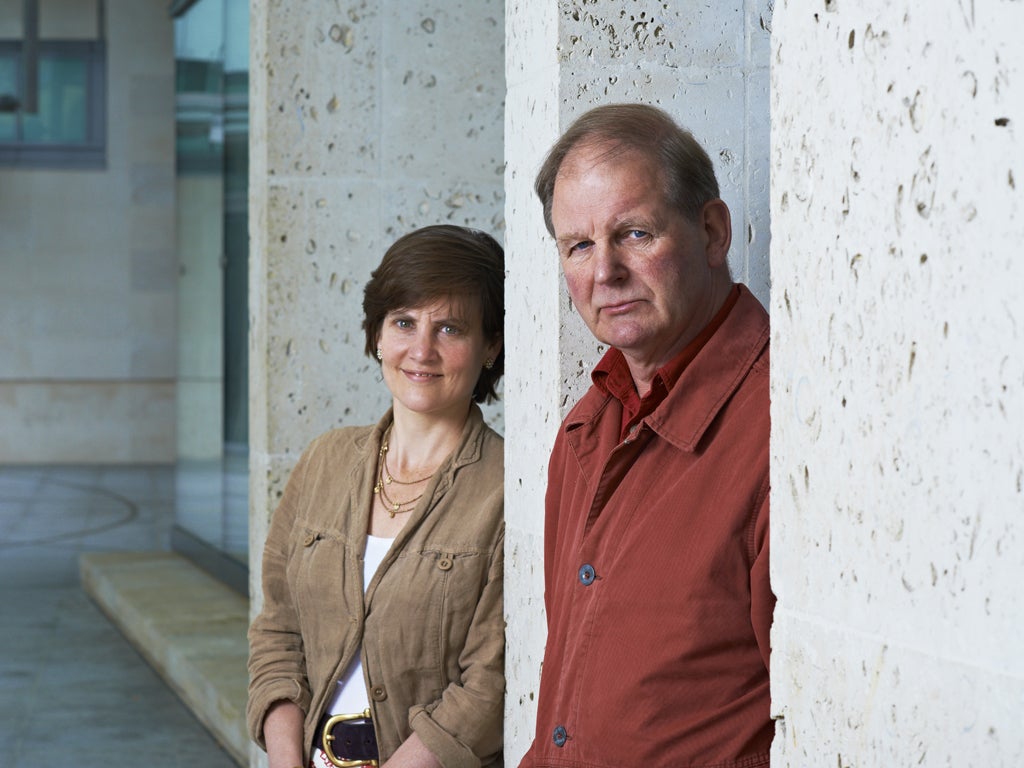
At 68, and with more than 100 books to his name, Michael Morpurgo is one of our best-known children's writers. But in her new biography, Michael Morpurgo: War Child to War Horse, Maggie Fergusson describes two quite distinct Morpurgos. There is the one who appears on stage at festivals in front of thousands of kids: high-voltage, confrontational, fearlessly confident. (The children's author Emma Chichester Clark calls it his "angry headmaster mode".) And then there is the other, off-stage Morpurgo: genial but also a little sad, regretful, doubting. It is the thoughtful, measured, gentler one who's arrived to be interviewed today.
He and Fergusson are discussing their book, a hybrid thing in which her biography is intercalated with seven stories he's written inspired by moments in her narrative. "I was slightly worried," says Fergusson, "that a book about Michael ought to have something in it for the age group who love his work so much." She'd seen the film Wilde, which weaves the story of "The Selfish Giant" through Oscar Wilde's biography, "and I remember thinking at the time: that's a really beautiful way to tell the story of a storyteller's life. You take a bit of the fiction and make it part of the tapestry." Fergusson doesn't propose biographical analysis story by story, but teases out recurring themes: a "thread of grief", "loneliness", "reconciliation".
Originally Morpurgo was approached to write his own life, but declined. "I've plundered memory and autobiography quite a lot in my stories," he says. Besides, such a book could never be sufficiently detached or unprejudiced. He wanted the story told, but thought there was a better chance of "an honest appraisal" if he were not the one assembling it.
So, while Fergusson relied on their extensive conversations for her narrative's foundation, she spoke to many others too. Some of whom said things Morpurgo was surprised to read. And then there was the other research: "boxes and boxes of material, some of which was gold dust. And some of which Michael had not actually read, like the letters between his mother and stepfather during the breakdown of her marriage."
Access to your subject and his memories is an obvious benefit of writing the biography of someone alive and co-operative. But there are downsides, too. For one, explains Fergusson, "you can't see the whole shape of somebody's life until it's done". And you're in thrall to living memory, which is a slippery thing. After a piece of research, she says: "I'd have to say to Michael, 'Actually, I don't think it's quite as you remember' ... " And naturally, particular sensitivities apply when writing about the living. That potential for discomfort is delicate, but necessary. "It's a bit nerve-wracking, but the only way of telling an interesting story is to have the light and shade – and it's also the only way of telling a convincing story."
"An honest story," Morpurgo adds.
For his part, Morpurgo found the process of excavation "cleansing". Sometimes "exhausting". "Uncomfortable", sometimes, too. He and his wife were given a complete draft to read, and while they responded with factual corrections, they never demanded cuts. He'd chosen Fergusson for the job himself (he'd just read her award-winning life of George Mackay Brown and admired its "integrity and honesty") and trusts her.
While always careful (her word), Fergusson doesn't shy away from that "shade": the complex relationships between Morpurgo's parents, say, or his sense of his own inadequacy as a father. She describes crippling losses and great regrets. His books examine war and loss without flinching. Yet on reflection, he considers himself "essentially an optimistic person".
Morpurgo's balance comes from Clare, whose presence pervades the book, and our conversation. When they married he was still a young military cadet at Sandhurst (to extricate him temporarily for his wedding, his mother had to send a pretend-desperate "Situation Critical" telegram). That was 49 years ago. One of the things Morpurgo discusses most proudly is an enterprise they set up in 1976 and ran together for a quarter-century: disillusioned and frustrated by his teaching experiences, the couple established Farms for City Children, since when more than 100,000 kids have spent a week living and working on an FfCC site. An experience during one such visit produced the spark that quickened the story that became War Horse.
Now re-imagined as a Spielberg movie and sell-out West End and Broadway show, War Horse has become Morpurgo's best-known book. The opening describes a "small dusty painting of a horse" in a Devon village hall. The painting, of course, was a fiction, but last year a real painting of "Joey" was unveiled in just that spot. Fiction and truth reveal one another; they can transform one another, too.
While working on the book, Fergusson found herself at a dinner sitting next to the biographer Richard Holmes, who quoted Virgil's Georgics to her: "Felix, qui potuit rerum cognoscere causas". "He said: 'Just pin that up on the wall in front of you, and keep asking where this story came from; how it happened'." Fergusson translates the line roughly as: "Happy is he who can know the causes of things."
"I'm not sure it's true, actually," says Morpurgo. Then reconsiders. "It gives you something that makes you understand, and that should give you some sort of reconciliation and contentment .... Yes."
Reading Fergusson's explanation of his causes has taken him by surprise. "Life for me has been a rush. I've leapt from one thing to the other with not nearly enough time to be thoughtful ... I feel the gathering of the causes, the understanding of causes, has helped a lot." Good stories will do that.
Michael Morpurgo: War Child to War Horse, By Maggie Fergusson
Fourth Estate £18.99
"Drawing on his memories of Kippe reading to him as a child he found that, if he could himself enter into a story, he could hold the children's attention perfectly until the bell went. But some stories worked better than others, and one February afternoon, reading Year 6 the first chapter of 'Stig of the Dump', he realised he had lost them. That evening, after talking to Clare, he decided to tell the children a story of his own ...."
Join our commenting forum
Join thought-provoking conversations, follow other Independent readers and see their replies
Comments