Nordic crime writers: The truth behind Inspector Norse
Christian House asks five of Denmark's leading crime writers about murders, motives and the unique appeal of Nordic noir
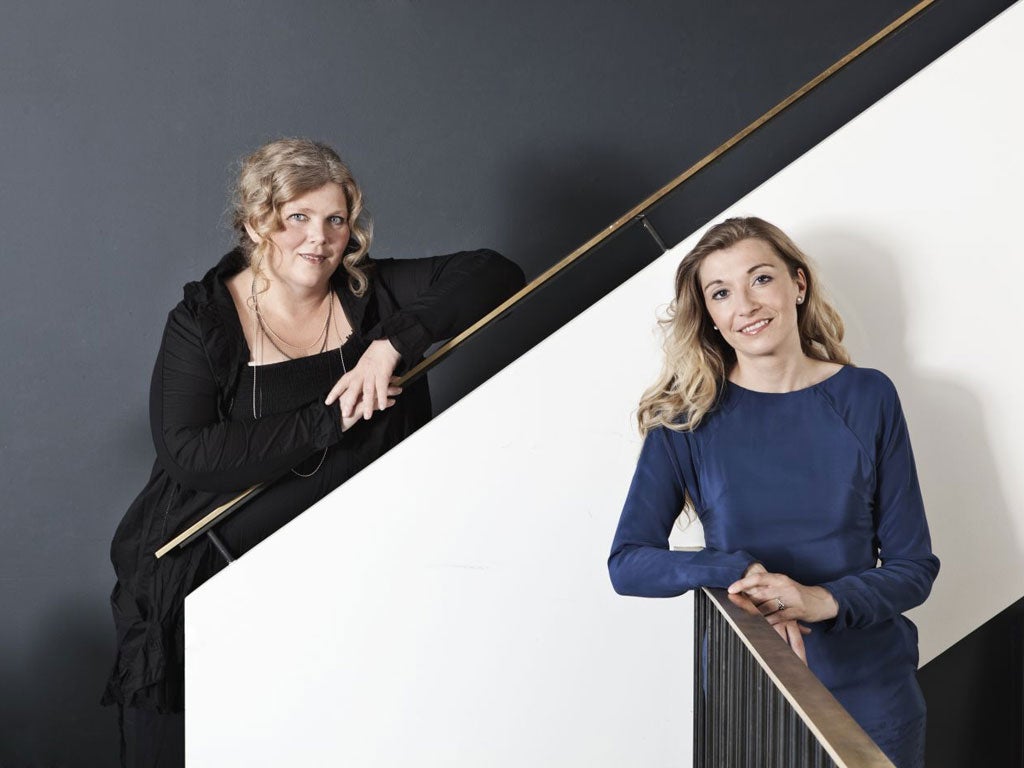
'I had this image which kept popping into my mind and wouldn't go away. And that was the central image of the book: of a small boy left in a suitcase in a luggage locker," says Lene Kaaberbol, smiling her candy sweet smile. "Please don't ask me to tell you where it came from and what kind of imagination I must have to come up with something like that." This is crime, Danish style.
I'm in Baroque Copenhagen, amid cobbled streets and heavenly spires, to discover how the Danes have carved a niche in the world of crime fiction in the wake of the extraordinary success of the Danish television series The Killing.
Kaaberbol and her writing partner Agnete Friis are talking to me in their publisher's offices, overlooking the autumnal hues of the Orstedsparken. Their runaway hit The Boy in the Suitcase has just made the New York Times bestseller list. The child in it is found by Nina Borg, a Red Cross nurse, who sets out to discover his identity. "In many ways it's a very simple story of a woman who's lost a child and a woman who's found it," says Kaaberbol. "And how are they ever going to meet?"
Kaaberbol and Friis form an unlikely authorial coupling. Kaaberbol is jolly, sentimental even, while Friis is, by her own admission, a sarcastic tough number. "This is very much like a marriage," Friis states. "It's interesting to see how many books we can write before getting into the nasty part of it. Any day we might hit the seven-year itch."
Having a nurse as their protagonist is inspired. "We thought, a lot of very good writers have done cops and reporters, perhaps we should do something different," says Kaaberbol. "We wanted our person to have a more human drive towards helping people," adds Friis. In their next Nina Borg novel, Invisible Murders, the plight of Lithuanian Roma gypsies is addressed; both books deal with immigrants caught on the periphery of Danish society. "When you look at crimes, you always have the two components. You have the punishment and the social rehabilitation part," says Friis. "And I think in the Nordic countries, as a whole, you have a tradition of emphasising the explanation of the crime."
I swap the parkside for the bustle of the Danish Film Institute café, where I meet the screenwriter Jacob Weinreich. Along with the director Anders Ronnow Klarlund, Weinreich created the nom de plume A J Kazinski. Their debut, The Last Good Man, is a page-turner concerning a plot to assassinate virtuous individuals from around the globe who are all linked by an obscure Jewish myth.
Their cinematic approach demands comparisons with that of Dan Brown. "The myth exists, from the Jewish Talmud," states Weinreich, who claims never to have read Brown. "It says that at all times there are 36 righteous people spread all over the world and they don't know they are chosen. They can keep evil from prevailing. We thought this could be the engine, the motor, to get the story going." The wheels are provided by Neils Bentzon, the Danish policeman who tries to solve this international murder mystery, while constrained by his fear of flying. "There is a very good dramatic contradiction in a Copenhagen cop who can't leave Copenhagen," says Weinreich, grinning. It's a cruel trick to play on a character. "Bitter to the bone, as we say in Danish."
Why, I ask, are Scandinavian authors so focused on homicide? "I have a theory about the welfare state," says Weinreich. "It's so boring here. Unless you get cancer or run over by a car, you live without any risks in your life. So we have to invent something exciting to not get bored." No fear of that: the second A J Kazinsky novel, Sleep and Death, is currently being translated.
I walk to the historic district of Frederiksberg, to a sunlit apartment in the Bakkehuset Museum, once a 19th-century literary salon. Here, a writer is subtracting the "who" from the whodunit. Pia Juul is a translator, poet and member of the Danish Literary Academy. Observing this cosily elegant lady, making me coffee in her kitchen while discussing her translation of Ted Hughes's Birthday Letters, it's difficult to imagine her conjuring up a gun-toting killer.
But then The Murder of Halland is a not your typical crime novel. In it, Halland is shot in the square of his small town. His wife, Bess, is the chief suspect. Juul's murder mystery is told in short staccato chapters, each preceded by a literary quotation. Oh, and the author fails to let you in on the culprit's identity.
"Of course, crime fiction novels are so different, you can't really say that there are any rules," says Juul. "What I set out to do was to write a novel that was situated in the outskirts of the real crime-fiction novel. So this book should be then about the widow, and not about the crime."
Juul's quotations, from Raymond Chandler to Edvard Munch, lend the book a quirky, referential air. "I had them all beforehand," she says. "They're annoying some readers. But as a reader I know that it's quite a common thing to do in crime fiction. Agatha Christie did it, and Dorothy L Sayers, and Colin Dexter." Juul is equally unapologetic about her lack of a reveal at the end of the story – but does she know who killed Halland? "Yes," she laughs. "Sometimes people think that authors want to make a riddle just to annoy you, but that's not the way it is. At least not for me."
Juul is aware that international attention for writers such as Jo Nesbo and Karin Fossum provides a valuable platform for a literary author such as herself. "It helps. The Killing helps as well you know. The fact that I was Danish made me interesting." She smiles and pauses before adding: "And they want to see if I was wearing a sweater."
'A gunshot had woken me. That's what the noise had been. Bjorn worked as the caretaker at the school on the other side of the square; he had seen Halland stagger and then fall. And he believed he had heard Halland say, "My wife has shot me." Gazing at me with pity, the policeman spoke, but I didn't understand a word. I didn't grasp that they wanted an explanation ...'
Join our commenting forum
Join thought-provoking conversations, follow other Independent readers and see their replies
Comments