Two weeks to save Britain's book trade
With sales falling and job cuts on the rise, publishers are pinning hopes of salvation on a string of books by big-name authors released in one rush
In the rarefied corridors of Britain's publishing houses, it has been a grim few weeks. Hitherto bankable authors are being shown the door and profits are tumbling. Penguin, one of the most venerable names in the book trade, is the latest to shed jobs, announcing 100 redundancies. To make matters worse, that mainstay of summer sales – the Richard & Judy Book Club reading list – has made its last-ever recommendations.
September is even at the best of times a crucial month as publishers pit their best novelists against each other in the search for bumper end-of-year sales, with a scattering of new hardbacks by heavyweight authors. Little wonder that this year it is being eyed by senior managers with a certain amount of apprehension, if not dread.
As the recession finally begins to bite in an industry which has previously found itself largely impervious to economic downturns, publishers are set to bombard bookshops and supermarket shelves in the opening days of September with an unprecedented flood of works by their strongest names.
With book sales in Britain recently reported to be 11.5 per cent lower than a year earlier, so it will be a make-or-break week or so for publishers' profit margins. In the words of one fearful executive, it will "mean the difference between caviar or cat food for Christmas dinner".
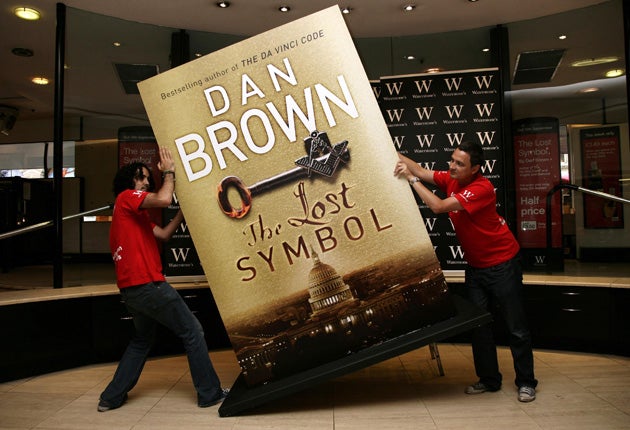
Looming over this gathering of some of contemporary literature's most illustrious performers is that nonpareil of modern bulk fiction, Dan Brown, of The Da Vinci Code. His follow-up to the hugely successful thriller is published on 15 September with 6.5m copies, the biggest initial print run in the history of its publisher, Random House.
In an attempt to gain a fleeting appearance in front-of-stores before Brown's The Lost Symbol makes its debut, authors including Sebastian Faulks, Nick Hornby and William Trevor have had the publication dates of their latest works brought forward. Faulks, whose James Bond novel Devil May Care last year became Penguin's fastest-ever selling hardback, was due to have his new book, A Week in December, released early next year; it will instead hit the shelves on 3 September.
It may well be a wise move. While critics may turn up their noses at the aesthetic qualities of Brown's prose, there is no doubting his ability to shift industrial quantities of literature.
The Da Vinci Code has sold 81 million copies, and with his three other books the American holds the top four positions in Britain's list of highest-selling paperbacks.
As that first Thursday in September shapes up as a bottleneck for literary titans, vying with Faulks will be Hornby, who has three previous books which have broken the barrier of a million sales, Booker Prize winner JM Coetzee, Iain Banks and Sadie Jones, winner of last year's Costa First Novel Prize. The latest book from Margaret Atwood, the revered Canadian author, appears the next day.
Simon Burke, fiction buying manager at Waterstone's, said: "There is always a pretty good line-up in September ahead of the Christmas market, but this year's list is unprecedented. Most publishers look to the potential for getting a book to number one in the week that it is published, and they realise that is nigh on impossible if they go head-to-head with Dan Brown.
"There's no doubt that when The Lost Symbol is published it will dominate for quite some time."
The battle for festive sales is given an added edge by a wider economic climate which has finally brought the harsh realities of faltering consumer confidence to the previously insulated bank balances of the big publishing houses. Penguin last week announced it was "preparing for the future" by making 100 staff at its London office redundant, or about 10 per cent of its workforce; Random House and HarperCollins have already shed five per cent of their workforces.
The value of sales in Britain's £4bn book publishing industry fell 6.5 per cent in the first quarter of this year, after more than a decade of strong growth, and the downward trend is continuing. Overall, the volume of books being sold has stagnated for the last two years at around 855 million books per annum. Even that hitherto gold-plated guarantor of publishing success, inclusion in the list of the recommendations for the Richard & Judy Book Club, has lost its sparkle. The franchise, which famously made the couple's executive producer (and book chooser in chief) Amanda Ross one of the most powerful people in publishing, came to a close last week with the second-lowest sales in its five-year history. The eight titles in the 2009 summer reading list have so far sold 338,834 copies, compared with the 1.1 million sales by last year's selection.
One senior publishing executive said: "Even allowing for the fact that Richard and Judy were no longer on a mainstream channel, I think those numbers show the wider picture. Those impulse buys at Tesco or WH Smith or Waterstone's that have helped to drive growth have melted away. If things are a bit tight, then you won't spend that extra £8 at the checkout. As a result you won't find one imprint in the land that isn't reviewing its [author] lists and looking to sell well on the established names."
Superficially, publishing budgets look as lavish as ever. Shortly before announcing its job losses, Penguin revealed it had paid £1.7m for the rights to Vikram Seth's A Suitable Girl, while Transworld has paid a £2m advance to entertainer Paul O'Grady for the second installment of his autobiography – double the sum he was paid for the first volume. But industry insiders say that behind the scenes established authors are being quietly told to seek a new publisher, while advances are being slashed to a quarter of what would have been on offer as recently as two years ago. Historians in particular have been badly hit, with books that would have earned a £120,000 advance now typically receiving just £30,000, and some imprints cutting their output in half.
Jonny Geller, managing director of the books division of the Curtis Brown literary agency, said he had seen advances of £70,000 to some authors cut to £25,000. He said: "It is crippling them. Publishing has become quite reactive. It is sales-led. We need publishers to start taking risks again." Even that buttress of the publisher's bottom line in recent years, the ghost-written celebrity memoir, is showing signs of wear. In April, Waterstone's blamed a 4.5 per cent drop in its sales on declining interest in celebrity biographies and travel books.
Liz Thomson, a former editor of Publishing News who now runs the book news website BookBrunch.co.uk, said that "At the moment we still have publishers spending big money on big names while trimming their budgets elsewhere. I know of at least one respected author whose previous books have sold moderately well but has been told by their mainstream publisher to go elsewhere.
"The publishing fixation with celebrities has been one of the less edifying trends of recent years and I think perhaps that is beginning to cool. There have been a few big buy-ups which have not made back the money that was paid for them. At the same time, quality fiction is still doing very well," she says. "If publishers were a bit more sensible about what they paid, they would be in a better position than they are now."
Released 1 September: Fay Weldon, Chalcot Crescent
The last 50 years through the eyes of Weldon's fictitious sister as she waits for the debt collectors.
3 Sept: Nick Hornby, Juliet, Naked
The author of High Fidelity and Fever Pitch returns to the themes of music and obsession with this story of a reclusive 1980s rock star.
3 Sept: Sadie Jones, Small Wars
The Costa First Novel prize winner sets her follow-up to The Outcast in Cyprus with a tale about a soldier pulled into a world of atrocities.
3 Sept: Sebastian Faulks, A Week in December
The Birdsong author steps into the recent past with a social satire set over a week in 2007.
3 Sept: Iain Banks, Transition
The science fiction writer and novelist returns to the fray with an account of the activities of an all-powerful organisation called the Concern.
3 Sept: JM Coetzee, Summertime
Reflections on a provincial upbringing, following on from Boyhood and Youth.
4 Sept: Margaret Atwood, The Year of the Flood
A visit to Atwood's latest dystopia where a totalitarian state awaits a waterless flood.
7 Sept: William Boyd, Ordinary Thunderstorms
A climatologist is sucked down into London's underworld.
15 Sept: Dan Brown, The Lost Symbol
The high priest of pseudo-historical conspiracy theories returns to the fray with his sequel to The Da Vinci Code. The put-upon Harvard symbologist Robert Langdon, on his third outing as Brown's protagonist, finds himself in Washington DC at the heart of a plot about Freemasonry. Originally due to be published in 2006, it will head the best seller lists with the largest initial print run in the history of its publisher, Random House – 6.5 million copies.
Join our commenting forum
Join thought-provoking conversations, follow other Independent readers and see their replies
Comments
Bookmark popover
Removed from bookmarks