Why would any writer make up stories about the Holocaust?
Why would any writer make up stories about the Holocaust? Melissa Katsoulis explores the strangest corner in the bizarre world of the literary hoa
Researching a book about literary hoaxes led me to investigate a sub-section of the misery-memoir genre which often left me reeling in amazement: the Holocaust hoaxers. Special privilege must be given to those increasingly few witness-writers who survived the Second World War in Europe, but they have certain duties too.
It is their right to write how and when they want (perhaps many decades later, if they are ready) and, as with Elie Wiesel, with their own definitions of truth and fiction. It was he who said that "Some stories are true that never happened."
However, those memoirists who think that they can pretend they were there when they weren't ought to remember that hijacking the experiences of others for selfish ends will only end in ignominy. Their motivations were, as so often in life and letters, a combination of pain, hope and greed, and they were emboldened by a marketplace in thrall to the misery memoir.
Why the huge demand for such books? Perhaps what readers seek in trauma stories is akin to what people look for in pornography: something edgy they have never seen before, followed by a spectacular resolution. And they want to identify (safely) with what they are reading; to try on someone else's crisis for a while and see how it compares to their own. All these hoaxers had difficult childhoods but, feeling that their truth was shamefully small, they sought the grand signifier of the Holocaust to attract the compassion that they desired.
Misha Defonseca's story began to emerge from her adopted Massachusetts in the mid-1990s and was, like many a hoaxer's tale, one which in retrospect seems ridiculously far-fetched. It also had that great asset of the schmaltzy life-story: the love of a four-legged friend.
She told of crossing the wastes of war-torn Europe as a lonely child and not only being adopted by a pack of friendly wolves, but single-handedly murdering a burly German soldier. She gave inspirational talks about her epic journey, smiled sweetly for the camera at a local wolf sanctuary and eventually published her story in 1997.
Misha: A Memoir of the Holocaust Years was an instant success, embodying the vain hope that belief, endurance (and fluffy animals) could mean something even in the face of Hitler's machine. It was money that brought her down. A falling-out about royalties led her publisher to enlist the help of historians to look into what was beginning to seem like a fishy back-story. When zoologists confirmed that no such wolf-woman love could have existed, and photos appeared of her war-time childhood (smiling, well-fed and out shopping with her grandmother), "Misha" knew the game was up.
Last year she finally confessed, admitting that she was in fact a Belgian Christian whose father's work for the Gestapo left her traumatised by the stigma of being a "traitor's child". She said: "It is not the actual reality – it was my reality, my way of surviving".
Binjamin Wilkomirski, who turned out not to be a Latvian-Jewish orphan but a rather comfortably-off Swiss clarinettist, is the most famous example. His spectacular lies were similarly accounted for by the repentant author. He initially claimed he had escaped to Switzerland after nearly dying in the camps, and in Fragments detailed rats feasting on corpses and Nazis crushing men to death. The book won him a host of literray prizes, but survivors noticed that his descriptions of camp life were unconvincing.
Research revealed him to be a local lad, Bruno Grosjean, fostered during the war after his mother gave him up. In her meticulous exposé in Granta, Elena Lappin concluded that as a child Bruno and his mother might have been indentured labourers, but that he had been conflating this with an imagined ghetto past for so long that he had become a "Man with Two Heads".
His humiliation was complete when it was revealed that one of the girls he claimed to have befriended in the camps, Laura Grabowsky, was a fraud herself – an unhinged American serial-hoaxer who had written not only a fake Holocaust memoir but a phoney one about satanic ritual abuse to boot.
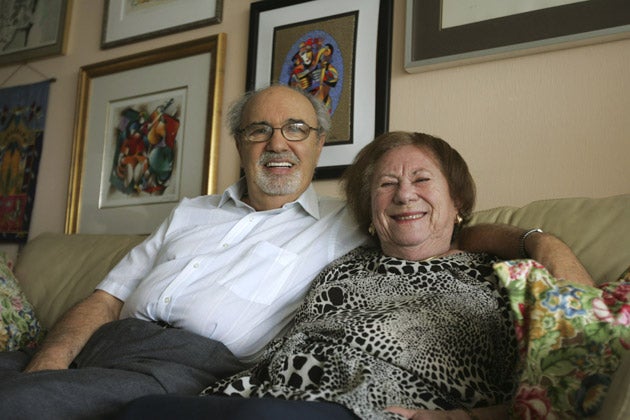
The most recent case is Herman Rosenblat, the twinkly-eyed American pensioner who came forward with a story so magical that it lifted the heart of every cynic in New York. As a young boy in Buchenwald, he said, he strolled daily along the perimeter fence to meet a little girl on the outside. She would toss him a shiny apple and in so doing gave him the hope - and the vitamins - to carry on.
Decades later, as he wrote in Angel at the Fence, which very nearly got published earlier this year, he randomly met a woman in New York who had also fled post-war Europe. As they talked, Herman decided that she must be the apple girl. They went on to fall in love and marry.
When his story came out, via appearances on Oprah, it was easy to debunk: anyone approaching the perimeter fence would immediately have been shot. Rosenblat had been promised a comfortable retirement on the proceeds of his late-flowering career as a memoirist, and his claim that he was only trying to spread a little hope with his story fell on deaf ears.
In fact, he really had been in a sub-camp of Buchenwald and the true story of his and his devoted brothers' survival is far more moving than the one he made up. Only nobody wants to listen to that now.
These three had at least been born in or near the theatre of war. But what would make an Australian born in 1972 fabricate a Holocaust story? The case of Helen Demidenko is the most peculiar of them all. Demidenko - real name Darville - was a right-wing student in Brisbane who in 1993 published The Hand That Signed the Paper, about the wartime experiences of the narrator's Ukrainian father and uncle. However, they were not victims of Nazi violence but the perpetrators, having joined the Einsatzgruppen after being terrorised by Russian-Jewish "commissars".
Florid accounts of their life as merry Jew-hating death squad members flowed enthusiastically from her pen, and when she won the Australian/ Vogel Literary Award she began appearing in Ukrainian national dress and speaking in a funny accent. Her unmasking was aided by the ire of the international Jewish community at her sideline as an anti-Israeli journalist. Interviewing David Irving was not her finest hour.
But unlike the other hoaxers, she remained unrepentant, blithely speaking of the "wog accent" she put on and her annoyance at a politically-correct culture whose prejudices she despised.
Darville's case may not be typical of Holocaust hoaxers, but it fits exactly into the mould of the Australian literary hoax. All of them, even the harmless-sounding Ern Malley poetry hoax, whose victim was a radical Jewish poetry editor despised by the young fogies who made up Ern's oeuvre, are characterised by a combination of racial anxiety and anti-intellectualism.
Darville is more than just a juvenile postscript to the strange canon of the Shoah-fantasists. She would never have committed her distasteful hoax had she not picked up on and wanted to subvert that dangerous concept of the "Holocaust bore".
That idea is perpetuated by people – like Defonseca, Wilkomirski and Rosenblat – whose output contributes to the notion of an unregulated Holocaust "industry", where victimhood is rewarded by money and fame.
Yes, the notion of absolute truth in life-writing is notoriously fraught. But when a writer stands before other survivors and gives as scripture what is stolen from the memories of real witnesses, they can expect little sympathy.
Melissa Katsoulis's 'Telling Tales: a history of literary hoaxes' is published this week by Constable
Join our commenting forum
Join thought-provoking conversations, follow other Independent readers and see their replies
Comments
Bookmark popover
Removed from bookmarks