Howard Jacobson: Funny? Jewish? Sad? No, it's just a novel
The new Booker Prize winner talks about comedy, controversy and literary labels with Boyd Tonkin
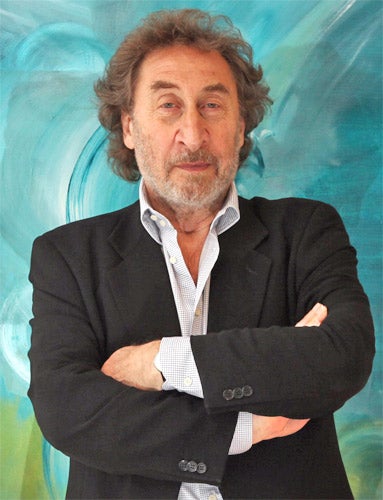
Novels by Howard Jacobson, those riotous buffet suppers of contentions and contradictions, seldom agree with themselves, let alone with the critics. So it should hardly come as a surprise to find that their author – on the morning after his Man Booker Prize victory, a late-night Soho party and two hours' sleep – wants to take issue with the headline tags for his own victorious book. Do you assume that The Finkler Question has at last secured our most coveted literary honour for both a leading comic, and a leading Jewish novelist? Think again: as Jacobson always asks us do to.
"I sometimes get irritated when I see my books described as specific hunts for Jewish identity," he says. "I don't feel that's what my writing is doing. I'm doing our identity." As for the "comedy" pigeonhole, he wants to slip that bond as well. "The comic novel is not a genre. It's the novel. The comic novel is doing what novels are paid to do." Indeed, it's non-humorous fiction that should have a quaint little niche of its own. "I see a novel that's got no play in it at all and I think, that's a half-living thing."
The Finkler Question throbs, and sobs, with life in a story of grief, belief and memory shared between three protagonists – two Jewish, one an envious wannabe. However adept at the skills of comedy, however immersed in Jewishness, the novel defies all label-stickers. Yet, "I walk into these things," its author admits. "I create the rods for my own back. I write about Jews, and then complain about being talked of as 'a Jewish novelist'.
"And I want people to find my books funny, because being the entertainer is hugely important to me – as serious and high-quality an entertainer as I can be. But when they call me a comic novelist, I don't like it. That's partly because I can't trust many people with the word 'comic' – trust them to know what should be meant by it."
For all his pre-prepared acceptance speech, Jacobson never thought he would see his day of Booker triumph dawn. He was "totally, totally flabbergasted" by the win. For he feels that the innate subversion of comedy – however broadly defined – will always divide judges. "If comedy is indeed as rattling as I think it is, then you're going to be very lucky to find three out of five people who won't argue furiously about it. Whereas a beautifully written elegy set in Connemara is likely to disturb that panel a lot less."
From his 1983 debut Coming from Behind to recent fictions such as Kalooki Nights and The Act of Love, Jacobson's comedy has always been as serious as life itself. Although a long-familiar presence on page and TV screen, the Mancunian novelist, presenter and columnist has never repeated the same old trick, or shtick. The Finkler Question's success comes after a series of books that saw him take ambitious gambles with form, tone – and even taste.
Kalooki Nights had concentration-camp scenes; The Act of Love turned on the fetish of a jealous husband's voyeurism. Jacobson has grown older, and bolder: "Breaking up narrative; not telling a story in a linear mode; writing scenes where you're not quite sure what's happening to whom. And some of the eroticisms explored are rather painful. So that was a risk of tact as well."
His audacity in The Finkler Question often pivots on the trials, and insights, of old age – especially as the widowed refugee Libor mourns his wife. Libor's creator, born in 1942, now relishes the view in winter. "However wonderful it is to see a young writer full of energy and juice, there is something about being an older writer that opens up a whole new world to you," says Jacobson.
For him, the Libor sections – his favourite parts – are about "the sadness of the fact that an old man is a complete man. An old man is not depleted. There's a tragedy about that, because it would almost be kinder if he were depleted. Because he would be less wounded by himself, or woundable."
As he wrote of Libor's ordeal, Jacobson looked into his own abyss. "This was writing that came out of doing something I have not done before, which was pushing myself forward into a dreaded hour. This is not play any more. It gets closer. I wanted to think hard about my own terrors here."
Another aspect of Jacobson's boldness turns on his depiction of the "ASHamed Jews": grandstanding anti-Zionists who make a media show of their disgust at Israel today. "I was highly conscious... that it could topple into mere satire," he says. "In the end, I thought, would it do any harm to have a change of tone and let some satire let rip a bit?"
Jacobson objects not to the protestors' political commitments, but to the carnival they make out of their conscience. "Criticise Israel all you like. It depends, as everything depends, on the temperature of your rhetoric and so on. But the 'ASHamed Jews' for me are a parody of people who are sanctimonious about their beliefs."
Yet their factional self-righteousness also reflects another side of his investigation of Jewish history: the eternal recurrence of feuds and splits. "You have to ask yourself... what is it about us that has made it so difficult for us to stay together on so many issues when it might have served us better?" Jacobson wonders, looking right back to Biblical times. "Is it monotheism that made it so necessary for us to splinter? We came up with it. It's ours. And it's so demanding: that you must all believe this one thing."
He thinks the notion of an invisible and indivisible God a "brilliant idea... It's so spectacularly intellectual. I adore it." Yet "you can see how people aren't going to keep running with that. People are going to defect. And the Old Testament is the story of one defection after another."
Against the public fuss of Zionists and anti-Zionists, the novel sets the private mourning of media philosopher Sam Finkler, Czech journalist Libor Sevcik – and their friend Julian Treslove, the very non-Jewish nebbish [an ineffectual or timid person] whose funny-sad hankerings for the grandeur of a Jewish destiny lends the book so much of its bittersweet laughter.
Julian's earnest elective Jewishness lets Jacobson shed light on the real thing – if it exists. "What it is, beyond what you eat or who you pray for, is one of the great mysteries – for Jews and for everybody."
He digs deep into the roots not only of anti-Semitism but of philo-Semitism – and hints that their origin in our deepest cultural memories may not lie very far apart. "If a Jew doesn't want to think about Jewishness, he either leaves or – better still – he practises. Then you never have to think," he says. "But if you think about it at all, then back you go into something so ancient it's almost unbearable". The Finkler Question takes us there, and back again, with both tears and jokes for company. Ultimately, it faces down not so much the absurdities of identity politics as what Jacobson calls "existential nausea".
Doing so, it wears an infinitely stoic smile: "You've got to survive this. And comedy is the great survival strategy."
Howard Jacobson's column appears in 'The Independent' every Saturday
Join our commenting forum
Join thought-provoking conversations, follow other Independent readers and see their replies
Comments