Christianity in Evolution: An Exploration, By Jack Mahoney
The relationship between Christianity and science has long been a fraught one, whether you go back to the persecution of Galileo by the Inquisition in the 17th century, the rejection of Darwin by the ecclesiastical bigwigs in the 19th, or the current stand-off between militant atheists among the scientific community, such as Richard Dawkins, and a Church that still has faith in miracles.
Yet there is, as Professor Jack Mahoney argues in this short, dense but enlightening book, plenty of common ground to explore, if only the centuries of mutual antagonism can be rolled back. His focus is the whole question of evolution – still causing tensions in schoolrooms 152 years after Darwin published his game-changing book, especially in the US with advocates of "intelligent design" slugging it out for access to impressionable young minds with the majority who accept "natural selection".
Mainstream Christianity long ago dropped overt hostility to Darwin, and even manages to speak of him fondly on occasion, but it has held back from the next logical step, bringing theology and evolution into meaningful dialogue. Christianity, Mahoney argues, "has been strangely silent about the doctrine of evolution" because to accept it wholeheartedly would then involve a redrawing of the theological map. Yet that is precisely what he wants it to do.
As a breaker of taboos, Mahoney has form. A Jesuit priest, and a distinguished professor of moral and social theology at the University of London, he ruffled feathers in the Vatican in 1984 with his book, Bioethics and Belief, advocating dialogue between medicine and religion. His thoughts on the moral status of the embryo were perceived as not in line with official teaching. And woe betides anyone who dares to question the Pope on the embryo.
This time round, Christianity in Evolution risks causing similar ripples when it argues that embedding evolution in theology would necessitate a wholesale reappraisal of such time-honoured Christian concepts as Original Sin, the Incarnation and the Fall. So Mahoney presents the life of Jesus, the divine made human, not so much in terms of a sacrifice made to atone for our sins, as countless generations of Christians have been told, but as part of an evolutionary cycle. "God [in the person of Jesus] became a member of the human species in order to provide the human race with a human expression in Christ...of the divine altruism that would counter any innate evolutionary tendency to aggressive self- or tribal interest."
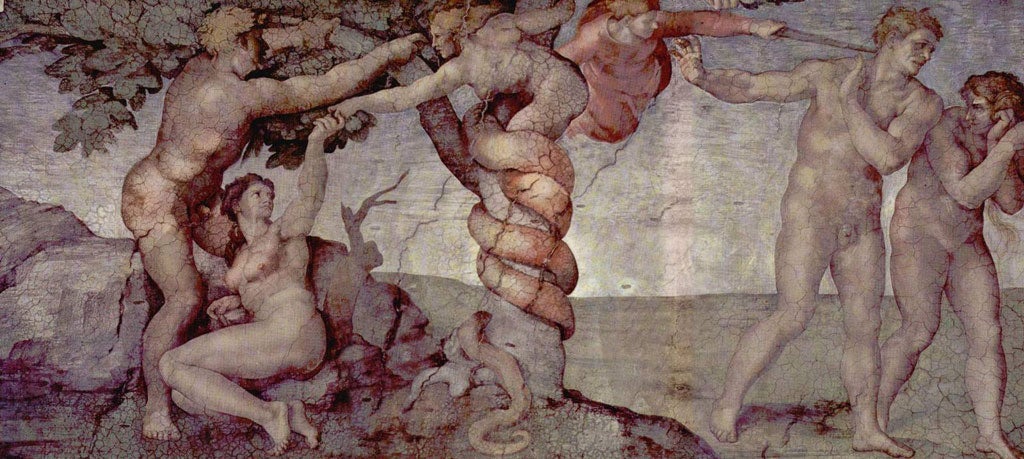
By the same measure, Jesus's death and resurrection saved us not, as traditionally taught, from our fallen nature, the legacy of Adam and Eve's sin in the Garden of Eden, but from mortality that is otherwise "a normal feature of all evolutionary life".
Mahoney is revising theology as he goes along, and producing – for me at least – an attractive and relevant blueprint. It is, he stresses, a first draft, something to provoke debate, not the finished item, but his impatience in the lack of progress is evident in his willingness to confront cherished beliefs in his own church. It is the sort of approach that, in the past, cost thoughtful believers their careers: men like another Jesuit, the French palaeontologist, Pierre Teilhard de Chardin, who was sent into exile in China in the 1930s for revisiting the concept of Original Sin. Yet today, 50 years after his death, Teilhard is regarded by some who seek an accommodation between religion and science as a prophetic voice crying in the wilderness.
He and Mahoney may one day be mentioned in the same breath. Whether that happens will depend, to some extent, on the willingness of the Catholic authorities and Christian leaders to think again, embrace change, learn the lesson that loyal dissent is what has moved their theology forward, however resisted in its time.
This is not an easy book to read. It requires commitment and stamina, but those who summon up these qualities will be richly rewarded. For it shows, for once, Christianity looking forward in partnership with the modern world of science, rather than holding itself aloof and apart in a time-warp. "I prefer to understand theology," writes Mahoney, "as a continuing dialectic between belief and experience, which involves the continuing attempt to make experience-sense out of faith, and faith-sense out of experience." Like much of the book, you have to think about this a while before its meaning hits home.
Join our commenting forum
Join thought-provoking conversations, follow other Independent readers and see their replies
Comments
Bookmark popover
Removed from bookmarks