Cracking The Egyptian Code: The Revolutionary Life Of Jean-François Champollion, By Andrew Robinson
Portrait of a quiet genius who revolutionised our understanding of the ancient world.

For free real time breaking news alerts sent straight to your inbox sign up to our breaking news emails
Sign up to our free breaking news emails
Is genius more like a flash of lightning, or a slow and inextinguishable smoulder? The breaking of codes and decipherment of previously unreadable old scripts like Egyptian hieroglyphic suggests it is a combination of both: a low-light background of steady and sometimes erroneous work suddenly illuminated by a moment of inspiration.
Jean-François Champollion's eureka moment came just before noon on 14 September 1822, when the 31-year-old burst into his brother and fellow-savant's office at the Academy of Inscriptions and Belles Lettres in Paris and shouted "Je tiens mon affaire" – "I've cracked it!" – before fainting dead away on the carpet.
The reason for his euphoria, explained in a formal paper a fortnight later, was the realisation that Egyptian hieroglyphic was neither wholly pictographic nor alphabetical, but a combination of the two with symbols representing sounds alongside whole-word symbols and contractions. It is a form of construction that perhaps makes better sense to a post-literate audience of texters and emoticon users than to classically trained students of text.
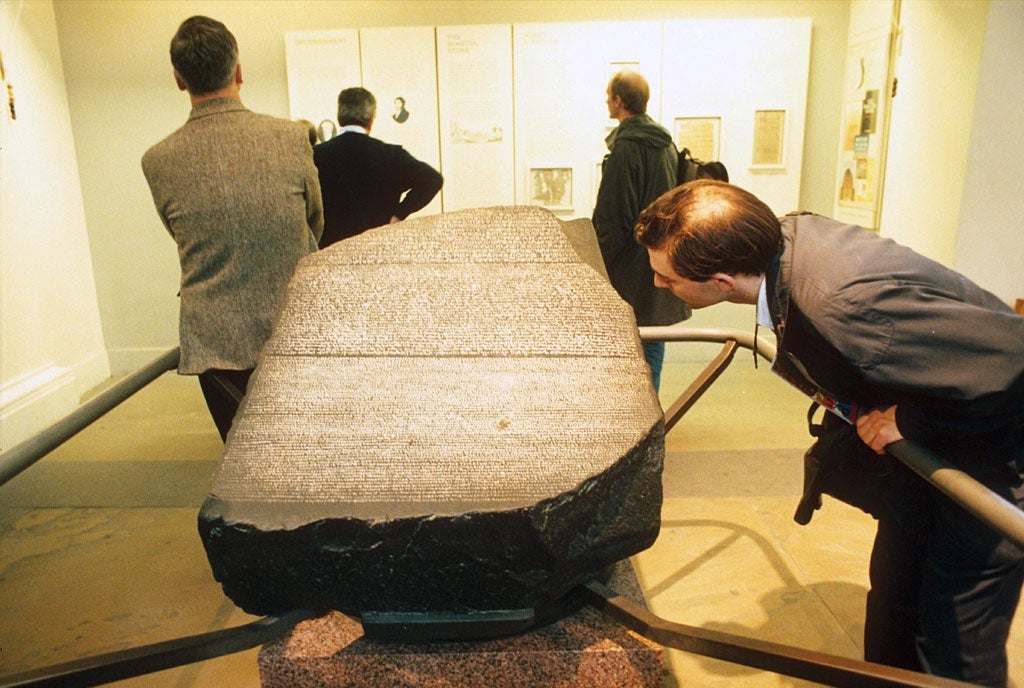
Present at Champollion's lecture but unacknowledged in his address was the brilliant Englishman Thomas Young, who had written an all-important supplement on Egypt for the Encyclopaedia Britannica. Young had discovered in his slightly haphazard way that the cartouches found on the Rosetta Stone indicating royal or divine names must contain some phonetic element.
Rivals in the way that only an older master and younger, more aggressive follower can be, Young and Champollion suggest different kinds of genius; the one a polymath and inveterate dabbler, the other a driven obsessive: panorama versus tunnel vision, fox as opposed to hedgehog in Isaiah Berlin's terms. Young never went to Egypt. His work was desk-bound. Champollion's dark skin – he may have been only a half-brother to Jacques-Joseph Champollion-Figeac, who extended his name to honour their birthplace and signal social ambition – allowed him to pass as an Arab in the desert, even should his grasp of languages fail him.
This is the first full biography of Champollion in English. Robinson has previously written about Young and about Michael Ventris, decipherer of Linear B, but he isn't blinded by knowledge of his subject and he lacks the faintly sensational touch of Lesley and Roy Adkins' book The Keys of Egypt: The Race to Read the Hieroglyphics. He presents instead a convincing and warm-hearted intellectual portrait of Champollion, who died at 41 after transforming our understanding of the ancient world.
Champollion was a hedegehog in every possibly sense, not just single-mindedness. An early biographer said of him: "He was a virulent polemicist, at times viperish, an implacable arguer, intolerant."
It was only when Champollion made his way to Paris that he made his breakthrough. He perhaps needed that bigger canvas, and didn't suffer from its frustrations and distractions. The greatest value of Robinson's account lies in another sharp contrast between Young and Champollion, or rather in the backgrounds they inhabited. The Englishman attended to his medical patients in Worthing by day, transcribed inscriptions by candlelight. Regency England was not Revolutionary France.
The Champollion brothers were admirers of the upstart Corsican emperor and greeted him in Grenoble at the start of the "Cent Jours". The association haunted them ever afterward, but Jean-François was hard-wired for controversy even if his country were not so volatile. The all-important Lettre à M. Dacier, in which the famous lecture was published, should have been addressed to his old teacher Silvestre de Sacy but they had, predictably, fallen out. De Sacy had warned him that deciphering the Rosetta Stone was likely to depend on luck as much as steady work or inspiration. No one likes to hear that.
This is an important book, not just in helping to correct a certain impression that Egyptology is the sole province of paranoid nutters hunting wheelmarks of the chariots of the gods but also more generally in showing how "genius", with which Champollion was undoubtedly touched, is almost always combined with turbulent circumstance and almost always dependent to some degree on someone else's hard work. Robinson has drawn on a substantial literature but the real work here is admirably his own.
Subscribe to Independent Premium to bookmark this article
Want to bookmark your favourite articles and stories to read or reference later? Start your Independent Premium subscription today.
Join our commenting forum
Join thought-provoking conversations, follow other Independent readers and see their replies