Electric Eden: Unearthing Britain's Visionary Music, By Roby Young
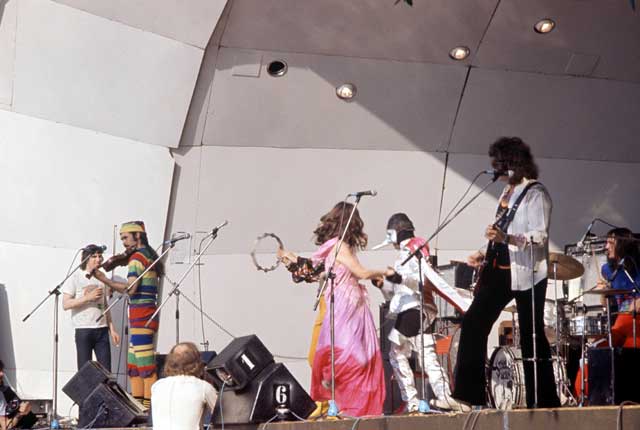
Upwards of 600 pages long, fanatically engrossed in its subject matter, covering a century of native musical culture in the minutest detail, Electric Eden has a symbolic high point that can be dated to 1975. With the entity known as "progressive rock" (Genesis, Pink Floyd, Yes etc) grown tediously overblown, and punk the faintest of stirrings on an unregarded horizon, this was the annus mirabilis of the English folk-rock group, Steeleye Span. A six-part BBC television series saw the band beamed out from a selection of historic country houses. Their stage shows became, as Rob Young puts it, "increasingly flamboyant". For "Lyke Wake Dirge" they trooped on stage wearing medieval space suits woven from priests' cassocks.
Come year-end the single "All Around My Hat" – bucolic harmonies with a back-beat borrowed from Status Quo – had spent nine weeks in the UK Top 40. Purists may have sneered, but provenance and framing were startlingly authentic: the song's roots lay in an early 19th-century "broadside", the lament of a cockney costermonger whose lover is about to be transported and who sports a willow-sprig as a remembrance.
It was, alas, the summit of Steeleye Span's career. After the over-ambitious and ruinously expensive album Rocket Cottage, they disbanded in 1978.
Young's aim, in this consistently absorbing study, is to map out a journey which, though it ended alongside Tony Blackburn and the Wombles on Top of the Pops, began in the Sussex back-lanes nearly a century before. Here, in other words, is a history of modern British folk music, starting with the transcriptions of Cecil Sharp, author of English Folk Song: Some Conclusions (1907), proceeding by way of Delius, Holst, Vaughan Williams and the "English Music" of the pre- and post-Great War era, to the more militant protest songs rescued from the hedgerows by AL Lloyd and re-invented by the 1950s folk stalwart Ewan MacColl. Its heroes – at any rate before the advent of rock and roll – are antiquarians, socialist visionaries and backward-looking simple-lifers, but also ordinary people bent on keeping ancient traditions alive – the Copper family from Sussex, for instance, whom Young marks down as a "rare instance of a Victorian working-class dynasty that cared for and archived its own store of folk songs and singing styles rather than leaving the job to a more privileged middle-class collector."
What transformed "British folk" from the sparse, shantyish and occasionally rather Stakhanovite flowerings of the MacColl era was not simply the electric guitar but the psychedelia that came with it. The Incredible String Band, Young's particular heroes from the late 1960s, offered an eclectic mix of Eastern-style instrumentation and mystical reverie. The guiding forces were even older, and Young makes out a good case for the guitarist Davy Graham, whose influences included Greek rembetika and Miles Davis, as the grand-daddy of them all.
If one pastoral strain went back to Kenneth Grahame, The Wind in the Willows and pipers at the gates of dawn, another dealt in pre-Christian trauma. As you might expect, Young is alert to the significance of Robin Hardy's cult film The Wicker Man (1973), while supplying fascinating details about the long-forgotten Comus – name taken from Milton's masque – who specialised in lurid neo-pagan gore-fests such as "Song to Comus" ("Hymen-hunter, hands of steel, crack you open and your red flesh peel") and "The Bite", which involves the lynching of a Christian.
Though Electric Eden has an agenda to pursue, or rather a line of descent to follow, most music fans will simply use it as a source-book for all the weird and wonderful music committed to vinyl between the early 1960s and the mid-1970s in the name of folk. Acts as various as Fairport Convention, Gryphon, Fotheringay and Richard and Linda Thompson are given their due. The inevitable dozen pages on Nick Drake are as sharp a dissection of that angst-ridden troubador's three-and-a-bit albums as I have ever read.
On the other hand, there are ways in which the book's chronological sprawl, its necessary selectivity and the sheer brio of the approach work against it. Quite a lot which is, or could be, central to Young's argument is only gestured at. Take his treatment of the Victorian idea of "Faery", which begins with some remarks about Richard Dadd's elf-strewn miniatures, but ignores George Macdonald, Christina Rossetti's "Goblin Market" and indeed one emphatic musical connection, which is Queen's "The Fairy Feller's Masterstroke", named after one of Dadd's paintings.
Then there is the faint desultoriness of the post-Steeleye Span coda. Lots of space for such recent expropriators of the old folk texts as Kate Bush and Talk Talk, but nothing about Wiltshire's XTC, whose re-imagined ruralism – see albums like English Settlement (1982) and Mummer (1983) - not only built on the folk tradition but used some of its personnel for backing.
Finally there is Young's habit of overdoing the stylistic flourishes. Of the 1960s chanteuse Anne Briggs: "All the while, though, she continued to act as an invisible catalyst, sprinkling traditional songs and her own compositions among more prominent artists like gold dust." As for Richard and Linda Thompson's decade-long career as a duo, it apparently "spanned the period when the hulking Avro Lancaster of folk-rock was shot down in a pall of smoke by punk's speeding Messerchmitts".
In mitigation, it's a mark of Young's diligence that he manages to tease out some connections between early 1970s folk and late 1970s punk – Squeeze, for instance, making their debut at a 1973 free festival with a piece of hippy whimsy called "Tomorrow's Children" - that no previous music historian seems ever to have spotted. After decades of opportunistic reportage, the modern publisher's catalogue positively crawls with big, serious and thoroughly well-intentioned books about "English pop". This is one of the best.
DJ Taylor's new novel is 'At the Chime of a City Clock' (Constable)
Join our commenting forum
Join thought-provoking conversations, follow other Independent readers and see their replies
Comments