Inside the Centre: The Life of J Robert Oppenheimer, By Ray Monk
He was a poet, mystic, progressive - and the scientist who opened the gate of nuclear hell
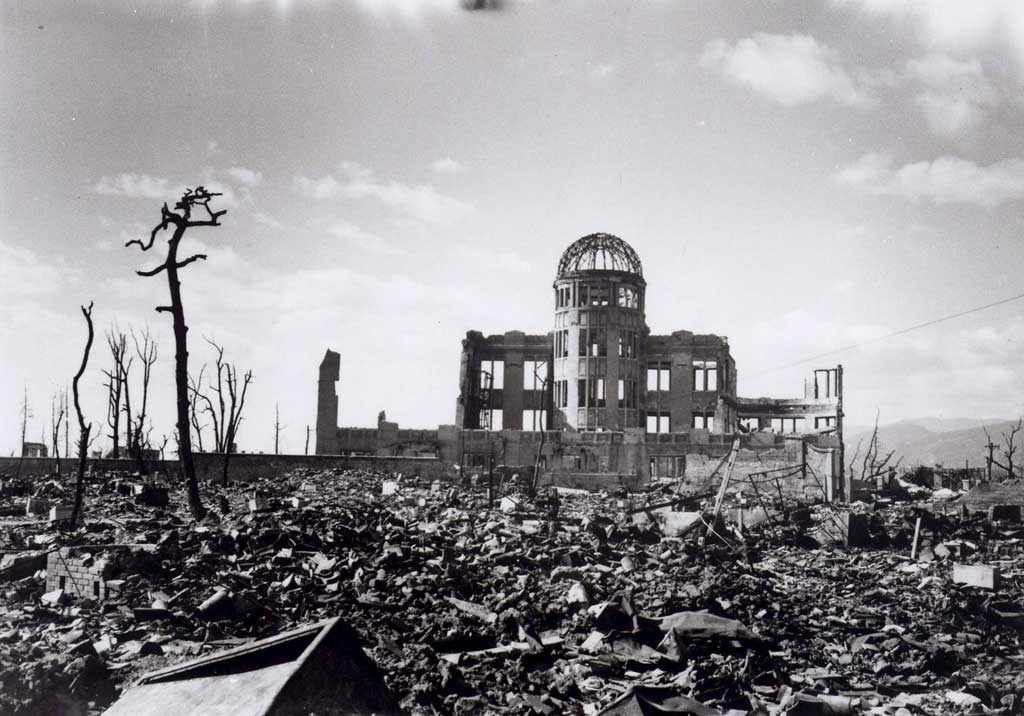
As head of the Allies' atomic bomb programme during the Second World War, Robert Oppenheimer is one of the few scientists to have directly influenced the main trajectory of history.
The Oppenheimer story also encapsulates other profound 20th-century themes: the Jewish Diaspora; the 1930s crisis of capitalism; the embrace by many intellectuals of communism; the post-war nuclear disarmament movement; the Cold War; McCarthyism; and the "Two Cultures" - Oppenheimer wrote poetry and stories and had many deep artistic interests. So it is not surprising that his (extremely demanding) science has received short shrift from his several biographers. It is this that Ray Monk's life has set out to rectify.
As a physicist, Oppenheimer was involved in many major scientific discoveries of the century but never quite claimed one for himself. In 1932, he had a good chance of elucidating the nature of the enigmatic positive electron, the positron, but just missed out. His most original work, mostly disregarded in his lifetime, and which might have won him a Nobel Prize had he lived longer, was the first prediction of Black Holes, as early as 1939.
But as a catalyst, Oppenheimer more or less singlehandedly orchestrated the world dominance of American physics from the mid-1930s onwards. He directed the Manhattan Project, culminating in the two bombs dropped on Japan in 1945, and after the war he was at the centre of the agonised debates about nuclear policy.
Despite Monk's emphasis on pure science, it is the epic story of the atomic bomb and Oppenheimer's fall from grace in the McCarthyite era that stir the reader, swept up in the torrent of Oppenheimer's life, experiencing vicariously the triumph of the scientists as the Bomb comes to fruition. But then the doubts set in. Uranium fission was discovered in Germany days before the war started, so the ostensible purpose of the Manhattan Project was always to be first to possess nuclear weapons. But the war with Germany ended and that country was revealed to have had no credible atomic bomb project. Nevertheless, Hiroshima, Nagasaki and the Cold War followed.
Who was Robert Oppenheimer? The central premise of the book is that no one quite knew where his emotional centre was, least of all himself. He was born into a rich German-Jewish family so assimilated that they belonged to a secular movement, the Ethical Culture Society, which ran schools and embraced the American way of life.
His childhood was closeted but at the age of 18 he discovered New Mexico, where he rode horses and generally broke free. He was so obsessed by New Mexico that he successfully manoeuvred to have the Manhattan Project located there. Unusually for a scientist of that era, Oppenheimer was also deeply aesthetic, multilingual, a lover of French poetry and with a leaning for Hindu philosophy. When the first test atomic bomb exploded in the New Mexican desert Oppenheimer quoted the Bhagavad Gita: "Now I am become death, the destroyer of worlds".
The story of 20th-century physics is one of the great human milestones, ranking alongside the birth of agriculture, Greek democracy, the Renaissance; but it is besmirched by the way that it debouched into the nuclear nightmare of the Cold War. This opened up an absolute gulf between the scientists, who wanted international control of this new weapon, and the politicians.
Niels Bohr, father-figure of the physicists, tried to warn Roosevelt and Churchill in 1943 that making a bomb involved no secrets: from now on, anyone could do it. Churchill dismissed him as "very near the edge of mortal crimes" (accusing him of potential treason). Oppenheimer himself was later derided by President Truman as a "cry-baby scientist".
Most people would assume that Oppenheimer's fall was a result of the McCarthyite witch-hunt. In fact, it was a hearing at the Atomic Energy Commission in April 1954, not the House Un-American Activities Committee or Senator McCarthy's own committee, that resulted in him losing government clearance to work on classified material. Oppenheimer had made many enemies and in the mid-1930s, like so many, he had been involved in left-wing activism. Many of his friends – some of whom he later betrayed – were avowed communists.
What brought this to critical mass in 1954 was Cold War hysteria and the escalating arms race with Russia to develop the hydrogen bomb. Oppenheimer had serious doubts about the need for this weapon, so big it could have no military value. Add to this cocktail the fact that some members of the US atomic bomb project, notably Klaus Fuchs, had passed secrets to the Russians, and Oppenheimer was a dish ready to be roasted.
He had sealed his own fate by what he later admitted was an idiotic lie he told to the FBI in 1943. Haakon Chevalier, a lecturer in French literature at Berkeley, a close friend of Oppenheimer's and a communist, had suggested that he knew of a conduit to the Russians. Chevalier wondered whether Oppenheimer would like to avail himself of this opportunity to acquaint them with the bomb project. Oppenheimer had dismissed this as "treason" but, wanting to protect himself and Chevalier, he told the FBI what he later called "a cock and bull story". Having covered up for Chevalier in 1943, in the 1954 hearings Oppenheimer betrayed him in the starkest manner.
Monk does a fine job on Oppenheimer's early life and the years of power, but the dominance of physics means that we don't quite join up all the dots in his traumatic personal life, which flickers intermittently. And the book loses energy towards the end.
Oppenheimer did not simply fall from grace in 1954. Later he was partially rehabilitated and in the last 12 years of his life he became a celebrity on the international lecture circuit. Too much of the last 35 pages is a recital of one lecture after another. The lack of substance in Oppenheimer's pronouncements on science and the public realm is perhaps a clue to that problem of the emotional centre: he had too much unacknowledged guilt in his life. The mystery of Robert Oppenheimer remains intact.
Peter Forbes's 'Dazzled and Deceived: Mimicry and Camouflage' is published by Yale University Press
Join our commenting forum
Join thought-provoking conversations, follow other Independent readers and see their replies
Comments