On the Road to Babadag: Travels in the Other Europe, By Andrzej Stasiuk, trans. Michael Kandel
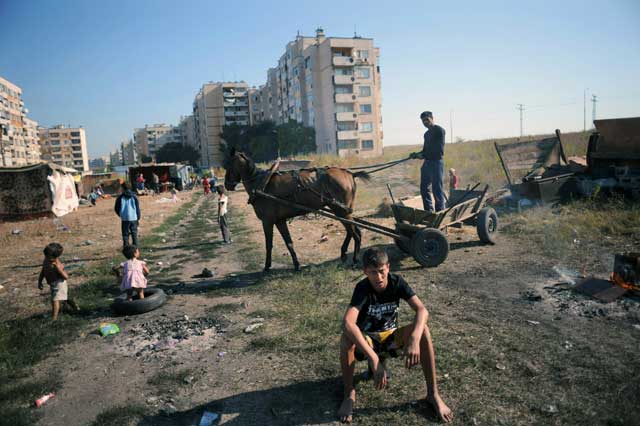
There isn't quite a name for the region that holds the Polish writer Andrzej Stasiuk in thrall. The general drift is from "the land of King Ubu to the land of Count Dracula", Poland to Romania; the reach extends to Albania in the south and Transnistria in the east. Its nucleus is the landlocked centre of Central Europe; its protoplasm spreads like an amoeba through the Balkans. It cannot be convincingly mapped. Stasiuk's allusion to the play Ubu Roi evokes its author Alfred Jarry's announcement that the action takes place in Poland – "that is to say, nowhere".
And that's where, in the end, Stasiuk wants to go. His travels fragment and the places jumble together; Hungarian, Romanian, Slovak, Polish names distinguishable by the slant of their accents or the roll of their vowels. Though hundreds of kilometres apart, all are in the middle of nowhere; and in Stasiuk's book they have a no proper location in time either.
Everywhere he goes he sees the same dust and the same ruts, a uniform inertia in which even decay seems to have slowed to a halt. He travels in order to find immobility – though he never stops for long, and sometimes doesn't bother to stop at all.
As travel writing, this is unconventional, but as literature profoundly authentic. The emptiness, the disconnectedness and the stasis deep inside Europe can be as emotionally transfixing and revelatory as the tumult of a city crowd on the Indian subcontinent. There are still places that insist the human condition is timeless.
Stasiuk insists it is too, and that therefore the cities of central Europe are alien impositions on a landscape of previously untrammelled obscurity. Having grown up near Warsaw, he now lives in a tiny village close to the Slovak border.
Stasiuk is not the first writer to have fastened onto the villages of eastern Europe. His fixation is singular, though, avoiding a number of pitfalls. While others have immersed themselves in their vision of the people, the folk that belong to the land, Stasiuk puts places first. It's not that he is anti-social: he drinks with strangers and travels with friends, though his travelling companions only appear when the narrative requires their presence. He has to maintain his own peculiar kind of detachment.
For one thing, he has to empathise with people from a dozen ethnic groups – often unexpected, as when a village in Romania turns out to be Russian – without prejudice. Pan-Slavic Romanticism is out too, not least because of his inevitable fascination with the Roma. From where he is standing, nobody embodies the time-resistant spirit of the people better than the Gypsies, as they still are to him.
He is also in a position to avoid looking down upon the people. Stasiuk isn't yet another smart Westerner on an expedition in search of comically backward eastern European natives. He is a central European, born in 1960 and raised under communism, used to bargaining for lifts in bronchitic cars. The regions most familiar to him are where he does his best work. When he gets to Albania, he cannot help but be the wealthy foreigner, and he is out of area in Slovenia, that scale-model Slav state "like some Hapsburg dream of the empire's mission to civilise".
His eye is keen and his commentary as rich as they are throughout, but these passages are travel writing; whereas the heart of the book is a meditation. The English title alludes to Kerouac (a more literal translation would have been simply "Going to Babadag") but says much more about the text by suggesting that it is about being rather than going. Stasiuk examines his consciousness by dissecting it into scenes that unravel the sequence of events, striving to be in the moment.
This endeavour is a form of dissidence. As a young man, Stasiuk served a prison term for deserting from the army; he was drawn to pacifism, an ideology especially marginal in a nation whose tradition of arms is second in importance only to the church for its sense of itself. Stasiuk's sweeping dismissal of the region's cities implies a rejection of grand history and all the destruction that its civilising missions have wrought. "Paroxysm and tedium rule here in turn," he observes. History records that little happens in these lands, but when something does, it is generally terrible.
The burgundy passports of Europe have spread across the region since this book first appeared in 2004. Time is on the march after all, and now English readers can enjoy the rewards of Stasiuk's entrancing attempt to stand in the way of progress. It's an exceptional writer who can rise to such an impossible challenge.
Marek Kohn's most recent book is 'Turned Out Nice' (Faber & Faber)
Join our commenting forum
Join thought-provoking conversations, follow other Independent readers and see their replies
Comments