Pathfinders: The Golden Age of Arabic Science, By Jim Al-Khalili
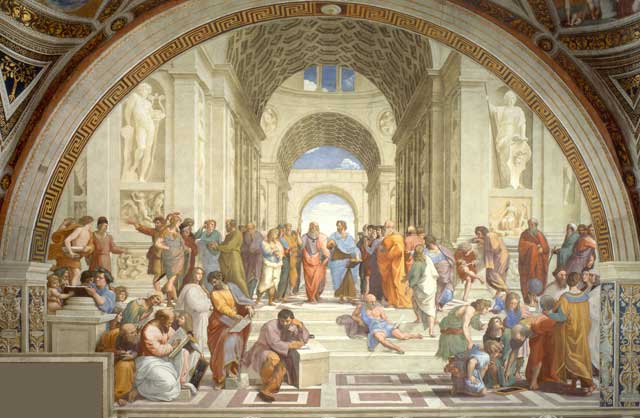
One of Raphael's most famous paintings, The School of Athens, is a fresco on the walls of the Apostolic Palace in the Vatican, depicting the world's great philosophers. At the centre stand Plato and Aristotle. Surrounding them are figures such as Socrates, Pythagoras and Diogenes.
Among the celebrated Greek philosophers is a lone Muslim: Ibn Rushd (or Averroes, as he would have been known to Raphael). His presence is an indication of the extent to which he was revered by the leading figures of the Renaissance. That he is the only Muslim philosopher in the painting is also telling. Ibn Rushd was but one in a line of monumentally important Islamic thinkers, whose work was central to the making of the Renaissance. Few were known to Christian Europe.
Half a millennium later, the situation is not much different. Educated Westerners have probaby heard of Ibn Rushd, and possibly Ibn Sina, or Avicenna as he is better known in Europe. Few know of any other Muslim philosophers. The conventional view is that little of intellectual value happened between the heights of Greek philosophy and the flourishing of the Italian Renaissance. In between lay the so-called "Dark Ages".
In fact, in those Dark Ages an intellectual tradition flowered as lustrous as that which went before and came after. Centred first in Baghdad and then in Cordoba, Arab philosophy and science played a critical role not just in preserving the gains of the Greeks and laying the foundations for the Renaissance and the scientific revolution, but in expanding the boundaries of knowledge.
Jim Al-Khalili is a theoretical physicist who also holds a chair in the Public Engagement in Science. He has a passion for bringing to a wider audience not just the facts of science but its history. Al-Khalili was born in Baghdad, and one senses also a burning personal desire to resurrect a history in which that city played such a prominent part.
The origins of "the golden age of Arabic science" lay in the pragmatic needs of the new Islamic realm that expanded in the seventh and eighth centuries, eventually to stretch from India to the Atlantic. To ensure better administration and access to technology, the new Caliphs insisted on translating documents into Arabic.
Soon they developed a thirst for knowledge for its own sake. The new empire had within its borders a treasure house of texts, mainly Greek and Persian. Books on medicine, natural history, astronomy and philosophy were all translated into Arabic.
In the mid-eighth century, the Caliph al-Mansur built the new city of Baghdad to be his imperial capital. Here his great grandson, the Caliph Al-Ma'mun, created the "House of Wisdom", a celebrated library and centre for scholarship that helped turn Baghdad into the greatest intellectual centre of its time.
By the second half of the tenth century, the translation movement had come to an end largely because all the great works had already been translated and studied. By now a new movement had begun – that of original Arabic scholarship, a movement that grew out of a desire to check empirically the claims of the Ancients in texts such as Ptolemy's Almagest, long considered unimpeachable as an astronomical work. Al-Ma'mun set up an observatory near Baghdad, the "first state-funded large-scale science project", as Al-Khalili puts it. Together with an even greater observatory built near Tehran, it helped transform astronomy and established the mathematics without which Copernicus "would certainly not have been able to arrive at his heliocentric model".
Not just astronomy was revolutionised. Arab scholars invented algebra, helped develop the decimal number system, established the basis of optics, and set the ground rules of cryptography. Seven centuries before the scientific revolution in Europe, the polymath Ibn al-Haytham effectively pioneered the scientific method, stressing the importance of observation and experimentation. He, Al-Khalili argues, "should be regarded as the world's greatest physicist between Archimedes and Newton".
Central to this flourishing of Arab learning was the Mu'tazil strand of Islam, a doctrine of open questioning and enquiry. "The fusion of Greek rationalism and Islamic Mu'tazilism," Al-Khalili observes, "led to a humanist movement the like of which would not be seen until 15th-century Italy".
Excavating this hidden story of Arab learning, and its importance to the modern world, is clearly of great historical importance. But history is not simply a story about the past; it is also a narrative about the present. In an age such as ours in which the question of identity has become so important, and history has become increasingly politicised, so the debates about Arab traditions of learning play a key role in defining the so-called clash of civilisations; in shaping how we think about the West and Islam.
Al-Khalili himself is not immune from the desire to use history for political purposes. In the final chapter, he exposes the calamitous state of science in Islamic countries. By resurrecting the great history of Arabic science, "a sense of pride can be instilled" in Muslim hearts that should help "propel the importance of scientific inquiry back to where it belongs: at the very heart of what defines a civilized and enlightened society."
The trouble with this argument is not simply that solutions to the contemporary problems of scholarship in Islamic countries cannot lie in the past. It is also that, as Pathfinders itself eloquently shows, scientific knowledge does not belong to one culture or another. It is universal.
Just as Al-Khalili, the boy born in Baghdad, came to follow in the footsteps of Newton and Einstein, so can any boy or girl born in that city - or in Riyadh or Lahore. And just as the legacy of Copernicus and Darwin belongs to all of us, so does that of Ibn Sina and Ibn al-Haytham. To think otherwise, as this book so powerfully reveals, is to do disservice to the tradition to which they belong.
Kenan Malik's book 'From Fatwa to Jihad' is published by Atlantic
Join our commenting forum
Join thought-provoking conversations, follow other Independent readers and see their replies
Comments