That Used To Be Us, By Thomas Friedman & Michael Mandelbaum
When Thomas Friedman, whose writing is the very distillation of the American elite consensus, begs for a third-party presidential candidate to shake up Washington, then you know that US politics is in unchartered waters. The slow-crushed hopes of Barack Obama's presidency; the virulence of the Tea Party and its bonkers figureheads; and the kamikaze spectacle of the federal government's near-default are feeding a collapse in the legitimacy of the US political system, under the duopoly of Republicans and Democrats. Whether the country can think the big thoughts needed to reform itself and head off a crisis of democracy that could have profound consequences across the world is a question raised, but frustratingly poorly tackled, in That Used To Be Us.
Let's be serious. It is not as if the American public has ever held its Congress in high esteem. Likewise, most politicians seem to live by the dictum that no one ever got voted from office by underestimating the intelligence of the American public. But while an angry or recession-weary populace might occasionally throw one set of rascals out, the governing elite itself has never before lost faith in its ability to govern.
Michael Mandelbaum, of Johns Hopkins University, is one of the country's leading writers on the US and its place in the world. Friedman is the Pulitzer-winning foreign affairs columnist for The New York Times, whose earlier book The World Is Flat catalogued the ways in which globalisation has reshaped how business is conducted, economies function, and how people must work.
The themes of The World Is Flat and its sequel, Hot, Flat And Crowded, are reprised in That Used To Be Us. It describes four major challenges the US has failed to meet. What globalisation, the IT revolution, climate change and chronic budget deficits have in common is their slow-moving impact and their need for long-term solutions, making the perpetual election cycle of the US system uniquely unsuited to dealing with them. Meanwhile, the parties are spiralling out to the extremes, hostages to special interests and ideologues, and repellent to the centrists needed for compromise and progress in Washington.
In an effort to sound like the reasonable centre, Friedman and Mandelbaum make a false equivalence between the parties and between their bogeymen of the right (the fingers-in-ears deniers of climate change) and of the left (the Democrats fighting to protect social security and healthcare). The latter will argue about when, how and how far to pursue reform of entitlements after the baby boomer generation is gone; you won't get to first base in an argument with the former about a fair price for carbon.
That aside, few could fundamentally disagree with the authors' diagnosis. The US has a political system generating only small responses to big problems. American schoolchildren have fallen behind and the country risks falling behind in innovation. Meanwhile, it is perilously dependent on deficit funding from China and oil from the Middle East.
However, their prescriptions range from the already consensus to the hopelessly naive. The education system has long been seized of the need to push maths and science, and to incentivise good teachers. At every level of government, taxpayer money is subsidising research and development, hi-tech manufacturing and green energy. The authors would say that much more needs to be done. For that to happen, they propose a bizarre "shock to the system", an independent candidate for president next year to advocate just that. They don't want him (or her) to win. Just to garner enough votes to galvanise the next president and the next Congress into enacting their programme.
Quite apart from the unpredictable consequences of third-party candidacies (Ross Perot splitting the Republican vote in 1992 and Ralph Nader's spoiler in the Bush vs Gore election of 2000), the authors ignore that we have just had a candidate articulating everything they wish for, who did galvanise independents in a challenge to the partisan rancour of old. He won, and his name was Barack Obama.
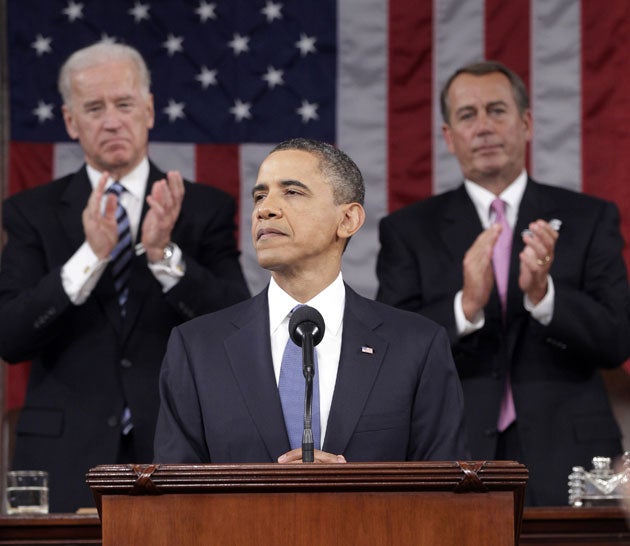
The irony is that Obama's State of the Union address this year is a perfectly condensed version of That Used To Be Us (stripped of Friedman's trademark clunky metaphors). The speech and the book both demand the US seizes a new "Sputnik moment", racing the emerging powers of Asia as it once raced the Russians in space. Where That Used To Be Us ends with a call to reinvigorate the US "formula" for success, Obama tried to rally the nation with his refrain: "We do big things".
Friedman and Mandelbaum bemoan a lack of "seriousness" in US politics, yet their magic-wand prescription for an independent candidate doesn't rise to the level of serious either. Better to take a forensic look at why the potential energy of Obama's campaign failed to generate the force expected of it.
If the US public invests so much expectation in the presidency, should it give the incumbent more power to push an agenda into law? Does the US have anything to learn from a French or a British system? What are the ideas and who are the donors around which a third party might form? Is there someone, anyone, who knows how to drain lobbying money from US politics? And how can we all tear ourselves away from the crack pipe of Twitter and the opium drip of cable news so as to think our own long-term thoughts?
That Used To Be Us stands as a decent outsiders' guide to the conventional wisdom right now. But what the US needs, and urgently, is some unconventional wisdom.
Join our commenting forum
Join thought-provoking conversations, follow other Independent readers and see their replies
Comments
Bookmark popover
Removed from bookmarks