The Particle at the End of the Universe, By Sean Carroll
The 'discovery' of the Higgs boson is a great event – but an anticlimax for lovers of the chase

For free real time breaking news alerts sent straight to your inbox sign up to our breaking news emails
Sign up to our free breaking news emails
On 4 July 2012, hundreds had queued for hours for the 9am event; many had camped out all night. Although journalists from across the globe had arrived in huge numbers, this was no launch of the latest must-have Apple product or the reformation of some ageing rock band.
The venue was CERN, Europe's centre for high-energy particle physics near Geneva, and the event was the official presentations of the latest data in the search for the world's most famous yet-to-be discovered particle, the Higgs boson.
Get money off this book online at the Independent Bookshop
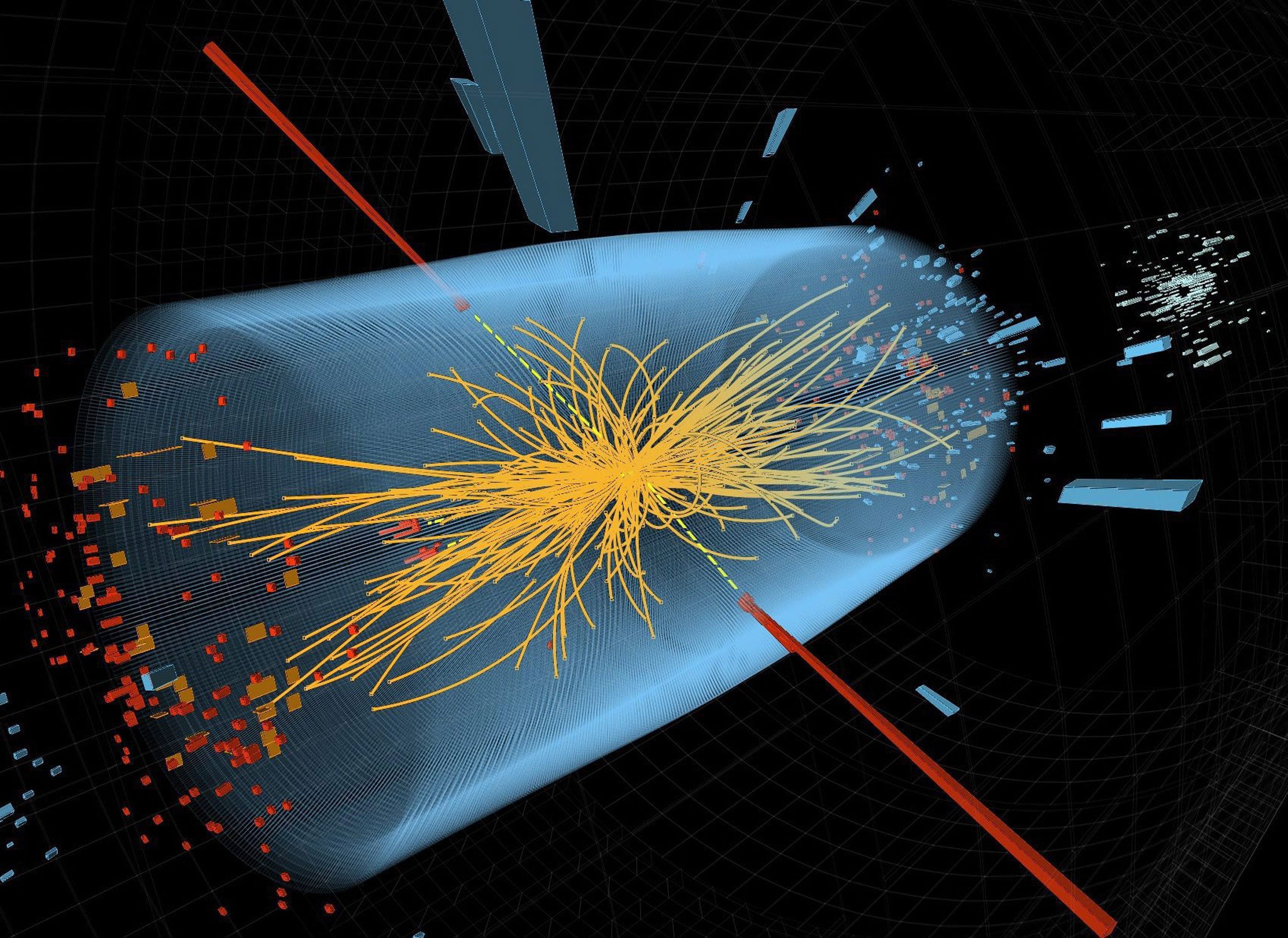
The handful of graphs from the two major experiments, ATLAS and CMS, that collect and analyse data generated by collisions in the Large Hadron Collider (LHC) would have seemed unimpressive to the untutored eye, explains Sean Carroll, a theoretical physicist at the California Institute of Technology. But they signalled, to the physicists in the audience, the culmination of decades of work and $9 billion in hard cash, and a new particle.
In The Particle at the End of the Universe, Carroll offers some words of caution amid the Higgsteria. What has been found is evidence for a very Higgs-like particle: "It has the right mass, it is produced and decays in roughly the expected ways". In truth, physicists don't want it to be the Higgs that theory predicts. It's always more interesting to find something unexpected. "Like Hollywood celebrities or charismatic politicians, scientific theories are put on a pedestal just so we can tear them down".
The best theory of particle physics, the "standard model", describes quarks, gluons, neutrinos and all the other particles and the forces that act between them. The Higgs is the missing piece of the theory and plays a special role in giving other particles mass. It dates back, and is named after, work done by Peter Higgs in Edinburgh in 1964.
Searching for the Higgs particle has been likened to looking for a bit of hay in a haystack. If all the data generated by the LHC were stored on CDs, it would fill more than a million discs every second. To overcome this problem detectors are designed to select data passed on for storage. The system that performs the selection process is called the trigger. It is the role Carroll plays in this compelling addition to the ever-growing list of books on the physics of which the Higgs is such a crucial component.
In a rare omission, Carroll fails to mention the first circular accelerator. Called the cyclotron, it was a pie-sized fabrication of glass, sealing wax, bronze, only 4.5 inches in diameter. In 1931, the American Ernest Lawrence's idea of using magnetic fields to help accelerate particles would launch the era of "Big Science" that would lead to the LHC, with a diameter of 8.6km and circumference of 27km.
Though not always easy reading, Carroll's book reveals that modern physics at the cutting edge requires extraordinary devotion and a willingness to bet high stakes in search of unique rewards. As he says, "When it all comes together, the world changes."
Manjit Kumar's 'Quantum' is published by Icon Books
Subscribe to Independent Premium to bookmark this article
Want to bookmark your favourite articles and stories to read or reference later? Start your Independent Premium subscription today.
Join our commenting forum
Join thought-provoking conversations, follow other Independent readers and see their replies