The Undiscovered Country: Journeys Among the Dead, By Carl Watkins
A cultural history that reflects on the traditions that surround our final journey – to the coffin

For free real time breaking news alerts sent straight to your inbox sign up to our breaking news emails
Sign up to our free breaking news emails
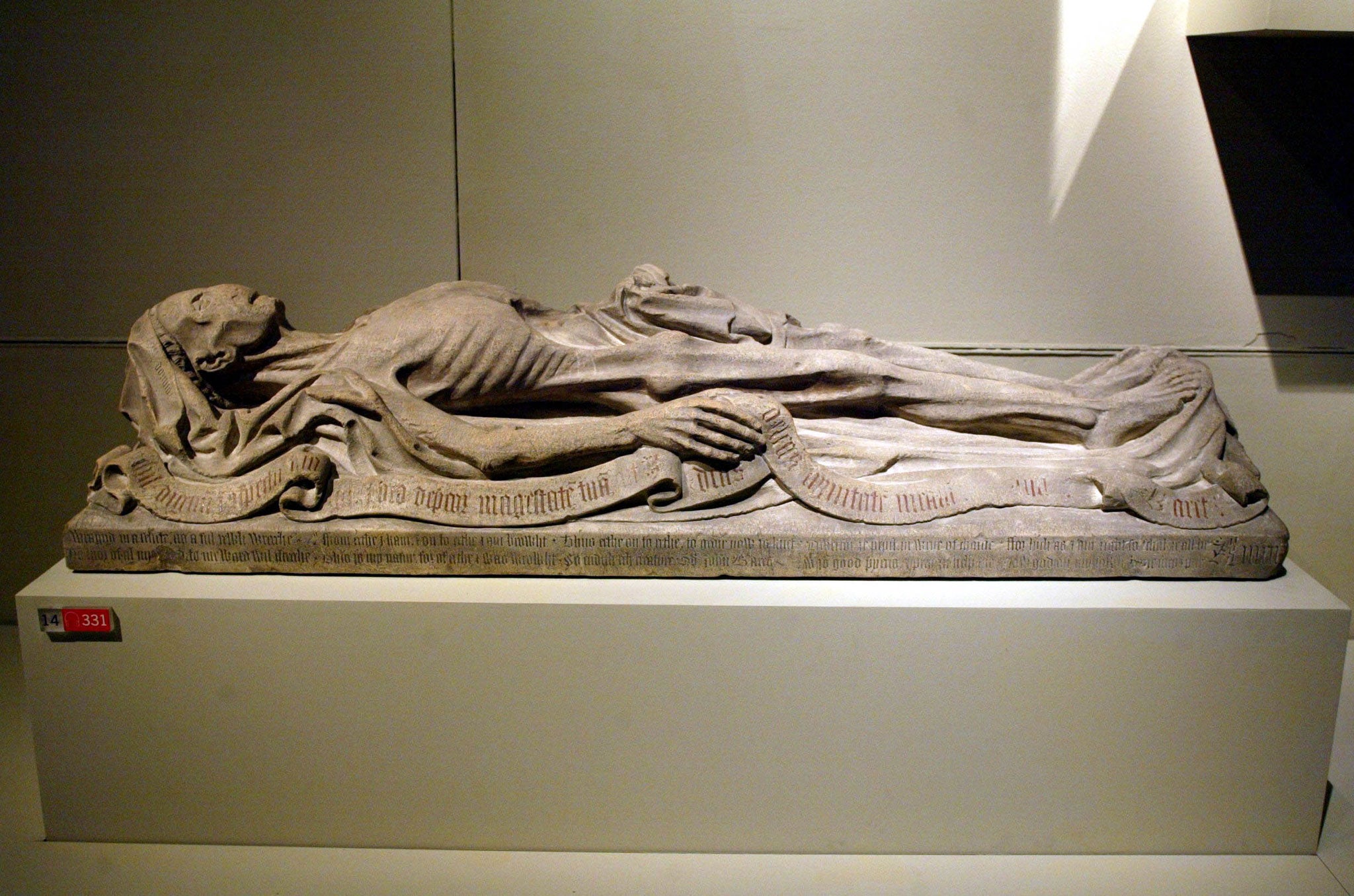
In the sleepy market town of Bury St Edmunds there is an effigy on a 15th-century tomb. It still draws in the morbid and horrifies the curious. This central motif of The Undiscovered Country is the ornate resting place of one John Baret, a wealthy merchant.
His sepulchre is unusual – instead of the customary elegant carving of a living person, Baret is shown, notes Carl Watkins, with flesh "stretched tight as a drum over bones that almost protrude, face set hard in a rictus, the nose crumbled away, the work of decomposition already begun". Bury St Edmunds was well-known to MR James, who in 1895 published a monograph on the library in the town, and it seems inconceivable he didn't visit the tomb. James was a Cambridge medievalist and academic, as is Watkins, but there the resemblance ends. Those expecting a book of well-seasoned ghost stories may be disappointed.
Watkins's book about the rituals surrounding death in British culture is at its best with his medieval specialisation. He's also a fellow traveller to historical antiquarians – the better known, such as John Aubrey and Sir Thomas Browne, are here. Others include Rev JC Atkins at Danby, who wrote down the fading rituals and superstitions of his Yorkshire parishioners. Yorkshire was still suffused with the remnants of English Catholicism.
Fears of crossroads and the ritual of elaborate wakes that sometimes involved marching a coffin for many miles over the moors were not unusual. Bells must be rung at Halloween. Front doors must be left open at funerals. "The signs of life – ticking clocks and fireside warmth – must be put in suspense lest they draw the dead back into the world". In the 1860s, when Irish navvies came to Slaithwaite in North Yorkshire, they too held wakes. "The protestant natives looked at it in bewilderment," notes Watkins. "They were gazing into another world, the world of their ancestors." The Victorian vogue for spiritualism had its origins as much in Yorkshire's Keighley as in America.
This touches on a key issue of the book. British ghost-belief has remained problematic since the Reformation. To say you believed in ghosts was to identify yourself as a Catholic, which for many years after the death of Henry VIII was a dangerous thing to do.
Better on aesthetics than social change, Watkins is least comfortable when venturing into the more modern world of the séance or discussing proto-socialists such as Robert Owen and David Richmond, and the theosophist Annie Besant. For them, hellfire was going the same way as purgatory. But even these non-conformist thinkers were still negotiating with the rituals around death. Hellfire was simply a separation from God.
There is one last return to the emotionally-charged catalfaque in the 20th century: the Tomb of the Unknown Soldier in Westminster Abbey, created in 1920 as a symbolic gesture. Watkins could have linked this with the resurgence of Catholicism in the UK in the First World War, with Catholic priests spreading tales about the Angels of Mons. But he's right – the archaic, ritual aspect of this gesture is a curious one in a world of tanks and gas.
By the rather unsatisfactory epilogue he talks about "post-Christian Britain" where ghosts have become "counter-cultural presences". I'm not aware of any such thing. Counter-cultural figures really weren't that interested in ghosts – demons maybe, in the case of William S Burroughs. Watkins means pop-culture – TV shows such as Most Haunted.
Culturally, ghosts show absolutely no sign of going away, and these phantoms are the true remnants of Watkins's medieval world. But our idea of ghosts has changed, and one survey showed that ghosts were simply now perceived as a "feeling". Where once our ancestors looked closely at an apparition to see whether they showed any sign of hellfire singeing their clothes, now we just think of them as an emotion field: a presence, a mood hanging in the air.
Roger Clarke's 'A Natural History of Ghosts' is published by Particular Books
Subscribe to Independent Premium to bookmark this article
Want to bookmark your favourite articles and stories to read or reference later? Start your Independent Premium subscription today.
Join our commenting forum
Join thought-provoking conversations, follow other Independent readers and see their replies