When A Billion Chinese Jump, By Jonathan Watts
Here are two facts. During the first quarter of this century, half of all the world's new buildings will be erected in China, and 50,000 of them will be skyscrapers, equivalent to ten New Yorks. And while this is happening, China will be producing 60 billion pairs of wooden chopsticks every year.
Your head swims. You need to read the figures again. But there they are in black and white, impeccably sourced, on pages 151 and 453 of Jonathan Watts' gripping new book. Makes no difference if it's the grandiose or the trivial, the ancient or the ultra-modern, the People's Republic is now producing more of it than anyone else, more than anyone ever has, more than anyone has ever imagined doing, in the most fantastical, credibility-stretching, mind-boggling explosion of economic growth the world has ever witnessed.
And a terrible reckoning is coming, Watts predicts, for China and its people, indeed for all the people of the world, for the simple reason that somewhere along the line, there has to be a limit, and the Chinese don't recognise limits. In the past, limits were a long way off. But the size of the assault China is now making on natural resources and on the environment to fuel its phenomenal industrial growth is unprecedented in the history of the planet. The country is already running up against limits within its own borders, and is starting to approach limits in the rest of the world.
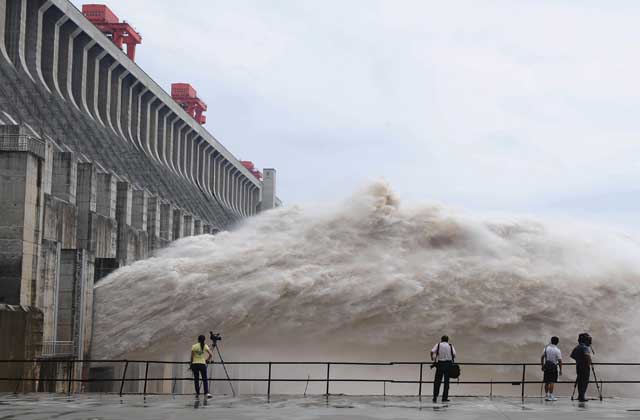
Consider a few more examples from the cornucopia of outlandish facts Watts provides. China has now built 87,000 dams (many have caused terrible problems). Since capitalism was unleashed in 1978, 176,000 Chinese miners have died in accidents in coal mines. By 2020, the volume of urban rubbish in China is expected to reach 400m tonnes, equivalent to the figure for the entire world in 1997. In 2006, the heavily-industrialised provinces of Guangdong and Fujian discharged nearly 8.3 billion tonnes of sewage into the ocean, without treatment, a 60 per cent increase from 2001.
As so many of its coastal fisheries have been ruined, China now produces more fish from aquaculture (32m tonnes in 2005) than from the wild oceans (the first country in the world to do so). And by one reckoning, China is now the source of half of all the airborne dust in the world.
As Asia Environment Correspondent of The Guardian, Watts is perfectly qualified to assemble detail after extraordinary detail, to build a riveting picture of one of human history's most astonishing episodes. But the great virtue of When A Billion Chinese Jump is that voices are as prominent as facts. The book is structured as an environmental travelogue, from Shangri-La (or its putative site) in Tibet to Xanadu in Inner Mongolia, by way of the darkest industrial hell-holes, most polluted rivers and sadly ruined forests you can imagine. All along the way Watts talks to the Chinese people, from destitute peasants to the flashy new rich of Shanghai, about what the growth explosion means to them. Their accounts are often very moving.
It is also in their words that Watts gives us an essential insight into why the Chinese growth explosion is likely to be uncontrollable. There are many who see the problems, and many noble souls trying to lessen pollution, say, because of its human cost. But very few take the view that the natural world itself can only be ravaged so far.
There is minimal respect for nature and for the environment as such, since the bedrock cultural attitude of the Han Chinese, the core ethnic group, reinforced by Confucianism, is that the world is there for our use, merely a resource without intrinsic value of its own. To me perhaps the most depressing of all Watts's revelations was the infinitely sad fact that "until the 1990s, the signs on cages in Beijing zoo identified which parts of each animal could be eaten or used in Chinese traditional medicine."
Watts has enormous sympathy with China and love for its people but he is clear-eyed and writes: "The finiteness of resources and the carrying capacity of the earth are simply not considered." In the frenzy to grow, the People's Republic has ruined many of its own rivers, lakes, grasslands and forests and is now, through its gargantuan demand, prompting the ruin of the natural environments of many other nations, from Russia to Brazil, without any notion of a halt.
But that's not the half of it. Over everything hangs the spectre of China's carbon emissions, the largest in the world, whose continuing, mushrooming growth will swamp any cuts the rich nations will be able to make, and may usher in uncontrollable climate that will do for us all. There can be no question of moral superiority; Western consumers are as much to blame, and the Chinese are only doing what we did, albeit on an unprecedented scale. Yet the consequences are discernible, and if humanity's ultimate fate is the precipice, it looks as if it will be the historical role of the Middle Kingdom to lead us over the edge.
Michael McCarthy is Environment Editor of 'The Independent'
Join our commenting forum
Join thought-provoking conversations, follow other Independent readers and see their replies
Comments