Golden ticket: British theatre's dynamic duo bring Don Giovanni to Glyndebourne
Can Jonathan Kent and Paul Brown make 'Don Giovanni' as relevant today as it was when Mozart wrote it 223 years ago? Those lucky enough to hold Glyndebourne's golden ticket are in for a big surprise
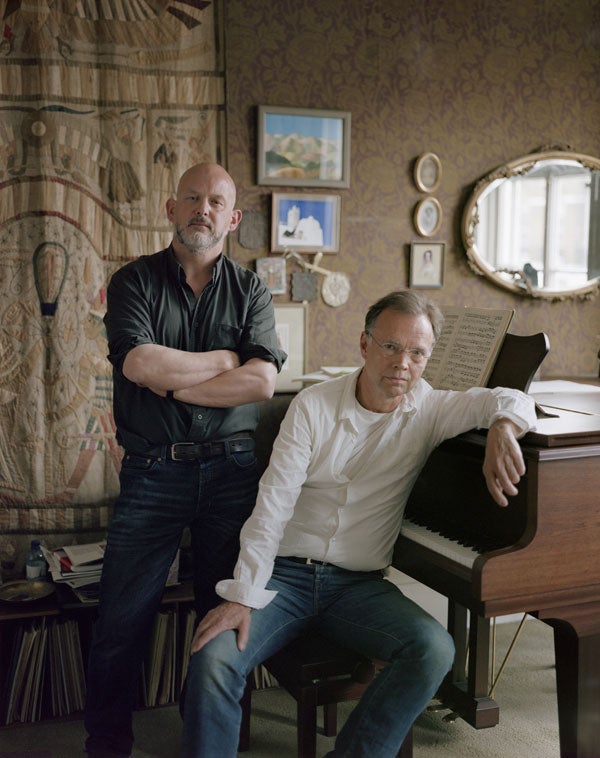
The challenge of Don Giovanni is that everybody has a Platonic vision in their heads, which the director's vision never lives up to," says director Jonathan Kent, who will unveil his own at Glyndebourne today. "No, it's always the designer who ruins it," mutters Kent's designer, Paul Brown. "For any conductor, this work is Mount Everest," says conductor Vladimir Jurowski, scaling this peak for the first time. Baritone Luca Pisaroni, singing Don Giovanni's sidekick Leporello today, but dreaming of one day incarnating the Don, says the central role "is about being so charismatic that nobody can take their eyes off you. Either you are fantastic, or you are terrible. There is nothing in between." Only the suave Gerald Finley, today's anti-hero, is entirely sanguine, but that's because his mellifluously baritonal Don has already been acclaimed in half the capitals of the West.
This work has often been called the "opera of operas". When it first erupted on to the stage in Prague in 1787, nobody had dreamt of such an intoxicating amalgam of comedy and tragedy, beauty and terror, sadistic vice and preternatural virtue. And composers such as Liszt and Tchaikovsky, writers from Alfred de Musset to George Bernard Shaw, and film-makers with Joseph Losey pre- eminent have been mesmerised by it ever since. But to its original audience, the story itself was cosily familiar. First told by the 17th- century Spanish playwright Tirso de Molina, then by the playwrights Molière and Goldoni, then commandeered by Italian commedia dell'arte troupes, it spawned no less than seven operas in the decade before Mozart produced his, and in each the plot was the same: the reckless seducer abetted by his valet; the father murdered while defending his daughter's honour; the anti-hero's dinner invitation to the murdered man's statue, which accepts and drags him off to hell. Why did this strike such a chord in the days of the Enlightenment – and why does Mozart's version still reverberate so powerfully today?
The first question is quickly answered. Religion's grip was weakening, as was the aristocracy's unchallenged hegemony. Don Giovanni's mocking toast of "Viva la liberta!" chimed perfectly with ideas of social and political upheaval: this was during the American revolution, and on the eve of the French. But Mozart's extraordinary creation raises deeper issues. By labelling the opera a "dramma giocoso", he indicated the compromise which had been reached, between the comedy his librettist Lorenzo da Ponte was bent on and the serious drama he himself felt impelled to write. His father Leopold had just died, and the Commendatore whom Giovanni kills, and whose ghost eventually annihilates him, is an archetypal Freudian father figure.
Meanwhile, Giovanni may be a convincingly flesh-and-blood character, but he, too, is an archetype. But of what sort? For the Danish philosopher Soren Kierkegaard, he represented the primal life-force; the German Romantic novelist ETA Hoffmann saw him as a reflection of "the eternal conflict of heavenly and demonic forces"; the French novelist Albert Camus described him as, "a man who says no, but whose refusal does not imply renunciation". No indeed: yea-saying is what most commentators see as the kernel of the Don's existence. "Don Juan lives in us all," writes Charles Russell, in a fizz of excitement. "Our daydream of adventure, our night-time dream of escape... the sexual
act of conquest or submission that we have all longed for... the act of daring we have never attempted... he is our ego asserting itself in its most elemental and selfish fashion."
But many critics have noted Don Giovanni's "blankness": he talks a lot in the opera, but it's all about sexual strategy, not himself. Since there are very few clues to the nature of his inner self, people can implant in him whatever nature they want. Thus the late (and lesbian) literary critic Brigid Brophy's assertion that Don Giovanni is really a repressed homosexual, "courting not women but his own destruction". She may have been on to something, for it is surely significant that, despite his long list of claimed successes, none of the attempted seductions we see in the opera actually comes off.
Jonathan Kent says his biggest test has been "how to give Don Giovanni a life, because his charm and his demonic quality are a mix which is entirely unexplained. And I wanted it to be clear that this was the first time he had killed. He goes to hell not because he's shagged lots of women, but because he's committed a murder. We've tried to give the thing an absurdist slant, jamming the moments of broad comedy right up against the blackest things. And we've tried to keep it all flowing fast. From the moment he kills, it's a helter-skelter ride through to damnation."
As the most brilliant director-designer team in Britain at present, Kent and Brown are much in demand, but they play their cards very close to the chest. It is only with difficulty that I discover that their take on this work will be set in 1960s Italy, with black-and-white references to the cinema of Fellini and Antonioni to make the audience feel at home, and with hints that the sexual revolution of the mid-20th century may echo the social changes which convulsed Vienna in the late 18th.
Asked how they approach a project, they deliberately look vague. "With us, things begin in the pub," says Brown. "Alcohol plays a strong part in our creative life. It's a slow burn, with false trails." How do they divide their responsibilities? Kent replies that when he was running the Almeida Theatre, he always thought he should simply list the production team, rather than assigning people specific functions, "as the grey area between Paul's designs and my direction, for example, is where they overlap and influence each other – and that's the most interesting area". Brown: "We're faceless people, it doesn't matter who we are."
Their last Glyndebourne production was a wonderfully off-the-wall realisation of Purcell's The Fairy-Queen, which had flying horses and giant cascades, and created worlds beyond worlds with a range of reference including Walt Disney and Max Ernst, The Lord of the Rings, and a stage full of inventively copulating rabbits. Brown's designs for the Glyndebourne Pelleas et Mélisande, which specified the whole stage should be a carpet of flowers beneath a transparent plastic film, is still teasing the ingenuity of directors who restage it. Professing to be hooked on adventure, Kent and Brown have created "pop-up" theatres for site-specific work in a disused King's Cross bus station and a Hackney warehouse, and for their final show at the Almeida they flooded the basement and half-demolished the auditorium.
But one senses behind their reticence a genuine curiosity as to how their Don Giovanni will emerge, as it is their policy to let performers put their stamp on things. In Finley's case, this bodes well, as his Don sounds refreshingly different: "Mine won't be drug-addicted, or pushing the limits of depravity, as ENO's latest version was. He won't be rough trade. As far as anyone can be noble in the 21st century, this Don will be. We're going for a nice, clean veneer, brightly polished, but with some energetically addictive passions underneath. For me, it's about almost being offensive, but not quite. It's more interesting if you're never quite sure if he's going to get in a brawl, or whether he'll just flip the switch and charm everyone again.'
For Jurowski, what sets this Don Giovanni apart is the fact that it follows the cuts and additions Mozart made for his Viennese audience, rather than being the usual hybrid crossed with the earlier Prague version. This means that while Donna Elvira emerges as a triumphant allegory of unconditional love, the peasant Zerlina gets a ruthless, hard-nosed makeover. And the ending leaves the audience slightly suspended, unclear as to what will happen next: far more suited, says Jurowski, to our 21st-century tastes.
Since the librettist didn't explain how Don Giovanni escapes the vengeful mob at the end of Act One, every director has their own solution. Glyndebourne's previous production by Graham Vick had part of the ceiling collapse and turn into a conveniently placed ladder: Kent and Brown presumably have a new trick up their sleeve. And there's something else about this production, a big secret which is being kept under such tight wraps that even my normally obliging Glyndebourne spies have clammed up. Later today, we will know.
Today's performance of 'Don Giovanni' at Glyndebourne is sold out, but for information on ticket returns, visit glyndebourne.com
Join our commenting forum
Join thought-provoking conversations, follow other Independent readers and see their replies
Comments
Bookmark popover
Removed from bookmarks