How we learned to start worrying and love Mahler
The Austrian composer is more popular than ever, with a host of anniversary concerts planned. Yet at first his work was overlooked because his sense of doom was out of tune with the times
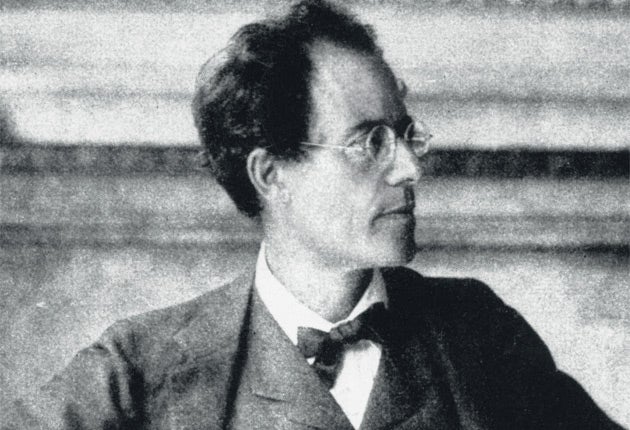
On Gustav Mahler's 11th birthday, the story goes, a family friend asked what he wanted to be when he grew up. "Jesus Christ," said the lad. To the astonished "Why?" he replied: "Because I want to suffer for other people."
The tale carries an apocryphal air, yet the comparison is not totally inept. Attend any of the composer's nine-and-a-bit giant symphonies, or the song cycles, equally works of genius, and you are not just subsumed by the tsunami of sound: you sense that the music, as philosophical as it is passionate and as universal as it is personal, takes into itself all the anxiety, existential soul-searching and quest for meaning that beset us today. It's as if Mahler is shouldering all the burdens of human existence. By massively inflating via sound his world view, with all its wild extremes of faith and doubt, wonder and suffering, he illuminates the shared universality beneath.
Mahler was born 150 years ago and died in 1911 aged nearly 51, handily providing two consecutive anniversary years. Although similar celebrations for the anniversaries Chopin, Schumann, Handel and others spawned ennui and protests of overkill, it seems now that we just can't get enough Mahler. The composer in his lifetime was primarily regarded as a great conductor who had an eccentric summer composition habit. Today he is looming larger in public consciousness than ever before.
I tracked down three of the top conductors in the UK, each of whom is individually immersed in an ongoing Mahlerian adventure, to find out what they thought of the megalithic maestro's endlessly expanding stature.
First, there's the question of why it took so long for Mahler to emerge – certainly in the UK – as more than a symphonic white elephant. Sir Mark Elder, Music Director of the Hallé Orchestra in Manchester, points out that the Third Symphony was not played in Britain until the late 1950s, although it is the most optimistic of the composer's works.
"That was astonishingly late," Elder comments. "It's as if it needed almost another half century after his death to begin to hear this music in all its depth, not just to be blown away by the aspiration, the breadth and the noise of it. It has taken that much time for us to assimilate its emotional journey." Mahler rewards the familiarity that emerges with longer acquaintance, Elder adds. "The better I get to know his works, the more moved I am by the size of the personality that created them."
That personality is extraordinarily modern. "His emotional range, the bitterness and the sarcasm, the perverting of musical material he's developed, it's reminiscent of the way so much of our society has become so angular and inharmonious," Elder says. "And his belief in triumph, or lack of belief in it – these are issues on a huge scale that a great many of us can relate to." Elder, with the Hallé and mezzo-soprano Angelika Kirchschlager, will be performing songs from Mahler's cycle Des Knaben Wunderhorn in September, having shared the symphonies with the BBC Philharmonic in 2009-10.
Meanwhile Andris Nelsons, the young Latvian rising star who is chief conductor of the City of Birmingham Symphony Orchestra, is launching his orchestra's new season with the gargantuan No 8, the Symphony of a Thousand. To him Mahler is not only bigger than ever before; he is the voice of the credit crunch.
Our times, Nelsons suggests, make us confront on a daily basis the terrifying issues with which Mahler's symphonies grapple. "Think of the contrasts today of extreme poverty and ridiculous richness, and now the question of where life in this world is going to lead. We have a crisis and everybody is afraid; nobody knows what to expect. Mahler's music, which is also very extreme, is constantly exploring these questions. He searched all his life for answers about why we live, what we need to do in life and what is our reason for living.
"These matters have always been with us, but perhaps in earlier decades it was not so comfortable to discuss those big questions. Now we are forced – which is a very good thing – to think constantly about the important issues. It's scary on the one hand, but on the other we do need to come back to the roots of humanity; we are a little far away from them in the modern world. Mahler's music can really encourage us to do that.
"I don't agree with the view that suggests Mahler is very controlled and cool," he adds. "He was nervous and expressive, sarcastic, sentimental and also very sincere; he was a tremendous combination of different human aspects. He was a mixture of Jewish, Viennese, Hungarian, Austrian, and maybe this mingling is why he's so immediate to us nowadays. As Leonard Bernstein said, every note in Mahler should be squeezed through a lot of experience, a lot of pain. Every note is vital. If you play with such an attitude, then that's what Mahler is for me."
Maybe not controlled and cool, but astute, visionary and uncannily accurate in capturing his zeitgeist: this is the view of Vladimir Jurowski, who, as principal conductor of the London Philharmonic Orchestra, is exploring Mahler's nine completed symphonies in chronological order. For Jurowski, Mahler is not only a prophet but a forensic scientist. And yet, he suggests, it is at times of least confidence in scientific "progress" that we seem to turn to Mahler most vigorously. "I think we are living in a time comparable with 100 years ago when Mahler died," says Jurowski. "It is past the turn of a century, now past the turn of the millennium. This time is usually marked with a rather apocalyptic feeling of doom. Mahler gave probably the most precise diagnosis of his time, which, of course, was far ahead of the game while he was still alive; that's why so few people understood the message."
Mahler, of course, had not experienced the two World Wars, but Jurowski is convinced that he predicted them in his art, which pulsates with nervous energy on a cosmic scale. "Today, having been through the 20th century, having been through those wars and the Shoah, and now living in a very uncertain era of globalisation, global warming and global terrorism, there is a general insecurity about the future," says Jurowski.
"We experience, as in Mahler's day, if in a different way, an existential sense of being forsaken, left alone, whether by God or by nature. We believe less and less in scientific and technological progress because it doesn't make us any happier. The moments when Mahler was not so popular were exactly those times when people believed that the further into the future you went, the better the life and the happier the people would be, and the more ridiculous all these private little fears and phobias would seem. A hundred years past Mahler's death I think we are closer to him, and his incredible gift to feel compassion for other people. We feel closer to him than ever before."
With Mahler set to stay centre-stage for the rest of this year and next, there's an unprecedented wealth of opportunity to hear his unique, visionary, voice and assimilate his message – which, ultimately, is one of compassion and hope. Perhaps Mahler can save the world. Now is the time to find out.
Symphony No 1: Berlin Philharmonic/Sir Simon Rattle, Royal Albert Hall, London, 3 September (royalalberthall.com); Symphony No 8: City of Birmingham Symphony Orchestra/Andris Nelsons, Symphony Hall, Birmingham, 16 September (cbso.co.uk); Symphony No 3, London Philharmonic Orchestra/Vladimir Jurowski, Royal Festival Hall, London, 22 September (southbankcentre.co.uk); Symphony No 4, London Symphony Orchestra/Valery Gergiev, Barbican, London,26 September (barbican.org.uk); Totenfeier; Songs from 'Des Knaben Wunderhorn': Angelika Kirchschalger, Hallé Orchestra/Sir Mark Elder, Bridgewater Hall, Manchester, 30 September (halle.co.uk)
Join our commenting forum
Join thought-provoking conversations, follow other Independent readers and see their replies
Comments
Bookmark popover
Removed from bookmarks