The relative beauty of the violin
Einstein sensed the secrets of the universe in music. A professor and a virtuoso are to explore the connection. By Jessica Duchen
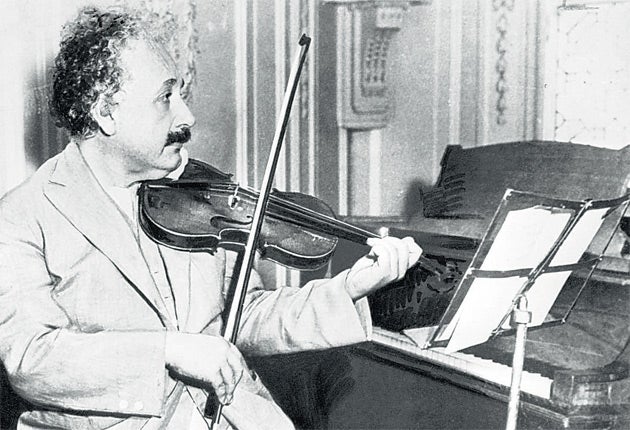
One day, the story goes, Albert Einstein was playing string quartets with his friend Fritz Kreisler, the great Viennese violinist. Einstein went wrong. "You know, Albert," said Kreisler, "your trouble is that you can't count."
It's a tale told in various permutations. But what's indisputable is that the discoverer of the theory of general relativity was also, in his spare time, an eager violinist. "If I were not a physicist, I would probably be a musician," he was quoted as saying. "I often think in music. I live my daydreams in music. I see my life in terms of music... I get most joy in life out of music."
Now there's a chance to explore the link between music and physics as exemplified by Einstein. The violinist Jack Liebeck, Young British Classical Performer at the Classical Brits 2010, has teamed up with Brian Foster, Professor of Experimental Physics at Oxford University, for The Music of the Spheres, a lecture and recital.
"Brian first heard me play at the Cheltenham Festival," Liebeck recounts. "We got talking and later he invited me to dinner at high table in his Oxford college, where I ended up quizzing him about particle physics for an hour and a half. And he is a keen amateur violinist himself, so I gave him a lesson."
The pair devised Einstein's Universe for the World Year of Physics in 2005; since then they have given presentations to schools and colleges across Britain, supported by the Science and Technology Facilities Council. But it's only now that they are appearing in a public event in London, at St John's, Smith Square, on 4 February. Foster will speak at 5.15pm; Liebeck will illustrate the lecture with extracts from Bach's solo violin works. The music could work upon the audience's mind in rather a similar way to that upon Einstein.
"He used music to clear his mind while it was twisted up with all these tortuous concepts," Liebeck suggests. Einstein would leave his desk, play his violin or piano for a short time, then return to the study in a more relaxed frame of mind: "It would help him to stand back a little from the problem and crystallise his thinking."
During the lecture Foster explains the activities of CERN (the European Organisation for Nuclear Research), and its Large Hadron Collider in a tunnel 100 metres underground. None of its experiments would have been possible without Einstein's discoveries. Yet, when the great man was due to receive his Nobel Prize in 1922, he was not present at the ceremony. He was in Japan, reportedly performing Beethoven's Kreutzer Sonata.
Liebeck, with pianist Katya Apekisheva, will end the evening with a performance of Johannes Brahms's three violin sonatas. Einstein had a special affinity with the first of them, the one in G major. As a student in Switzerland, he heard a performance of it by the violinist Joseph Joachim; afterwards, the scientist set about practising the piece intensively, determined to learn all he could from Joachim.
Einstein often used his fame to meet and befriend musicians he admired. He would play chamber music with them and, though no virtuoso, could usually hold his own. Except for counting, that is: Jelly d'Aranyi, the Hungarian violinist for whom Ravel wrote his celebrated Tzigane, once stopped while playing a string quartet with Einstein and remarked: "Albert, your time is very relative today..."
The American author Jerome Weidman left another beautiful anecdote. As a young man, considering himself tone deaf, he attended with trepidation a musical soirée at the home of a New York philanthropist. He found himself sitting next to Einstein, who asked if he liked Bach. When Weidman admitted he had no ear for music, Einstein whisked him out to their host's study; there, with the aid of a Bing Crosby record and other music, culminating with Bach, the scientist proved to the youth that he had simply had his ears closed to classical music by an unfortunate early experience with a teacher, and that his "ear" was perfectly good. The evening instilled in Weidman a love for Bach that never left him. When their hostess asked why they had missed the performance, Einstein smiled: "My young friend here and I were engaged in the greatest activity of which man is capable: opening up yet another fragment of the frontier of beauty."
Beauty was paramount in Einstein's concept of the universe – inspired not least by the "architecture" and "inner unity" he found in the music of Bach and Mozart. "Einstein's work was very much an attempt to unify physics, to explain apparently disparate elements within the same framework," Foster points out.
"He used to say that that framework could be extremely beautiful. Einstein's example in looking for beautiful solutions is still going on today: the work at LHC is very much about unification and beauty." Foster suggests that the LHC's research could fulfil Einstein's dream of understanding the universe in one unified theory.
Lecture and recital are free to those aged 25 and under. And there, perhaps, lies a special relevance, while the Government and many local councils are considering potentially devastating cutbacks to music education. Yet there is a possibility that, without his musical know-how, Einstein might never have made the connections and discoveries that changed the world.
"Playing music opens neural pathways that otherwise might not open," says Liebeck . "It makes cross-references between different areas of the brain that might not connect so readily without it.
"We hear so much on the radio and TV of politicians stressing the importance of the 'three "R"s', but I think it might be more productive if all kids learned to play a musical instrument. It would focus their brains in a much better way."
The performance takes place at St John's, Smith Square, just round the corner from the Houses of Parliament. Government ministers could do worse than pop in and listen.
The Music of the Spheres, featuring Jack Liebeck, Katya Apekisheva and Professor Brian Foster, is at St John's, Smith Square, London SW1 (020-7222 1061) 4 February at 5.15pm
Join our commenting forum
Join thought-provoking conversations, follow other Independent readers and see their replies
Comments