The Ring Cycle: What on earth was Wagner on?
As a new Ring opens, John Walsh tries to get to grips with its fantastical plot
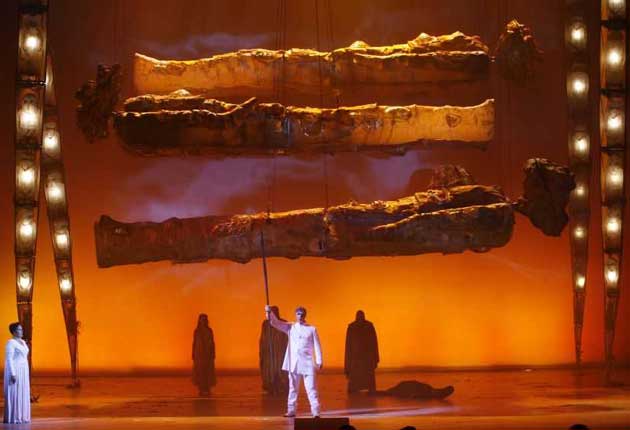
Forget Hardy, Proust and Dostoevsky: nobody beats Richard Wagner for baroque plotting. Der Ring des Nibelungen is gloriously barmy. It's a tale of stolen gold and national pride, of heroism and revenge, of youth and innocence and redemption. But it's also the opera in which a midget robber is outsmarted by a god, who loses out to a giant, who transforms himself into a dragon, which is killed by a hero who can talk the language of birds. Realistic it ain't.
The love interest is provided by twins who have an incestuous affair, and whose son is fated to marry his aunt. All male members of the cast are notably stupid (especially Siegfried, a dumb hillbilly along the lines of L'il Abner), while the females are nearly all strong and terrifying. The characters' names tend towards the absurd: Wellgunde? Mime? The Gibichungs? You wonder what exactly Richard Wagner was on for the 26 years he took to write it.
At its heart, it's the tale of a divinely disfunctional family living on a mountaintop. Wotan, a tyrant and paterfamilias, is King of the Gods; his wife, Fricka, is Goddess of Hearth and Home. We learn that Wotan, a shocking ladies' man, has impregnated Erda, the Earth Goddess, nine times – their strapping (and immortal) daughters, led by Brunnhilde, are called Valkyries – and that he also likes to visit Earth under the alias "Walse", to meet earthling babes. On one pulling mission, he sired the twins Siegmund and Sieglinde, but abandoned them. That's most of the dramatis personae.
The first episode, Das Rheingold, is all about theft, property and paying your bills. It opens with Alberich, a malevolent dwarf, spying on three innocent Rhinemaidens bathing in the eponymous river. When it's clear that they don't appreciate his sexual allure, he steals the gold they're guarding and fashions a ring that gives him power over the whole world. He can do this because he renounces the possibility of love. It's apparently something you can do in Nibelung circles: renounce love and win a fortune in ingots.
Wotan, the Homer Simpson of the Upper Regions, is having trouble with the builders. He commissioned two giants, Fasolt and Fafner, to build a celestial castle called Valhalla and promised, as payment, that they can have Freia, the Goddess of Youth, Love and Beauty. Since Freia is his sister-in-law, this is clearly a terrible idea. Hearing of Alberich's gold heist, Wotan and his sidekick, Loge, descend to earth, kidnap the megalomaniacal midget and steal his gold to pay off the giants. Alberich puts a curse on the ring that will affect all future owners. Wotan sensibly hands it over to the giants, and, predictably, a row breaks out. Fasolt is killed and Fafner flees with the toxic bijou.
That's the set-up. The plot thereafter becomes a three-generation towering saga of conflicting family loyalties, battles, much fleeing, clasping and sundering, and lots of symbolic weaponry.
Wotan's son Siegmund runs off with his (married) twin sister and discovers a magic sword his father promised him. Wotan breaks Siegmund's sword with his spear and kills him. (Another Sigmund, namely Freud, would have loved all this.) His pregnant lover, Sieglinde, flees into the forest with the remains of the sword and gives birth to Siegfried, who puts his father's weapon back together, kills Fafner(now a dragon,) kills Alberich's son – and defeats Wotan, breaking his mighty spear with his father's revulcanised claymore. Siegfried climbs the mountain, rescues Brunnhilde from imprisonment and travels down the Rhine, to the land of the Gibichungs, whose king, Gunther, is ...
Oh, the hell with it. Fourteen hours of intertwining family drama later, this headlong tale of love and power ends with Brunnhilde putting her dead husband Siegfried's body on a funeral pyre, riding her horse on to it, rescuing the ring and returning it to the Rhine, as Valhalla burns in the distance. The meddling gods have expired. The earth has survived Alberich's curse. Wotan, Siegfried, Brunnhilde and almost everyone else is dead, but the world has been made safe for buxom water babes washing their hair in the Rhine.
'Der Ring des Nibelungen' at the Royal Opera House from 29 July to 1 August
Join our commenting forum
Join thought-provoking conversations, follow other Independent readers and see their replies
Comments
Bookmark popover
Removed from bookmarks