Stand-up Dylan Moran takes on the world
What do you do when you hate celebrity, advertising, technology and interviews? Start telling it like it is, says the Black Books star on the eve of his tour
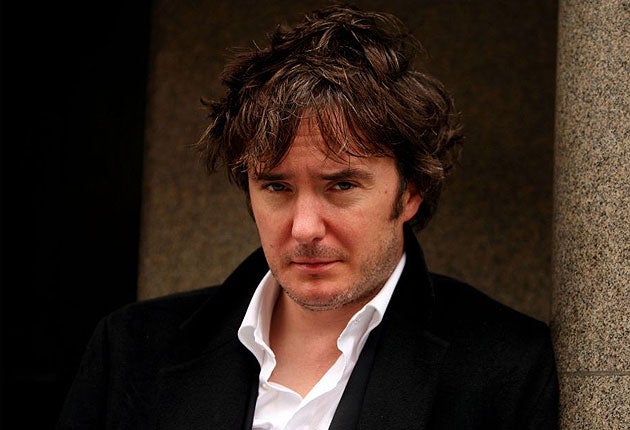
Approach with caution, is the advice of those who have encountered Dylan Moran. Not because he is the same misanthropic shambles as Bernard Black, the character he played in the popular sitcom Black Books – "I'd be in jail or in hospital if I was, that much should be obvious," he jokes – but because he has made his feelings on interviews quite clear. In the DVD extras of his stand-up show Monster, he recreates taking inane interview questions in a bored manner; in a past interview, he observed that: "There is nothing left to say, of course, but they keep asking. It's necessary, but it makes you feel like one of those guys standing outside a dodgy restaurant saying: 'Come in, come in.'"
"You've got to bang a pot, but it's not the best part of the gig," confirms Moran to me as we sit outside a restaurant on Great Portland Street in London at the height of the lunchtime rush hour. "You can't take it for granted, but on the other hand you can't do it [stand-up] if you don't take it for granted and work on the assumption that there is an audience. And indeed there is one, luckily for me. I can't offer a guarantee that people will enjoy my new show, though. I've not done a lot of stuff lately – I hope it goes all right."
Not that the 36-year-old Irishman is overly interested in his reviews. "If you're a sketch troupe, for example, you're thinking, 'How can we make our optician sketch funny?', not, 'How can we make it funnier than the optician the reviewer saw two weeks ago?' Also, when someone writes something like, 'Such and such a comedian's tired material about that hoary old subject, differences between men and women', it's a ludicrously wrong-headed and backward statement. The topic is neither here nor there – the approach is everything, whether it's men and women, cats and dogs or Israel and Palestine."
All this could, unkindly perhaps, be construed as Moran getting his retaliation in first before his new theatre tour begins. His preparation for the tour is minimal: he will only do a handful of warm-up club dates, and says that he only feels fully rehearsed after a week and a half on tour. "When I go out, most of it will have been said not at all. My normal rehearsal space is the show."
That said, the comedian and actor wants his latest live stand-up show, What It Is, to be more "fully realised" than his previous work. This might seem difficult, considering that he must now juggle a career spanning film and TV, but Moran brushes it off. "Juggling is exaggerated. It's not that often that you're on tour and you get asked if you want to do a really great film or collaborate on this script. Maybe if you're P Diddy and your wires are crossed and you have to promote your pyjama range while selling your garden gnome accessories."
However, some things have changed, he says. "The bullshit becomes harder. You get more intolerant of verbal props and habits. If I swear now I really want it to be justified. Everything has to work a bit harder to be included."
Much of Moran's new show stems from his "not very cheery" assessment of how the world is faring. "Life is very cheap right now. There's an undervaluing of the human, and of human essentials like community. There's a few things going on here: the advertisement materialist culture, the rise of technology and the information age, the demise of religion, all these secular people like you and me who are up for grabs in terms of their belief systems, individuals free-floating in this homogenised community of the world, where there is too much of everything and where the high streets look the same everywhere and everywhere is nowhere. It's kind of lonely, and everyone is reinventing themselves constantly."
Moran believes that eco-activity has filled the void left by the demise of religion, and that in the context of the world as he sees it, "politics becomes performance, because you're imbued with a culture that is materialistic, where people shop for what they want. And they do that with politicians as well. Look at who is running for president of the US – you don't get anymore photogenic, smart, or nimble than Barack Obama. I watched that guy dance [to Beyoncé's "Crazy In Love"] on The Ellen DeGeneres Show, which I happened to see on telly. Can you imagine a politician 20 years ago dancing his way to an election?
"Politicians used to be people who couldn't communicate effectively on television, and now you look weird if you appear human. One of the most striking things about Blair was watching him upstage Catherine Tate. It was eerily brilliant, vastly savvy and deeply wrong. Everybody nowadays is pretty wised-up when it comes to perception, and that has taken priority."
Moran's demeanour, though intense, is some way removed from his stage persona and the perceived misanthropy that has dogged him in previous interviews. "I was lucky in the sense that I was never blessed with an overly reflective nature," he says. Though he now lives in Scotland with his wife and two children, as a child growing up in Ireland, he says, "I wanted to show off – a simple impulse or drive; in much the same way as some kids wanted to play football, I wanted to show off. Not complicated in that sense, very natural, it just depends on how you want to show off."
Navan, County Meath, was then, he says, "very bureaucratic and a second-world economy, where the church had a lot of power". It suffered, he says, from "a pervasive kind of crappiness that you associate with Eastern Europe. It concentrated the mind as to what mattered. Talk was very important." Then, as now, Moran noticed those things that are "ridiculous or inherently absurd but widely accepted. It wasn't difficult to find in Ireland when I was growing up – when intelligent 19-year-olds would have to find out who had said mass so that they could pretend to their parents that they'd been to church."
After "making that transition from sitting around in cafés talking about stand-up, to doing something, allowing myself to get scared", Moran's own church became Dublin's Comedy Cellar, the venue that Father Ted's Ardal O'Hanlon helped to set up. He left Ireland at the age of 20 for London's comedy scene, and won the Perrier Award at Edinburgh in 1996, when he was 25. Three years later, he was cast in the comedy drama How Do You Want Me? opposite Charlotte Coleman; his subsequent screen credits have included The Actors with Michael Caine and Shaun of the Dead, as well as the much-loved sitcom Black Books, alongside Bill Bailey and Tamsin Greig.
Despite reaching No 17 in Channel 4's 100 Greatest Comedy Stand-Ups, Moran once remarked that he was "as famous as a fourth-division footballer in the 1970s". He says his level of fame is "liveable with". "It came to a point where people would come up to me and say, 'You're that guy – you did that thing, it was really funny, my sister liked it.' It's never them who like it, it's always somebody else, their cousin, somebody who's died..."
Celebrity does not appeal to Moran. He says that celebrities have "every kind of psychological problem you can think of, totally messed-up with no real friends. They're on drugs, they're basket cases, they go in to rehab because they don't like the smell of paint or they're attracted to the wrong kind of chairs. They are people so insecure they have nothing left, literally vaporised in the limelight, they take it all too seriously and are done in by what they perceive other people's perceptions to be."
He would, however, like to write a novel. It's a step he has previously described as "inevitable", but despite recently reading extracts at Flat Lake Literary and Arts Festival in Ireland, he continues to describe his book as "a work in suspension". It's the only point in the interview when Moran sounds like his character in Black Books, deliciously vague and offhand. "Oh, I mean, you know, I will put a book out at some point... Er, I've got stuff in the pipes but no point talking about it. I'll talk about it when it's out. But it will happen eventually, no rush."
Dylan Moran is touring to 1 December (see www.chortle.co.uk for venues)
Join our commenting forum
Join thought-provoking conversations, follow other Independent readers and see their replies
Comments