Darkness and despair: that's dance on screen
Darren Aronofsky's Black Swan is the latest film to explore the keen contrast between surface grace and extreme pressure in ballet. Sarah Hughes examines a movie obsession
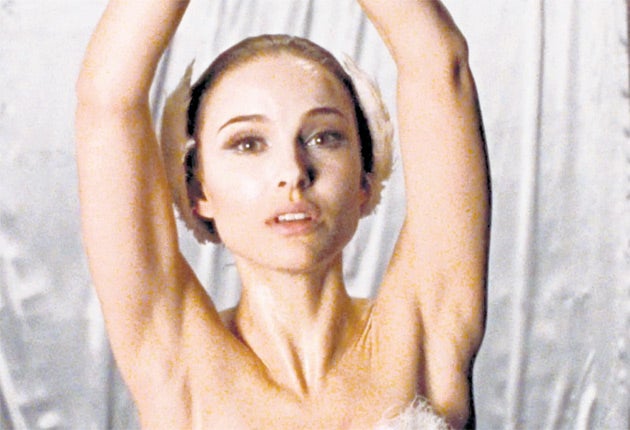
From Michael Powell and Emeric Pressburger's The Red Shoes to Robert Altman's The Company, the cloistered world of ballet, its outward elegance masking a reality of pain, denial and intense rivalry, has long fascinated the movie industry.
Now, Darren Aronofsky, the director recently lauded for his bleak drama The Wrestler, is set to give us his take on dance with Black Swan, a psychological thriller which will open the 67th Venice International Film Festival on 1 September.
The film, which stars Natalie Portman and Mila Kunis as rival ballerinas, plus Vincent Cassel as a Machiavellian dance master who stirs up the competition between the two women, is one of the most highly anticipated releases of the autumn, and not just because Aronofsky remains one of the most interesting directors at work right now.
For it is not only those behind the camera that feel ballet's magnetic pull. For many people – myself included – ballet films are something of a secret obsession. Raised on books such as Ballet Shoes, Noel Streatfeild's endearing (and enduring) tale of three orphans, we may not have ever wanted to dance ourselves but we thrilled to the sight of those who did.
In part, the appeal lies in the sense that you are being given a glimpse into a secret world, complete with its own language, rhythms and codes of conduct. The audience at a ballet sees only the graceful finished product; we applaud the beauty of the steps without stopping to consider the effort behind them. By contrast, the ballet movie purports to take us behind the curtain, to show the pain, frustration and strength behind those graceful movements.
Thus in Center Stage, Nicholas Hytner's flawed take on the trials of a group of young ballet students at the fictitious American Ballet Company, we see the daily grind of learning to dance, the issues with weight, the conflicts with their private lives, the struggle between their desire to succeed and the dawning recognition that such success will not come easily. Hytner aims for a downbeat realism but falls prey to some of the more obvious ballet-film clichés: the bulimic star, the rebellious student (an entertaining turn from a young Zoe Saldana) and the stern teacher with the heart of gold.
Similarly, 1977's soapy The Turning Point examines the different paths in life taken by Anne Bancroft's prima ballerina Emma and Shirley MacLaine's former dancer turned frustrated homemaker Deedee. Despite a tendency to bang the audience over the head with its message ("Ballerinas. Must. Suffer. To. Make. Art."), The Turning Point's strength lies in the way it uses ballet to examine the nature of female friendship, the longing for what might have been and the passing of time.
Far better than both, however, is the 1937 French film La Mort du Cygne (remade as the trite 1947 Hollywood movie The Unfinished Dance), which tells the tale of a young girl desperate for her shallow idol to stay on top. Such a bare synopsis fails to do justice to this subtle, haunting film, which uses the ballet company to look at the fear-driven and class-riven Parisian society on the brink of the Second World War.
Yet although rivalry and despair are often the key components of a good ballet film, they are not always required. In recent years, audiences have thrilled to the way in which Billy Elliot cleverly combined its choreography with a modern soundtrack to give an exhilarating sense of the freedom its young hero feels when he dances. Even more conventional teen dramas such as Save the Last Dance and Step Up include adept, well-choreographed scenes where dance stands as short-hand for the passion of our thwarted lovers.

Watch Apple TV+ free for 7 day
New subscribers only. £9.99/mo. after free trial. Plan auto-renews until cancelled.
ADVERTISEMENT. If you sign up to this service we will earn commission. This revenue helps to fund journalism across The Independent.
Watch Apple TV+ free for 7 day
New subscribers only. £9.99/mo. after free trial. Plan auto-renews until cancelled.
ADVERTISEMENT. If you sign up to this service we will earn commission. This revenue helps to fund journalism across The Independent.
For it is a strange truth about ballet films that their fans will forgive any number of flaws if the actual dance scenes are well conceived. My own interest in the genre was fuelled as a teenager by the schlocky Taylor Hackford thriller White Nights. I didn't care about the frankly ridiculous Cold War plot or the risible dialogue ("It's much better to work in the theatre... than in a mine." "Don't do this, he's just a goddamn dancer."). Instead, as a 12-year-old, I was transfixed by the power and precision with which Mikhail Baryshnikov danced.
When I was a university student, the great pull of Dario Argento's Suspiria was not so much its reputation as one of the finest horror movies of all time but rather the fact that it took place in a ballet school. Argento's gothic tale plays on the idea that the enclosed nature of ballet schools leads to an atmosphere of sexual hysteria, and ramps the terror levels up to almost unendurable levels. His traumatised dancers, trapped in a hallucinatory fairy-tale, are constantly on the verge of collapse, unsure of who to trust and aware that there is no possibility of escape.
A similar blurring of the lines between fairy-tale and reality suffuses Powell and Pressburger's enthralling The Red Shoes (arguably the greatest ballet film of them all). There is a nightmarish quality to The Red Shoes' story of a dancer consumed by her desire to dance. As Arlene Croce, the former dance critic for The New Yorker, wrote: "[It] was a horror story told in the form of a dance musical with dance supplying the main thrills."
Those thrills are not confined to either the dizzy choreography of the Red Shoes ballet itself, or the (admittedly glorious) melodrama of the story; they can also be seen in a number of clever, small touches. From Ludmilla Tchérina's brisk dancer's glide as she shows the young composer Julian Craster backstage, to the transported look on Moira Shearer's face when she first steps into those titular shoes, we are always aware that this is a film not just about dancers but about the transporting power of dance itself.
Like the Hans Christian Andersen tale on which the ballet is based, The Red Shoes gives us a portrait of a woman destroyed by that which she most loves, and, in doing so, shows us why the seemingly simple act of a dancer stepping on stage continues to enthral even in our technology-driven age.
So what can we expect from Aronofsky's foray into the genre? Early stills show Natalie Portman, dressed as Swan Lake's Odile, all elongated limbs and eerie make-up, in pictures that clearly reference The Red Shoes. Aronofsky, whose sister studied dance, has called the Powell and Pressburger film the only ballet movie to "have a realistic point of view of this unique world" and the only one "to capture the human drama and sacrifice".
Portman herself has described the film as more psychological thriller than straight-up ballet tale, while Cassel has said that he modelled his arrogant ballet master on the New York City Ballet's infamously demanding co-founder George Balanchine. There have been hints, too, of David Fincher's Fight Club, with rumours suggesting that Kunis's rival dancer may exist only in Portman's mind.
If that is the case, then Aronofsky clearly intends Black Swan, like The Red Shoes, to mimic the ballet it draws on. Just as The Red Shoes used the Hans Christian Andersen fairy-tale to show us a woman who is almost possessed by her art, so it would seem that the Black Swan intends to use ballet's most demanding and famous dual role to examine psychological breakdown.
Such a decision would certainly not be unusual in an Aronofsky film. From Ellen Burstyn's pill-addicted downward spiral in Requiem for a Dream to Mickey Rourke's cocaine- and self-loathing-driven supermarket rampage in The Wrestler, Aronofsky has always dealt in paranoia. The cloistered world of ballet could prove to be the perfect fit for a director who prefers to operate in the devastating gap between dreams and despair.
'Black Swan' will open the 67th International Venice Film Festival on 1 September. It opens in the UK on 11 February 2011
Dance On: Five Great Ballet Films
The Red Shoes
It's melodramatic, yes, but Powell and Pressburger's Technicolor classic (below) remains the gold standard for ballet films.
La Mort du Cygne (aka Ballerina)
Yet to be released on DVD, this 1937 French film is a fascinating depiction of the realities of life at the Paris Opera on the eve of the Second World War.
Suspiria
Dario Argento's horror movie about a ballet school run by witches makes dancing seem like the most terrifying occupation of them all.
The Company
Robert Altman's movie (starring Neve Campbell, above, who trained as a ballerina), has little in the way of plot but makes up for it with some beautiful dance scenes and a scene-stealing performance from Malcolm McDowell.
Summer Interlude
Ingmar Bergman's melancholy tale of a ballerina haunted by her past makes the cut for the emotional final scene, when Maj-Britt Nilsson loses herself once more in dance.
Join our commenting forum
Join thought-provoking conversations, follow other Independent readers and see their replies
Comments
Bookmark popover
Removed from bookmarks