Everlasting Moments: At the pictures
Everlasting Moments is the latest in a line of films to focus on the fine art of the photograph. Kaleem Aftab celebrates cinema's sharpest shooters
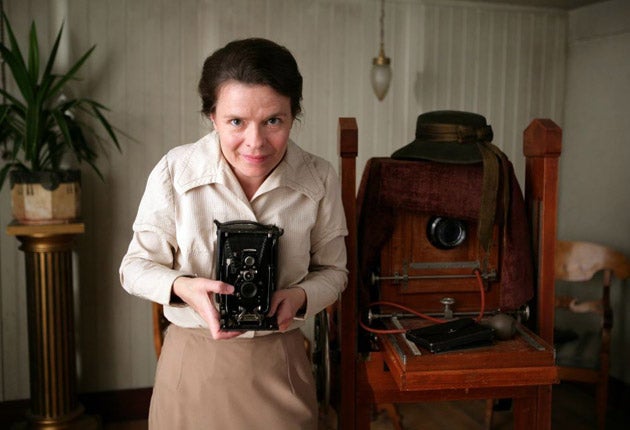
Maria Heiskanen stakes a claim for being one of the most unlikely photographers to appear on screen. In Everlasting Moments she plays Maria, a young working-class mother who, with a raffle ticket bought by her fiancé, wins a camera in Malmo in 1907, just before the couple embark on a brutal, unhappy marriage. It turns out that the camera is his greatest gift to her. A few years down the line, at her lowest ebb, Maria decides to sell the camera to feed her family, but the Danish owner of the photography shop, Sebastian Pedersen (Jesper Christensen), convinces her to keep the contraption and offers to give her photography lessons.
Directed by the great chronicler of Swedish life, 78-year-old Jan Troell, the tale is based upon a biography written by his wife, Agneta. For Maria, the camera becomes a form of escape, something she uses to capture the wonders of the world around her, and the tool through which her relationship with Pedersen develops. The septuagenarian director also uses the contrast between the stillness of the photography, and its ability to create the "everlasting moments" of the title, with the movement of film images that suggest the passing of time.
Given that celluloid film is comprised of still images lined up one against the other and that the perception of movement comes from running these still images through a projector at 24 frames per second, it's probably no surprise that still photography and photographers have a special place in cinema. There have been a number of great movies about photographers, who are usually depicted as being either unemotional voyeurs looking to use pictures as a source of exploitation, such as Paparazzo in La Dolce Vita, or as humanists using their cameras as a form of emotional expression, just like Maria does in Everlasting Moments.
The most famous photograph on film appears in Michelangelo Antonioni's Blow-Up. David Hemmings mimicked the comportment of David Bailey to play Thomas, a fashion photographer who, upon having a bad day at the office, wanders into a nearby park and takes photos of two lovers frolicking. Annoyed at being photographed, the woman, played by Vanessa Redgrave, follows Thomas back to his studio and demands that the photos be given to her. Intrigued, Thomas decides to take a closer look at what he has shot and in developing the film and then blowing up the images, he sees what looks like a body and a gun in the bushes. Has Thomas uncovered a murder?
The photograph in Blow-Up reveals an important difference between still photographs and the moving image. Antonioni is at pains to highlight how the still photograph encourages viewers to take a look inside the frame and discover a greater truth. He contrasts this with the moving image where the audience is constantly pushed to look beyond the frame and wonder what's going to happen next.
It's a strange irony that one of the most vacuous photographers ever depicted on screen has had the biggest cultural impact. Paparazzo in Federico Fellini's La Dolce Vita appears as a mercenary figure, ever ready to grab a picture to sell to the newspaper, unencumbered by the slightest emotional investment in the subject. This type of photographer struck such a chord with the audience that, from that moment on, photographers who make their living taking shots of celebrities to sell to media outlets became known as paparazzi.
Louis Malle used the perception of celebrity photographs as vacuous to great effect in his 1978 picture Pretty Baby. Set in 1917 New Orleans, Brooke Shields plays Violet, a 12-year-old model raised in a brothel by her mother (Susan Sarandon). A silent, eccentric photographer named Bellocq, played by Keith Carradine, befriends her and becomes her protector. Malle plays on the fact that the audience will see his initial lack of passion when taking pictures of prostitutes as a sign of coldness, so it's more of a surprise when Bellocq shows real emotions towards the child.
The type of subject that the photographer is interested or employed in shooting is crucial to how the audience feels about the character. In Mike Leigh's Secret and Lies, Maurice is a wedding photographer, and as such his job reveals just how highly he regards marriage and why he doesn't leave his selfish wife, Monica, despite the fact that she makes his life unbearable.
As Everlasting Moments effortlessly, and successfully, exploits, the real power of still photography in film is its ability to create a sense of nostalgia. Photographs, like no other artistic medium, have an inherent ability to make audiences think fondly of the past. In recent times, American independent film-makers have most often reverted to using photographs in movies as a device to sound echoes of the past. Spike Lee did it first in She's Gotta Have It and again in 4 Little Girls, his documentary about the 1963 Alabama church bombing. The photographs, especially in the latter film, tug at the heartstrings by showing moments of past happiness.

Watch Apple TV+ free for 7 day
New subscribers only. £9.99/mo. after free trial. Plan auto-renews until cancelled.
ADVERTISEMENT. If you sign up to this service we will earn commission. This revenue helps to fund journalism across The Independent.
Watch Apple TV+ free for 7 day
New subscribers only. £9.99/mo. after free trial. Plan auto-renews until cancelled.
ADVERTISEMENT. If you sign up to this service we will earn commission. This revenue helps to fund journalism across The Independent.
At Cannes last week, Lee Daniels was revealed as another director who knows how to use photographs to great effect. In his forthcoming film, Precious (better known as Mariah Carey's latest vehicle), a scene of a mother (Mo'Nique) beating up her daughter (Gabourey Sidibe), who has her newborn baby in her arms, is contrasted with photographs of happier times. The trick and power of these shots lies in the fact that it's not clear whether these photographs are meant to be real documents or merely wistful imaginings of a better life.
Alex Holdridge, the director of In Search of a Midnight Kiss, uses still photographs to highlight echoes of the past and to bring a sense of history to the Los Angeles locations. Harvey Keitel does the same in Wayne Wang's diptych Smoke and Blue in the Face by taking a picture of his corner shop from the same spot, at the same time of day every day for a number of years. Finally, Christopher Nolan uses the connection between memory and photographs with stunning effect in his memory-loss thriller, Memento.
There are also a plethora of films inspired by photographs. Most famously, Jean-Luc Godard and Jean-Pierre Gorin made Letter to Jane, a 52-minute documentary in 1972 that mockingly deconstructed a photo of Jane Fonda in Hanoi. On the fiction side of things, Clint Eastwood's Flags of Our Fathers and Letters from Iwo Jima were inspired by Jim Rosenthal's lauded photographs of the raising of the American flag at Iwo Jima.
Some film-makers, especially former photographers, have made whole films using only still images. The most famous is Chris Marker's La Jetée (1962) about a few surviving humans researching time travel in the aftermath of a Third World War. Here, Marker is using the fractured moments of photographs to capture a sense of time jumping. The sense of otherworldliness that comes from seeing still photographs when we expect moving images is akin to the unnaturalness of walking on a static escalator, and this unnerving feeling is exploited by Godfrey Reggio in Koyaanisqatsi, a word meaning "life in turmoil". The form and structure of the film compliments the subject in both these films.
The same could not be said of Jonas Curon's recent Ano Una, which features a love story between an American exchange student and a young Mexican. Here, the still photographs, strung together like a slide show, seem like an elaborate gimmick rather than a tool that makes best use of the unique emotions created by photographs when they appear on the big screen.
'Everlasting Moments' is out now
Join our commenting forum
Join thought-provoking conversations, follow other Independent readers and see their replies
Comments
Bookmark popover
Removed from bookmarks