Gaspar Noé - The shock of the Noé as an enfant terrible returns
The director who put a graphic ten-minute rape scene in his last movie is back with more explicit and disturbing scenes in his latest offering. James Mottram hears why
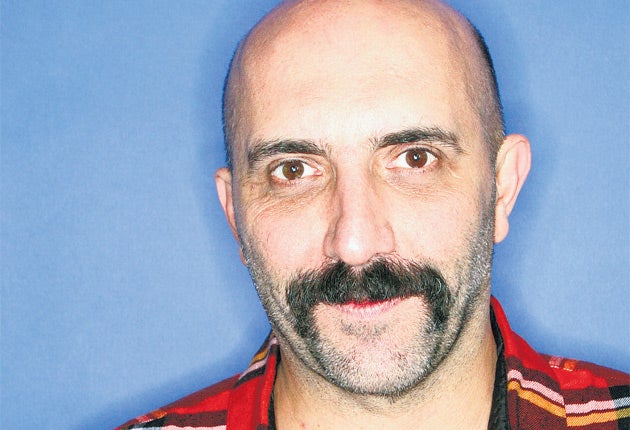
When Gaspar Noé returned to Cannes last year with his third film, Enter the Void (released in the UK later this month), he could be forgiven for expecting the worst. His previous movie, 2002's Irreversible, with its reverse narrative that featured a ten-minute graphic rape as its centrepiece, was that year's cause célèbre. The blurb on the French-edition DVD boasts that at the premiere, of the 2,400 attendees, 200 walked out. "People were booing, whistling and screaming," remembers Noé, in a soft voice that's anything but confrontational. Yet, despite a warning that the film's frequent use of strobe lighting might induce epilepsy, Enter the Void was different. "I expected more reactions," he shrugs. "But it was very silent."
You can almost sense the disappointment in his voice – not helped by the fact that Lars von Trier rather stole his thunder by premiering the toe-curling Antichrist just days earlier. After all, shock is the bald-headed Noé's stock in trade. The infamous title card of his 1998 debut, I Stand Alone, reads: "You Have 30 Seconds to Leave the Theatre", before counting down to zero to deliver the brutal resolution to its nihilistic tale of a jobless butcher "struggling to survive in the bowels of the country".
Noé likens a trip to the cinema to the tense pleasures of a roller-coaster ride. "If you go to the cinema, and someone is trying to shock you, you should be happy," he says.
Irreversible certainly manages that – from the casting of French glamour couple Vincent Cassel and Monica Bellucci as the film's main protagonists to the nauseous opening sequence in The Rectum, a gay club so seedy it makes Dante's inferno look attractive. In it, as the camera swirls and the soundtrack pulsates, Cassel's Marcus brutally caves in the head of a man he believes raped his wife with a fire extinguisher. As shocking as it is, Noé believes this has little bearing on the film's standing. "A good movie is a good movie," he argues. "A bad movie is a bad movie. Movies can be shocking and bad. Or movies can be shocking and great."
If he sounds like a child who gleefully loves to provoke – it's not for nothing that he's frequently been called an enfant terrible – when it comes to being a genuine provocateur, he may stand alone. As veteran director Paul Schrader, whose bile-driven screenplay for Martin Scorsese's Taxi Driver feels like a direct influence on Noé's feature debut, recalled: "I had an interesting lunch recently with a French director named Gaspar Noé who wanted to do a film with me, something with violence and pornography and all that. And I said to him, 'I don't think anyone's shockable anymore'." Noé has evidently set out to prove him wrong.
Yet in the case of Enter the Void, a film he describes as a "psychedelic melodrama", Noé is evidently looking to do more than simply set pulses racing. Set in Tokyo, it tells the story of two Western newcomers to the city, Oscar (Nathaniel Brown), a small-time drug dealer, and his sister Linda (Paz de la Huerta), a nightclub stripper. When Oscar is shot dead in a club toilet during a police raid, his spirit emerges to float up into the neon-lit Tokyo night. As we see in flashback, Oscar once promised to his sister that he would never leave her – and even in death, as his spectre hangs over her, he makes good on that pledge.
This being Noé, it's anything but a pretty ride. Entirely shot from the point of view of Oscar, the camera floats above city streets, through walls and even into a fallopian tube, overseeing everything from a graphic abortion (the scene Noé admits he thought the Cannes audience would boo) to an explicit jaunt around a Tokyo love-hotel. If the result is not unlike the filthy-chic of his previous films, Noé believes it different to its predecessors, in particular his last film. "Irreversible was kind of not serious," he says. "Like the name of the club – The Rectum – there are many things that are childish in that movie. But this one is more serious."
Whether audiences will buy into the earnest nature of what comes on like a prolonged acid-flashback is debatable, but there can be no argument that this is Noé's most technically advanced film to date. He's been thinking about making a film in this manner since he was 23 and watched Robert Montgomery's 1947 Raymond Chandler adaptation Lady in the Lake, also shot entirely from the point of view of one character, Montgomery's gumshoe Phillip Marlowe. Noé was hallucinating on magic mushrooms at the time. "I was transported into the TV and into Marlowe's head," he recalls, "even though the film was in black and white and subtitled."
It was not the first time Noé had felt this way inclined, following an early experience of Stanley Kubrick's masterwork 2001, which concludes with its famously trippy "stargate" sound and light show. "I remember the first drug trip I had in my whole life was when I was six," he says. "My parents brought me to see 2001: A Space Odyssey. I felt like I was on drugs. I was overwhelmed. I was mind-possessed – when I was six years old. And again and again, each time I see the movie. It made me want to take control of those kinds of mind-possessions by recreating the same situation with other people. This time I'm the puppet-master."

Watch Apple TV+ free for 7 day
New subscribers only. £8.99/mo. after free trial. Plan auto-renews until cancelled.
ADVERTISEMENT. If you sign up to this service we will earn commission. This revenue helps to fund journalism across The Independent.
Watch Apple TV+ free for 7 day
New subscribers only. £8.99/mo. after free trial. Plan auto-renews until cancelled.
ADVERTISEMENT. If you sign up to this service we will earn commission. This revenue helps to fund journalism across The Independent.
Invariably, like 2001, Enter the Void is destined for cult status amongst those who have ever experimented with LSD. "Some say they would never do drugs after seeing my movie. But some say, 'I love it. I felt like doing acid again!'" he reports, estimating LSD is due for a "comeback", at least in his neighbourhood. "From time to time, I hear people in Paris saying 'I'm going to drop LSD.'" Does he think it's dangerous? "I'm not a priest," he shrugs, again. "LSD can be dangerous. It can be addictive. But you can be addicted to masturbation, too. I had two addictions in my life: masturbation and coffee. I quit the first one when I was 20."
Born in Buenos Aires in 1963, where his father studied art and law before working as a journalist, Noé's childhood was one of relocation. When he was two, his family moved to New York, where his father was awarded a Guggenheim fellowship. A further six years back in Argentina followed before the family moved again to Paris. After a desire to become a comic-book artist was quelled, Noé enrolled in the Ecole nationale supérieure Louis-Lumière when he was 17 to study cinema and photography.
While he worked briefly as an assistant director in the 1980s, Noé began writing scripts and shooting shorts, including what would eventually become 1991's 40-minute effort, Carne. The film won Best Short in Cannes. Only a detour to produce and act as cinematographer on 1996's La Bouche de Jean Pierre, a 50-minute film by his then-girlfriend, now-wife Lucile Hadzihalilovic, delayed him making his feature debut with I Stand Alone.
Unsurprisingly, given all the controversy his work causes, Noé has struggled to find funding for his films. In particular, Enter the Void – with its shoot in Japan, with an unknown and largely non-professional cast, proved difficult. "This was an expensive movie and [financiers] Wild Bunch took a big risk with the money they put into it. They gave me a lot of freedom – over the length and the X-rated content. There are many aspects of the movie that made this a dangerous production."
While many reviews suggested the film's 162-minute running time needed trimming, Noé, typically defiant, finally snipped only eight minutes from the so-called definitive cut that was shown at Sundance this year. He certainly has no intention to prune the film's more graphic moments for censorship reasons, either. "If you say 'no', they don't cut it. If they cut it, it's because you agree," he says, explaining his blanket policy with censors. "I don't think it's going to be good for the movie to be cut. I don't think anybody is going to try to cut anything. There's nothing offensive. Maybe Irreversible was offensive. But I don't think there's anything offensive in this movie."
That rather depends on your point of view. Towards the end of the film, viewers are confronted with a (CGI) penis thrusting towards the camera and ejaculating sperm. In truth, it's a gentle comedown after one hell of a trip. But it's nevertheless a moment destined to shock, something Noé seems to believe is crucial to his particular brand of cinema. He's already thinking in the same terms for his next sex-centric project.
"I haven't seen many really good erotic movies," he says. Expect shockwaves in a cinema near you.
'Enter the Void' opens on 24 September
Join our commenting forum
Join thought-provoking conversations, follow other Independent readers and see their replies
Comments