Marjane Satrapi: 'If I'm bad, it is God's fault
As a teenager in Iran, Marjane Satrapi was so rebellious her parents had to pack her off to Europe. Now her comic-strip account of those wilderness years has been made into a film. So has age mellowed her? Of course not, dummy
Read the two volumes of Marjane Satrapi's autobiographical comic strip Persepolis, then watch her film adaptation of it. You'll feel you know the Iranian artist's eventful life inside out. But, Satrapi says, you'd be wrong: "If seven years of my life could be said in 400 pages of comic, it would mean just one thing – that I'd had a very miserable life."
In a time when misery memoirs rule the bestseller lists, Satrapi could have beat all comers. A picaresque narrative of the author's education and exile, Persepolis begins with the young 'Marji' as a naive pre-teen in the Shah's Iran; follows her through the 1979 revolution and the moment she and her female peers found themselves obliged to wear the veil; and through her teenage rebellion and subsequent years of isolation, confusion and homelessness as a young exile in Europe.
The story could have been harrowing. Instead, Satrapi turned it into the boisterously witty black-and-white comic that was first published, to huge acclaim, in France in 2000. Now Satrapi, 38, and fellow comics artist Vincent Paronnaud have co-directed a screen adaptation of Persepolis, a hugely entertaining, politically informative animated feature – filmed in black and white.
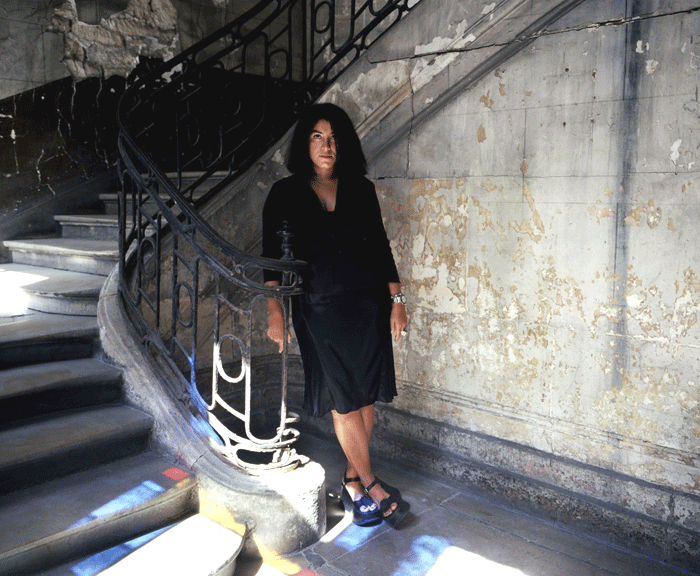
On page and screen, Persepolis is bracingly funny at its creator's expense: Marji is characterised as gauche, argumentative, sometimes foolish, even callous. You can see how the gamine comic grew into the adult Marjane, who comes across in person as the proverbial tough cookie. Her English comes fast, fluent and sometimes loud. Dressed in black with a silver tiara-like band in her hair, she resembles a stylish biker godmother. I meet her in a London hotel lounge.
Growing up in Tehran in the late 1970s and early 1980s, the Marji of Persepolis learns life's harsh realities through her relatives' political travails: among them, her Marxist uncle Anoush, who suffered first under the Shah, then under the Ayatollahs. Her family was middle class and left-wing, politically outspoken, but not unusually so, Satrapi says.
"My grandfather went to political prison, my uncle too. But there were a lot of families with this background. Of course, it depends on which social class you come from. If I came from a small town by the Afghanistan frontier, I would not be here [or] able to read and write. Probably at this age, I would have been dead."
The first Persepolis book depicts the post-revolution Islamic order which drastically changed daily life, in which people assumed devout roles by day and risked their necks to attend illicit dancing-and-drinking parties by night. "You have to create a character who is not yourself, who lives a social life outside your house. Then there's you yourself inside your house, and you're all the time dealing with feelings, which leads to schizophrenia – there's no other word for that."
Concerned their daughter's rebellious tendencies would land her in trouble, when she was 14, Satrapi's parents sent her to study in Austria: "Not the country with the most hospitality, let's say." Persepolis depicts Satrapi's first stint of European exile as a nightmarish period in which she grew up fast, discovered sex, drugs, deprivation and a spell of homelessness leading to severe bronchitis.
With the Iran-Iraq war raging, Satrapi decided to return home, worried about her parents; she would later return to Europe, aged 24, this time for good. Back from Austria, however, Satrapi felt like an outsider in her own country. Depressed, she tried psychoanalysis, but is scathing about the experience. "In the West, people don't have any real problems. It's all based on bad conscience, a very Christian notion. I don't have any bad conscience. If there's a God that created us, if I am bad, it's his fault."

Watch Apple TV+ free for 7 day
New subscribers only. £9.99/mo. after free trial. Plan auto-renews until cancelled.
ADVERTISEMENT. If you sign up to this service we will earn commission. This revenue helps to fund journalism across The Independent.
Watch Apple TV+ free for 7 day
New subscribers only. £9.99/mo. after free trial. Plan auto-renews until cancelled.
ADVERTISEMENT. If you sign up to this service we will earn commission. This revenue helps to fund journalism across The Independent.
Some people, I suggest, might think that writing Persepolis was itself therapy. "I'd say to these people that they're dumb," she snorts. In her books, she explains: "I use myself to talk about other things. I'm not a historian, not a sociologist. I'm a person born in a place where I've seen some stuff. That's why I put myself in as a character." The point of Persepolis, says Satrapi, is to set the record straight about Iran. "I heard so many stupid things about my country. [Journalists] dehumanise the people who live there because they reduce them to some abstract notion."
As for using the strip cartoon form, Satrapi explains: "I think with pictures, I'm a very lousy writer. If I write without pictures, I become this pathetic chick sitting somewhere trying to be interesting."
Satrapi insists she was never enthusiastic about turning Persepolis into a film, but was urged to do so by producer friend Marc-Antoine Robert. "I said, 'Yeah OK, we'll make an animation movie in black and white, and I want to do it with my best friend. I want Catherine Deneuve [the voice of Marjane's mother]. I want it handmade, I want to do it in Paris.' He said OK, and I was like, 'Shit, now we have to make it.'"
The film premiered in Cannes last year, winning the festival's Jury Prize. Since then, it has won two French Cesar awards and was nominated in this year's Academy Awards as Best Animated Feature. The Iranian government has been less impressed, attacking the film as a French provocation, although it has now had limited screenings in Tehran. Satrapi does things in film that she can't on the page: notably, a brief history of the Shah's regime, done as a pastiche of traditional puppet theatre; and the witty use of the 1980s hit "Eye of the Tiger" to show her rallying after a suicide attempt.
Satrapi married a young artist during her first return to Tehran, and Persepolis recounts their life together in detail. She now has a second husband, who is Swedish. Her last visit to Iran was in 2000 but she now lives in Paris. "I love the French for their sarcasm, their irony. I love them for their bad moods."
Satrapi sees her work as being anti-fundamentalist. Even so, she balks at having her opinions too neatly defined: she's well aware of how they have changed with time, from the days when, as a child, she walked around dreaming she was Che Guevara. "You realise all your convictions fly, one after the other. For a long time I considered that all the people in the Shah's regime were just bad people. Then, a few years ago, I was invited by all these royalists to make a speech. There were all these old men sitting there – and I realised that some really believed in what they were doing. They showed me a point of view that was really unknown to me."
Now she is famous, people frequently ask Satrapi to stand up and represent particular political standpoints. When they do, she says: "I tell them, 'Fuck you.'" Providing answers, she says, isn't her profession. "You want a quick answer? Ask a politician. I'm an artist – let me ask you the questions."
Comic capers: From the page to the silver screen
Ghost World (Terry Zwigoff, 2001)
Zwigoff adapts Daniel Clowes's melancholy smalltown chronicle on the woes of teenage misfit Enid Coleslaw (spot the anagram)
Crumb (Terry Zwigoff, 1994)
Robert Crumb's Fritz the Cat was an underground hit in 1972. Two decades on, the artist – and his dysfunctional family – are made the subject of this documentary
American Splendor (Shari Springer Berman, Robert Pulcini, 2003)
Crumb associate and comics memoirist Harvey Pekar comes to life in a gritty depiction of a world-class outsider and misanthrope
Sin City (Frank Miller, Robert Rodriguez, 2005)
Frank Miller co-directs this stylish, digitally innovative adaptation of his brutal essay in hipster noir
Tank Girl (Rachel Talalay, 1995)
How not to treat a cult: a catastrophic mess-up of Hewlett and Martin's postapocalyptic lark. Rapper Ice-T shares the blame as a human kangaroo
'Persepolis' is released on Thursday
Join our commenting forum
Join thought-provoking conversations, follow other Independent readers and see their replies
Comments
Bookmark popover
Removed from bookmarks