Real life stories from the film front line
Even in these tough times, the annual American Film Market remains the place to go for finance for your film, and it helps to have a newsworthy figure as your subject, writes Geoffrey Macnab
It is a slow Saturday afternoon in the Loews beachfront hotel in Santa Monica, California, midway through the American Film Market (AFM). These are tough times in the independent film world.
Cinema-going may increase during periods of economic stress, but that is of little consolation to film-makers, who have seen the DVD and foreign sales market contract in alarming fashion in recent years. Foot traffic in the Loews is slow.
Even the hangers-on who usually turn up at weekends at the AFM to pitch their movie ideas or simply to mill around the bar are in shorter supply than normal.
Kevin Costner has been spotted in the lobby. He's here to tub-thump on behalf of a new independent movie that his producers want to interest the foreign buyers in, but his presence doesn't provoke much commotion or excitement.
In one hotel suite, producer George Lascu is showing a small audience of distributors footage from the Renny Harlin film he is midway through shooting in Georgia. The film stars Rupert Friend, Val Kilmer and Andy Garcia as Georgian President Mikheil Saakashvili. It's about a war correspondent (Friend) caught in South Ossetia as the tensions between Georgia and Russia spill over into war. The promo reel was edited days before and flown in from Georgia by Lascu. It's full of tanks and explosions – the kind of big set pieces designed to convince the distributors that this really is an epic.
In the hotel restaurant downstairs, Russian producer Dmitry Rudovsky is keen to talk about the epic $30m movie on the Battle of Stalingrad he is planning with his business partner, Fyodor Bondarchuk. Generally, when producers announce massive new projects during the AFM, their declarations are taken with a pinch of salt.
However, Bondarchuk has already completed one movie, sci-drama The Inhabited Island, with a budget of close to $40m. He is the son of Sergei Bondarchuk, who directed an Oscar-winning version of War and Peace. The signs are that this is a film that will actually happen.
Actor/writer/director/producer/financier Damian Chapa of Amadeus Pictures is sitting in his hotel suite/office, waiting for the buyers to appear. Chapa's new film Polanski Unauthorized is advertised prominently inside the lobby of the hotel. This is his biopic of the Polish director (still under arrest in Switzerland and threatened with deportation to the US.) Chapa plays Polanski – even though he doesn't look anything like him. He also directed the film and financed it. No, he says, he didn't rush the movie into production to take advantage of the controversy surrounding Polanski's arrest in late September. In fact, he made it last year.
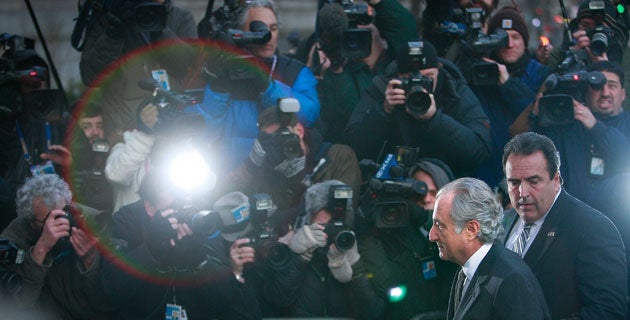
Polanski Unauthorized is typical of the kind of film that is always found at the AFM. Alongside the erotica, cheap family animation and horror fare, there are always topical, low-budget movies on notorious figures. (It's no surprise that there is a poster for a Bernie Madoff project in the Amadeus office.)

Watch Apple TV+ free for 7 day
New subscribers only. £9.99/mo. after free trial. Plan auto-renews until cancelled.
ADVERTISEMENT. If you sign up to this service we will earn commission. This revenue helps to fund journalism across The Independent.
Watch Apple TV+ free for 7 day
New subscribers only. £9.99/mo. after free trial. Plan auto-renews until cancelled.
ADVERTISEMENT. If you sign up to this service we will earn commission. This revenue helps to fund journalism across The Independent.
However, the AFM is also where many of the films screening "at cinemas near you" are financed and distributed. Buyers from all over the world come to Santa Monica to acquire "product". By doing so, they enable films to be made. Even big US movies are dependent on pre-selling internationally.
"More than 60 per cent of our budgets are covered by foreign pre-sales," Patrick Wachsberger of Summit Entertainment, the company behind the successful Twilight franchise, told the Los Angeles Times last week.
The problem – at least as far as foreign film companies who don't have Robert Pattinson or an equivalent in their casts – is that they can't generate enough in pre-sales to get their movies made.
Foreign buyers are still ready to stump up big advances for US movies. However, US buyers are showing little interest in pre-buying foreign movies. Budgets for foreign movies have therefore shrunk alarmingly.
In theory, it's a grim market, but optimism and opportunism have always run side by side in the indie film world.
Even when the business seems set to implode, there are always enough examples of movies that work at the box office against the odds to convince the rest of the industry that nirvana isn't so far away after all. Hits arrive in the most unlikely guises. The recent success of Oren Peli's tiny-budget horror pic Paranormal Activity suggests that the Blair Witch dream is alive and well. It is still possible for film-makers to come from nowhere and make movies the entire world wants to see. As soon as one is successful, dozens of mediocre clones appear in its wake.
One result of the economic crisis is that the number of films being made has declined. The talk in Santa Monica this week has been of "a market correction". No longer is the industry awash in movies that have little realistic chance of distribution. That, we are told, is all for the good.
Trawling the corridors of the Loews this week, you could still see posters for plenty of low-grade exploitation pics.
Italian softcore meister Tinto Brass was back on the Caligula trail with Who Killed Caligula? This came billed as "The First Erotic Comedy in Stereoscopic 3D". Serial-killer movies were as plentiful as ever. So, bizarrely, were Scandinavian family films about gnomes. Even so, it was evident that there were fewer films available for the international distributors to fight over. As ever, there were a handful of titles that they all seemed to want. Steven Soderbergh's film about flamboyant Hollywood showman Liberace, which will star Michael Douglas and Matt Damon, was one title which tantalised the buyers. Many were curious about The Talking Cure, the film David Cronenberg is planning about Freud and Jung. Those with more earnest tastes were also drawn to Robert Redford's new project The Conspirator, about the assassination of Abraham Lincoln.
British comedies and musicals also proved to have an unlikely traction in the market. One of the more surreal sights in Santa Monica this week was of foreign distributors trying to make sense of the promo for Four Lions, the new comedy about terrorism from British satirist Chris Morris. The film's French sales agents, Wild Bunch, put subtitles on the promo because they felt the accents would be impenetrable to the distributors otherwise. The film is about "a bunch of British jihadis" out to wreak havoc in a Britain they see as a "bullshit, consumerist, godless, Paki-bashing, Gordon Ramsay, Taste the Difference Speciality Cheddar torture-endorsing, massacre-sponsoring... Sky One Uncovered, 'who gives a fuck about dead Afghanis' Disneyland!" Judging by the screenplay, it will be both provocative and hilarious.
The distributors seemed to like it, even if they were discomfited by just how politically incorrect it seemed.
Another British movie which proved a mini-sensation in Santa Monica was StreetDance 3D. This is a film about a London dance crew training for the UK street dance championships who are forced to work with ballet dancers from the Royal Dance School in return for rehearsal space. The international buyers seemed to love it. In tough economic times, a brash, upbeat musical has an obvious appeal.
Film financing is a Darwinian business. Anyone reading the trade press during the AFM will have noticed that many rival new projects had the same actors in them. The Brits are all desperate to cast Carey Mulligan. Twilight star Robert Pattinson now seems to excite the international buyers in the way that Leonardo DiCaprio did in his Titanic prime. Helen Mirren still has an extraordinary pull. The only problem is that these actors can't possibly appear in all the films to which they are ostensibly attached. As schedules clash, it's a case of survival of the fastest. Whoever can nail down their financing the quickest is most likely to be able to make their movie. Those who take too long stand the risk of losing their stars and seeing their lovingly assembled projects unravel in front of their eyes.
Damian Chapa confided that the AFM was as slow as he remembered it, other than in the year immediately following 9/11. There were many other nervous film companies in Santa Monica this week, wondering just who was going to buy their movies or give them the lines of credit to make new pictures. At the same time, though, the mood was surprisingly optimistic. The market was picking up after last year – by consensus one of the worst in memory. The woes are familiar enough. Companies have gone out of business. The challenge of adjusting to the brave new world of Video On Demand and internet distribution remains daunting. Even so, the examples of the Twilight franchise, Paranormal Activity and even StreetDance 3D seem to have encouraged everyone. The film business has almost always been in a state of semi-crisis. In the 1970s, the industry doomsayers confidently predicted that the advent of video would bring it to its knees. It survived then... and all the signs are that it will survive now, too – at least, until the next crisis come along.
Join our commenting forum
Join thought-provoking conversations, follow other Independent readers and see their replies
Comments
Bookmark popover
Removed from bookmarks