Richard Burton: In from the cold
Richard Burton wasn't just another over-hyped hellraiser with a tawdry love life and a legacy of lousy movies. Look again at the star who brought beauty to the screen, says Geoffrey Macnab
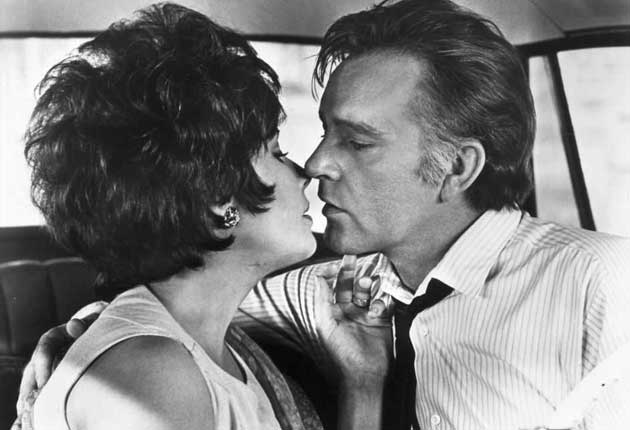
It is strange to think that it is now a quarter of a century since Richard Burton died in August 1984. He was only 58 but contemporaries attest that he already seemed an old man by then, arthiritic and racked by ill-health.
What does Burton mean to younger cinemagoers? Do they even realise that the Welsh actor was once – as Melvyn Bragg's biography of him puts it – "thought to be one of the top half-dozen money earners in the world?"
Today, when Brad Pitt and Angelina Jolie are the movie couple that the gossip columnists most fawn over, Burton's relationship with Elizabeth Taylor (whom he married twice) seems like an episode from a distant, half-forgotten era. The very idea that a pockmarked, saturnine Welshman from the Rhondda Valley, "pustular and acne'd and angry and madly in love with the earth and all of its riches" (as Burton once described himself) could be a movie star seems fanciful in the extreme.
Twenty-five years on, what is clear is that Burton made many lousy movies. See him in a toga that didn't suit him in Cinemascope epic The Robe (1953) or with his hair bleached blonde as a very trollish looking Alexander the Great (1956), or mooching around Heathrow Airport alongside various other celebrities in The V.I.Ps (1963), and you might wonder just why his film career is being celebrated at all.
John Gielgud's famous remark about Burton's "rather mad way of throwing away his theatre career" takes on a special poignance when you see him in his lesser screen works. His voice lent dignity to even the corniest dialogue. "He spoke with a tympanic resonance so rich and overpowering that it could give an air of verse to a recipe for stewed hare," Time magazine once noted of him. The problem was that many of the scripts for his films did indeed seem like recipes for stewed hare.
There is something ultimately tiresome, too, about the myth of the hard-drinking, self-destructive Celtic artist that has for so long been spun around Burton. Bragg's entertaining and hagiographical biography treats him as if he is a cross between Dylan Thomas and an ancient warrior king. Even Burton's boozing – which was admittedly on the heroic scale – is presented as something that the Fates compelled him to indulge in. It was simply part of his Celtic nature, "the excess the Celts like to claim as uniquely theirs, releasing poetry and song, fortifying for battle, reminding you of the brevity of life, numbing you against its grief".
Then again, without the alcohol, would Burton have been able to bring so much pathos and weatherbeaten intensity to his roles in films like The Night Of The Iguana (1964), The Spy Who Came in from the Cold (1965) and Who's Afraid Of Virginia Woolf? (1966) Partially because of that magnificent voice and partially because of his gravitas, Burton excelled at playing kings and generals on screen. (All his experience starring in Shakespeare productions at the Old Vic obviously helped too.)
Where he was at his very best as a screen actor, was as anti-heroes: defrocked priests, spies or unhappy husbands. He brought an unlikely majesty and lyricism to characters who would have been simply seedy and pathetic if played by other actors.
The producer Simon Perry who worked with Burton on his last film, Michael Radford's adaptation of George Orwell's Nineteen Eighty-Four (1984), offers a humorous and moving account of the actor, just a few months before his death. Burton plays the high-ranking party member and torturer O'Brien.

Watch Apple TV+ free for 7 day
New subscribers only. £9.99/mo. after free trial. Plan auto-renews until cancelled.
ADVERTISEMENT. If you sign up to this service we will earn commission. This revenue helps to fund journalism across The Independent.
Watch Apple TV+ free for 7 day
New subscribers only. £9.99/mo. after free trial. Plan auto-renews until cancelled.
ADVERTISEMENT. If you sign up to this service we will earn commission. This revenue helps to fund journalism across The Independent.
"Suddenly, in the little caravan at Twickenham Studios, we had someone who was a major star, someone Mike Radford and myself had grown up watching," Perry recalls of Burton's arrival from Switzerland on the set.
Right at the start of shooting, Radford told Burton: "I've hired everything about you, Richard, except your voice. I don't want the famous Burton voice."
A more insecure figure would have reacted with fury at being bossed around in this way. Burton, however, took the instructions in good heart. "I see," he replied. "You don't want me going for a Burton!"
Very quickly, Burton charmed his colleagues. He'd tell scurrilous anecdotes to the technicians. "He found sitting down rather painful so he would stand in the middle of this trailer in the car park at Twickenham Studios. He'd spend all day when he wasn't actually on set regaling anyone who would listen with stories. Particularly, he told stories about Elizabeth Taylor. They were very affectionate. He had a particular attitude to her. He said she could spot a diamond at a hundred paces." Burton used to joke that although the world's media thought Liz Taylor was deeply enigmatic, he found her no more mysterious than "a glass of lemonade".
Perry remembers that the actor was in obvious pain. Burton struggled to remember his lines and needed cue cards. In one key scene, in which O'Brien is torturing Winston Smith (played by John Hurt), O'Brien holds his hand in front of Smith's face and asks: "How many fingers do you see, Winston?" Burton was so debilitated that he needed an assistant director out of shot, holding his arm up and helping him keep his hand steady.
"It was sad to see this titan of the boards and the screen physically reduced," Perry recalls. "But the eyes were still there. The brain was fine, even if the memory wasn't great. As an actor, he had lost none of the old skills."
Burton's performance as O'Brien was indeed remarkable. He looks grey and drawn. He's a torturer but also strangely gentle as he tells Winston Smith, "We will lift you clean out of history.... You will be annihilated in the past as well as the future."
In 2009, there is no sense that Burton has been annihilated from popular memory. Nonetheless, the days when the Welshman was one of the world's biggest stars seem a very long way in the past. Many still contend that his greatest work was done on stage. "That whole Hollywood royalty period of the 1960s and (early) 1970s – I don't know that people remember that kind of cinema very much," reflects Simon Perry.
"It somehow got overtaken by that movie brat cinema of the 1970s that we all love. That's when American cinema really became alive again and it slightly effaced the period before, that Richard was part of."
Some of his greatest work for the screen – for example, his monumental performance as Wagner in Tony Palmer's biopic of the composer – remains little seen. Kids can still see him in TV reruns of action movies like Where Eagles Dare (1968) and The Wild Geese (1978). Anyone interested in cinema will be aware of him as a good-looking, charismatic star who led a glamorous, alcohol-fuelled life and was married to Elizabeth Taylor. They're unlikely, though, to have any detailed knowledge of his work. "He was a very, very beautiful man," Perry reflects. "Even damaged, ageing and frail, there was a real beauty about him." Perhaps the new season of his films may jog memories about just what a consummate screen actor he once was.
The Richard Burton season at BFI Southbank runs throughout August
Join our commenting forum
Join thought-provoking conversations, follow other Independent readers and see their replies
Comments
Bookmark popover
Removed from bookmarks