Saul Dibb - from gun-crime to costume drama
How did the director of 'Bullet Boy' make a Keira Knightley costume drama? Kaleem Aftab explains

Get our free weekly email for all the latest cinematic news from our film critic Clarisse Loughrey
Get our The Life Cinematic email for free
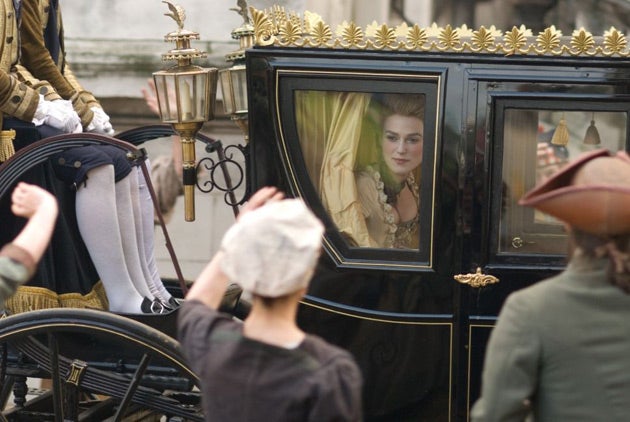
On paper, the costume drama The Duchess couldn't be any more different from British director Saul Dibb's previous cinematic outing, the urban gun-crime drama Bullet Boy. Replacing hoodies, prisons and East End grime vernacular are corsets, country estates and posh English. In the space of three years, Dibb has seemingly gone from being the young Turk of the British film industry, concerned about the poor underclass, to becoming part of the old school network, making movies primarily appealing to the chattering classes. As if to reinforce the point, he's got the British acting establishment on board for his adaptation of Amanda Foreman's book Georgiana: Duchess of Devonshire, with Ralph Fiennes, Charlotte Rampling and Keira Knightley.
But as it turns out, The Duchess and Bullet Boy are not so very different. They're both about young people trying to defy social conventions and expectations and create new paths for their lives. One just happens to be set in luxurious 18th-century England while the other roams the streets of Hackney.
When I put this to Dibb, he replies, "You're the only person who has said that!" He adds: "I see it that way, too. Everyone says it's so different from Bullet Boy, but I think the differences are superficial. Obviously, it's set in a different era about a different class of person, and to a large part it's shot a different way, but the fundamentals of the story are very similar."
The career jump for the 40-year-old director is a bit like going from being the manager of West Ham to the helm of Manchester United. "You do get lots more interest in a film because it's Keira Knightley starring, but you also get lots more interest because everyone's investment in the film is that much greater financially," says Dibb. "The push for it to be successful is not limited to the company that invested in the film but with those distributors who have bought territory rights for the film, especially the States. All of a sudden you're expected to make an international rather than just a British hit."
He has a methodical approach that can be seen in the way that he cast his movie. "For the three principal roles, the duchess, the Duke of Devonshire and Lady Spencer, I wanted people who could bring baggage with them and for them to be iconic in their own way. The duke and lady needed to be aristocrats of the acting world and Ralph Fiennes and Charlotte Ramping fitted the bill. Then Keira shares similarities with Georgiana, both being female superstars of their day. Finally with Lady Bess Foster and Earl Grey I chose Hayley Atwell and Dominic Cooper as I felt that they should be actors on the rise whom audiences aren't terribly familiar with yet."
Despite Knightley's dominating the movie poster, it was Fiennes's autograph that the director was most anxious to get. Dibb says: "I fought pretty hard to get him, I fought hard to meet him and once I'd met him I fought hard to make the schedule work around him because he was shooting The Reader at the same time. He brought loads to the party, lots of questions, he wouldn't accept playing the duke as just a two-dimensional evil aristocratic figure. He wanted the duke to be more complex and ambiguous."
The clinical approach to the casting is also being replicated in the drive to get Knightley an Oscar nomination for the performance. It would be entirely unmerited, considering that this is a below-par turn from the actress, but lack of merit has never stopped the Academy before, especially when faced with an English rose in a period drama. Dibb sheepishly says: "I think Keira has had favourable responses in the States [in previews] and the film will hopefully be given a big push at it's premiere during the Toronto Film Festival next month. I think Keira will definitely do a lot of stuff in the States."
Toronto holds happy memories for Dibb because it was the city where Bullet Boy launched, although the director recounts that the festival organisers were surprised when he arrived. "Bullet Boy was in the Black Film section and I think that the organisers were slightly disappointed when I turned up. Everyone, when they hear my name on the phone, they think my name is Sol rather than Saul."
These sadly mistaken souls would also not have known that his dad is the documentary film-maker Mike Dibb, best known for his documentaries Edward Said: The Last Interview and the made-for-TV The Miles Davis Story. The Duchess's director also began his career in film-making by making documentaries: Lifters is about serial shoplifters, and Easy Money focused on a couple working in the porn industry.

Watch Apple TV+ free for 7 days
New subscribers only. £8.99/mo. after free trial. Plan auto-renews until cancelled
Watch Apple TV+ free for 7 days
New subscribers only. £8.99/mo. after free trial. Plan auto-renews until cancelled
The move into feature film wasn't part of some career play. Dibb says: "I don't make a conscious attempt to try to do one thing and not another. I try to do films on their own merits and I was certainly not expecting anyone to come to me with a film set 200 years ago, but I guess what they wanted from me was a consequence of me having made docs and doing things like Bullet Boy; they wanted something that would feel more real, not in a social realist sense but in a way in which you can engage with characters on a more immediate level. With a lot of period films I tend to feel there is a difference between the characters on the film and my daily life and I wanted to bridge that gap."
The father of three also doesn't want to differentiate between documentaries and fiction films or cinema and television: in between doing Bullet Boy and The Duchess he directed the BBC adaptation of Alan Hollinghurst's novel The Line of Beauty. Again, he's at pains to say that it's the subject matter that is his primary concern, not the mode of storytelling.
Having experienced the surprise success of Bullet Boy, the director is also being careful not to commit to his next project until after The Duchess is released: "After Bullet Boy I got a lot of disenfranchised youth scripts through the door and people were thinking that I was either not able to do, or not interested in doing, other things. Because I have kids I have to think about my family and I'm not able to just decide that I'm going to make a film in America, unfortunately. I think my next move will all depend on how this goes down."
Dibb is far too much of a realist to make any brash statements or to give himself any false expectations about where his career is heading. He draws a parallel with his own career and the philosophy towards life espoused by the film's eponymous duchess. "We make happiness out of the situations we find ourselves in, even though they can be quite different from the things we set out to achieve in the first place."
'The Duchess' opens on 5 September
Subscribe to Independent Premium to bookmark this article
Want to bookmark your favourite articles and stories to read or reference later? Start your Independent Premium subscription today.
Join our commenting forum
Join thought-provoking conversations, follow other Independent readers and see their replies