The mavericks who won't sell their souls – or films
Clerks director Kevin Smith hired the cinemas himself to show his latest movie. He's not the only rebel, says James Mottram
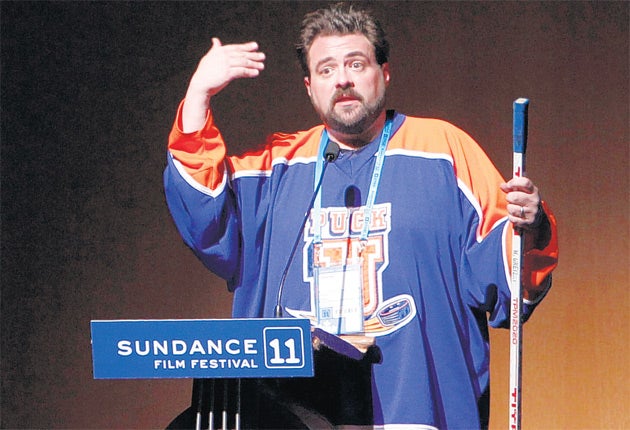
When Kevin Smith took the stage at the Sundance Film Festival in January, the director who began his career at the festival with 1994's micro-budget Clerks announced that he was going to sell the distribution rights to his latest movie, a religious horror entitled Red State. Mounting the podium, he started the bidding at $20 – and then closed the auction. With dozens of Hollywood buyers in attendance, Smith then laid into the industry with a profanity-fuelled rant. "True independence," he declared, "is schlepping [the movie] to the people yourself."
Which is exactly what he did – taking Red State on a 15-date tour around the US. Beginning with a sold-out splash at New York's Radio City Music Hall (which took $160,000 on its first night), Smith was determined to cut out the middle-men and take the film direct to the fans. No traditional press junket or print and TV advertising; just spreading the gospel via Twitter, his so-called "Smodcasts", and his own internet-launched radio station, SIR. Despite inflated ticket prices (upwards of $40 a seat), fans flocked, with Smith attending each screening for a Q&A. This, he told the incredulous buyers at Sundance, was indie 2.0.
His argument was simple: why spend four or five times the movie's modest budget (in the case of Red State, $4m) fruitlessly trying to market the film to those beyond Smith's core fanbase, making it impossible to turn a profit? "We believe the state of film marketing has become ridiculously expensive and exclusionary to the average film-maker longing simply to tell their story," Smith and his producer Jon Gordon said on the Red State website. "Honestly, it didn't make sense to do it the other way anymore," Smith has argued. "And since we're gambling with such a small amount of money, it's pretty easy to achieve."
While Smith has the loyal fanbase to make this model work, he has managed to alienate most of Hollywood and the media. "God Hates Press Screenings" read one banner he held aloft in a throng at Sundance. In the UK, where Smith has sold the rights to the company Entertainment One, he forced the cancellation of the advance media screening at the 11th hour earlier this month before getting in to a war of words on Twitter with disgruntled critics. He then decided to offer seats at a future press screening to 15 fans and their plus-ones. "Why show it to some of the loudest shit-talkers for free," he tweeted, "and NOT folks who REALLY wanna see it?"
In truth, Smith is hardly in the vanguard. Based on a model called "four-walling", whereby cinema screens are privately rented, directors have been self-distributing for years. Don Coscarelli took his Elvis-is-alive Egyptian horror Bubba Ho-Tep on a road-trip and turned a profit. Lance Hammer did the same for Ballast, noting that in such tough economic times a typical advance from a distributor for securing the rights to an independent film would be $25,000 to $50,000: "If you made a $50,000 project, that makes sense. If you happen to spend more money than that, it becomes difficult to justify giving up creative control."
For directors who had mortgaged themselves to the hilt to get a movie made, it was the only option. But for Smith – who notes that Mel Gibson's self-release of The Passion of the Christ inspired him – it read more like a V-sign to the industry that made him. He claims that his next film, hockey comedy Hit Somebody, will be his last (he's reportedly now working on a talk-show) – and, after the bridges he has burnt, that's maybe just as well. Directors who bite the hand that feeds usually end up as the ones with sore hands.
In 2005, Steven Soderbergh, a director infinitely more savvy than Smith, participated in a ground-breaking attempt to launch a new "simultaneous distribution" model. His film Bubble premiered in the US in theatres on the same day it could be viewed on cable, only days before its DVD release. The scheme angered many in the industry, in particular theatre owners who believed going "day-and-date", as it's called, would kill their business and Bubble was not shown on many US screens. "We sold a lot of DVDs on Bubble but didn't make any money theatrically," Soderbergh later told me.
Soderbergh had already tried to buck the system with the proposed formation of F-64, a co-operative of four directors with Spike Jonze (Being John Malkovich), David Fincher (Fight Club) and Alexander Payne (Sideways), dedicated to the exclusive production of their films. "You would own the negative after seven years," Payne said. "The company would actually own the film. It's kind of a financial and moral thing about owning your own creative work." In principle, it was a great idea; keeping the studios at arm's length and using them only where necessary.
But like the short-lived Director's Company formed in 1973 at Paramount Studios by Francis Ford Coppola, William Friedkin and Peter Bogdanovich, it failed to get off the ground. Directors are, by their very nature, egotistical – making the creation of a co-operative almost impossible. Only United Artists, the studio formed by DW Griffith, Mary Pickford, Charlie Chaplin and Douglas Fairbanks in 1919, lasted. But even its original intentions – for each independently to produce five pictures a year – fell by the wayside as the price of producing films grew.

Watch Apple TV+ free for 7 day
New subscribers only. £8.99/mo. after free trial. Plan auto-renews until cancelled.
ADVERTISEMENT. If you sign up to this service we will earn commission. This revenue helps to fund journalism across The Independent.
Watch Apple TV+ free for 7 day
New subscribers only. £8.99/mo. after free trial. Plan auto-renews until cancelled.
ADVERTISEMENT. If you sign up to this service we will earn commission. This revenue helps to fund journalism across The Independent.
The trouble is, directors who try to attend to business matters often end up over-stretching themselves. Consider the extra blood, sweat and tears that self-distributing a film takes; going on the road simply means less time for making movies, which is surely self-defeating, not to mention it offering limited audience exposure.
Better examples of directors-as-entrepreneurs come with self-financing. In 2004, the British director Franny Armstrong made the eco-documentary The Age of Stupid, pioneering "crowd-funding", a method whereby the financing (£450,000) was raised by selling shares to individuals and organisations, who all received a pro-rata share of the profits.
At this year's Sundance, Super Size Me director Morgan Spurlock highlighted the possibilities of using product placement. The Greatest Movie Ever Sold is a documentary entirely funded by advertisers, as Spurlock spends the film luring in backers on the promise of promoting their goods and services. With the likes of Hyatt Hotels and US airline JetBlue on board, it meant that, when Spurlock went to sell the film, the distributors were offered an inbuilt marketing campaign, with corporate partners already on board. He calls it "a new crossroads – between the power of distribution and money influencing creativity". Rather than the arrogance of a go-it-alone like Smith, this reads like smart thinking.
'Red State' opens on 30 September; 'The Greatest Movie Ever Sold' on 14 October
Join our commenting forum
Join thought-provoking conversations, follow other Independent readers and see their replies
Comments