When Woody met Larry
Woody Allen has cast fellow neurotic New Yorker Larry David as his latest anti-hero. As the film premieres in America, Sara Vilkomerson meets cinema's oddest couple
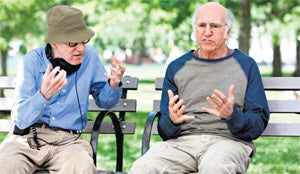
"It used to be Diane Keaton – she always used to tell me, 'I'm terrible, I'm awful, I can't do it, you should get someone else.' And she was always brilliant. Well, Larry is like this," says Woody Allen, discussing his forthcoming movie Whatever Works, which stars Larry David. "I'd always been a fan. I asked him to do it, and he said, 'But I can't act! I can only do what I do, I'm not an actor, you'll be disappointed,'" says the 73-year-old director.
"Those are the ones who can always do it. The ones that tell you how great they are can never do it. When it came time, he did it. And not just the comedy, which I expected, but all the other things which required acting, emotions and being touching."
"I didn't even know I was on his radar, to tell you the truth," says Larry David, 61, with utmost seriousness, a couple of days later. "When you hear that Woody Allen is a fan of yours... " he pauses. "It's surprising. I gave him every opportunity to get someone else. I was kind of uncomfortable. I was out of my comfort zone. But then I take one step to the right and I'm out of my comfort zone."
So, a new Woody Allen movie, starring Larry David, filmed in New York City. Could there be a more deep-fried mix of talent, comedy and neuroses? Many film fans grew up with a vision of this city spun by Annie Hall and Manhattan, where the skyline always twinkles and romance lurks around every limestoned corner; where brainy, nervous men charm young and naive beautiful women in grand pre-war apartments lined with bookshelves; where there are country weekends with lobsters to chase and always, always love to find and fail. And then there's David, another Brooklyn boy made good, co-creator and writer of Seinfeld, which defined New York all over again in the 1990s, with its exquisite, endless examinations and sweating of the small stuff – soup Nazis, being master of the domain, parking garages and puffy shirts.
Since his 1999 HBO special Larry David: Curb Your Enthusiasm, and the still-airing series that followed, he has made performance masterpieces of excruciating situations. The news that he was to star in Allen's latest has had some rubbing their hands in anticipatory delight, others sharpening their knives, all anxious to see if David could pull off the ultimate as a Woody misanthropic paradigm.
This is harder than it might seem. Remember the disastrous Jason Biggs turn in 2003's Anything Else? Kenneth Branagh in Celebrity? But Whatever Works is Woody Allen exactly as you want your Woody Allen to be. It's witty, dark, poignant, zany and hilarious. And as for David, he pulls it off and then some, playing Boris Yellnikoff, a half-suicidal almost-Nobel Prize–winning physicist who suffers from night terrors and minor OCD (he washes his hands and sings "Happy Birthday" – twice – in order to kill all the germs), then tosses it all away.
The Woody angel who enters this time is Evan Rachel Wood as Melody, a teenage Southern runaway who manages to entrance Boris in spite of himself. A May-December romance follows with its inevitable complications, but darker than usual and heartbreak ensues. A terrific supporting cast includes Patricia Clarkson, Michael McKean and Ed Begley Jr.
The director originally wrote Whatever Works, his 39th feature film, with Zero Mostel (another great Brooklyn Jewish comedian and Mel Brooks' original Max Bialystock from The Producers) in mind for the role of Boris. When Mostel died in 1977 Allen put the script in a drawer. When he decided he wanted to film something in his native New York again after shooting his last four films in Europe, he dusted it off and updated it.
The title refers to a rather pragmatic philosophy, namely that if you find something or someone in your life that makes you happy, go with it – regardless if it appears to be all wrong. "As long as you're not hurting anybody or doing anything that's causing any mischief, whatever works to get through your life is fine", says Allen. "All the nonsense about what one should be doing and shouldn't be doing and what's appropriate according to what I call the appropriate police – it's nonsense. It's a tough scuffle through life. A tragic situation. Whatever gets you through – as long as it doesn't hurt anybody else – is fine."

Watch Apple TV+ free for 7 day
New subscribers only. £9.99/mo. after free trial. Plan auto-renews until cancelled.
ADVERTISEMENT. If you sign up to this service we will earn commission. This revenue helps to fund journalism across The Independent.
Watch Apple TV+ free for 7 day
New subscribers only. £9.99/mo. after free trial. Plan auto-renews until cancelled.
ADVERTISEMENT. If you sign up to this service we will earn commission. This revenue helps to fund journalism across The Independent.
Whatever Works has its fair share of dark corners, but also, ultimately, a sunny rom-com message. It's strange to think that Allen wrote it decades ago, long before we learned far too much about his own private romantic struggles. Its doctrine is an easy leap from his infamous "the heart wants what it wants" remark in 1992 amid the Mia Farrow/Soon-Yi scandal. "My philosophy has been consistent over the years, and it appears either persuasive or idiotic depending on how good the film is," he says. "If I make a film and the film itself works, then I feel people come away saying, 'Gee, the philosophy here makes sense'. And if I make a film where I've struck out and I've made bad artistic choices, then they think, 'his ideas are stupid and narcissistic and irrelevant'. But really the ideas have always been the same... it's just that I've failed artistically."
At the start of the film, Boris looks around at his comfy life, his just-right uptown apartment and appropriate spouse, and realises he feels miserable and trapped enough to die (something he manages to fail at, too). He trades it all in for a ratty bathrobe, teaching chess and holding forth in coffee shops. Yet happiness is lurking for him, in the most unusual of places. "This happens all the time," says Allen. "You meet somebody, you have a relationship and, on paper, it seems completely logical and right. And it is right, yet for some inexplicable reason, you gravitate toward the person who is consummately wrong for you, and makes your life into a hell. And that still attracts you more."
"Something very odd on paper could be perfect, and something about that person makes you feel good," adds David. "Usually for me, those are the first people I reject. Why should I feel good when there are women who can't stand me and whom I can't be myself around? Those are the ones I want."
This sort of sentiment is exactly what we'd expect to hear from David on Curb Your Enthusiasm, where he plays a bizarro version of himself. If that persona, the one we think we know ("what I'm playing on TV is not really me," he says, "although I've said many times that I wish it was"), is now playing yet another cinematic version of Allen, we're into Lost-levels of confusion when it comes to the line between performer and reality. Is Boris, with his crushing anxieties and disgust with the human race, a representation of the director?
"I don't know Woody that well, but it's pretty obvious it's at least a bit of some of who Woody is," David says. "He must have seen something in me to make a passable stand-in for him." David recently brought Annie Hall home for his 14-year-old daughter to watch. "She couldn't get through it because [Woody's character] reminded her too much of me. She can't watch me, either. As far as I know, we're the only two people she's said that about."
One could spend hours listing the similarities between Allen and David: both are New York-born, outer-borough Jewish comedians with wicked dark streaks, a certain amount of performative self-hatred plus self-regard, sharp pens, significant intellectual chops and even sharper tongues. But the differences are more interesting. Though both men may be called pessimists, the ways in which they are pessimistic are quite contrary.
"Woody's more of a pessimist about the big picture," David says. "The hopelessness, meaninglessness of it all – the blackness of eternity. I'm probably more pessimistic about the smaller things: the relationship won't work out, the Yankees will lose, the movie will bomb... People won't watch ball games with me."
"I have what I would perceive to be a very realistic view of life, whereas other people criticise me all the time as being cynical, misanthropic and nihilistic," Allen says. " I don't think I am. It's possible I have a blind spot. But I think my perception of it is correct – that it's a tragic event and it takes real improvising, real luck and real work to get through it."
Allen always tells his actors to paraphrase him. David, an excellent improviser by nature, wound up wanting to stick to the script, though he had the urge in the beginning of shooting to try to change things around. "I've been speaking my own words my entire life," David says. "It started to get a bit refreshing to get someone else's words in my mouth." Did he ever start to feel comfortable in his leading role? "Maybe the next-to-last day," he laughs. "Yeah, on the last day I was like: 'You know what? I thought this is pretty easy!"
Now that he has finished his film, Allen claims that he'll never see it again. "I made Take the Money and Run in 1968 and I've never seen it since, or any of the others." But surely he'll attend the glitzy premiere? No, he never actually sits through the films. "I go in and walk on the red carpet... smile... answer the questions, and then I sit down and the second the lights dim, I'm out. I'm at a restaurant with my wife and we have dinner. And then I go to the party afterwards and go back into phony social mode where people are exchanging enormous insincerities. They've hated the film but they're saying, 'gee, great film'."
You might expect this kind of gloom from Boris, but not Allen. "I can't ever say I've been happy with my films," he says quietly. "It's always the same story: I set out to make them and I'm setting out to make, you know, the greatest thing ever made. Citizen Kane or Othello. But by the time I've finished, when the compromises set in, and I've screwed this up artistically and I couldn't get that actor and I didn't have enough money for this, and I guessed wrong on this joke... by the time I put the picture together, I've gone from being sure that I was going to make the next great American masterpiece to just praying that it won't be an embarrassment." Allen sighs. "So I find myself in the cutting room, scrambling, taking a moment out of here and sticking it there. Putting a piece of music in here, and patching up something there, hoping that I'll just breathe and survive. I've abandoned all integrity and all hope of an uncompromising masterpiece."
© New York Observer
Join our commenting forum
Join thought-provoking conversations, follow other Independent readers and see their replies
Comments