Biopic to tell the outrageous story of Peggy Guggenheim
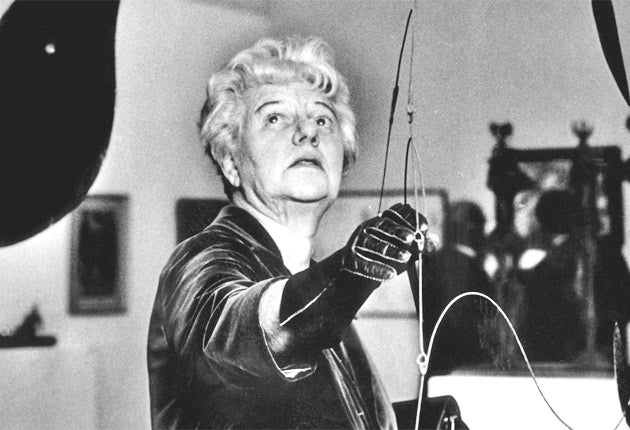
A film featuring racy sex scenes, the sinking of the Titanic and portrayals of Marcel Duchamp, Jackson Pollock and James Joyce might be dismissed as too far-fetched by Hollywood standards.
The extraordinary life of Peggy Guggenheim, the bohemian doyenne of the 20th-century art world, often defied rational explanation, however.
A big screen biopic is in the works, and Guggenheim family aficionados and wary film censors can be certain that it will contain a lot of sex and art. The art collector denied the oft-repeated rumour that she had gone to bed with almost 1,000 people – men and women alike – but admitted that her lovers could be counted in the hundreds.
She became a close friend of Marcel Duchamp and is credited with advancing the careers of Jackson Pollock and Max Ernst. In the process she helped to develop abstract expressionism, the first American art movement to achieve worldwide importance.
Eleanor Cayre, a New York-based art advisor, is to lead the film's development in partnership with Nikki Silver, the Emmy Award-winning producer.
"I have always been fascinated with Peggy's collection and life story," Ms Cayre said. "She was an eccentric figure, who not only championed, but also had intimate relationships with some of the most creative minds in modern art history."
The film, which is still untitled and has yet to reach the casting stage, is expected to begin production in 2012. Perhaps the most surprising thing about the project is that it has taken so long for somebody to commit Peggy Guggenheim's life to celluloid.
Born in New York in 1898, Peggy Guggenheim never had to worry about money. She was the niece of Solomon Guggenheim, founder of the world famous museum, and her father Benjamin was a wealthy businessmen, who like his father, earned a fortune in mining.
In 1912, when Peggy was a teenager, her father boarded the RMS Titanic for its maiden voyage, accompanied by his mistress, his valet and his chauffeur. According to witnesses, after hearing of a collision with an iceberg he ushered his mistress to a lifeboat before returning to his cabin and changing into his evening dress, remarking: "We've dressed up in our best and are prepared to go down like gentlemen."

Watch Apple TV+ free for 7 day
New subscribers only. £8.99/mo. after free trial. Plan auto-renews until cancelled.
ADVERTISEMENT. If you sign up to this service we will earn commission. This revenue helps to fund journalism across The Independent.
Watch Apple TV+ free for 7 day
New subscribers only. £8.99/mo. after free trial. Plan auto-renews until cancelled.
ADVERTISEMENT. If you sign up to this service we will earn commission. This revenue helps to fund journalism across The Independent.
Benjamin Guggenheim did indeed go down with the ship, and by the time his daughter was 22 she found herself with an income of $22,500 a year in the form of a trust fund. One of her first acts after gaining financial independence was to hire a surgeon to carry out work on her nose, a feature she hated and referred to as her "Guggenheim potato".
Bored and frustrated by her small clique of New York friends, she decided to leave the US to go travelling in Europe in search of sexual and artistic adventures.
In her autobiography Out of This Century, Peggy said: "All my boyfriends were disposed to marry me, but they were so respectable they would not rape me.
"I had a collection of photographs of frescos I had seen at Pompeii. They depicted people making love in various positions, and of course I was very curious and wanted to try them all out myself."
In 1922 she married a French artist called Laurence Vail, whom she later referred to as the "King of Bohemia". They had two children but divorced in 1928 after six tempestuous years during which their fights ranged from the unpleasant – he would rub jam in her hair – to the downright violent: "Once he held me down under water in the bathtub until I felt I was going to drown," she wrote.
She mingled with numerous writers and artists, including James Joyce, Marcel Duchamp and Isadora Duncan. She played tennis with Ezra Pound, describing him later as "a good player, but he crowed like a rooster whenever he made a good stroke".
Her next relationship was with John Holms, a frustrated writer who drank too much. She invited him and his partner to visit her home in Pramousquier, writing later: "They came overnight and we went in bathing at midnight, quite naked. John and I found ourselves alone on the beach and we made love."
In 1938, with the help of Marcel Duchamp, she launched Guggenheim Jeune, a modern art gallery in London. She bought many of the works herself, before travelling to Paris to purchase cut-price paintings from artists desperate to leave the city before the outbreak of war.
At a dinner thrown by James Joyce in 1939 she met Samuel Beckett, who escorted her back to her apartment. They had a brief affair, much of which was spent in the bedroom, during which the young writer persuaded her to concentrate solely on modern art.
Driven out of Europe by the Second World War, she set up a gallery in New York called Art of This Century, where she showcased artists including Jackson Pollock, Clyfford Still, David Hare and Mark Rothko.
Perhaps her greatest triumph, the gallery also proved to be the undoing of her marriage to the surrealist artist Max Ernst, who left her for one of 31 female artists she had featured in a show. "I realised that I should have had only 30 women in the show," she remarked drily after their divorce.
Join our commenting forum
Join thought-provoking conversations, follow other Independent readers and see their replies
Comments