Georgia welcomes 'President Garcia'
Shooting starts in Tbilisi for Hollywood take on last year's war with Russia
EPA
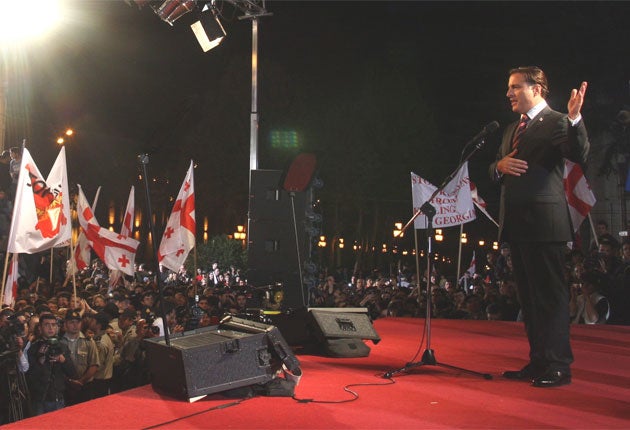
Andy Garcia performs in Tbilisi as Georgian President Mikheil Saakashvili during a shooting of scenes for a film about the Russian-Georgian war last year
Andy Garcia is playing a very different type of leading man this week. The Hollywood star, best known for his very American roles in The Untouchables and Ocean's 11, has taken on the part of Georgia's flamboyant leader Mikheil Saakashvili in a big-budget film about last year's Russian-Georgian war.
Filming in Georgia's capital, Tbilisi, began in earnest this week with a crowd of thousands of volunteer extras, who had gathered to stage a huge mock rally. Garcia was in full Saakashvili mode, intoning lines that would seem boilerplate were it not for the fact that they are more-or-less direct cribs from Saakashvili's actual speeches.
"Tonight, do not be deceived, we are not alone," Garcia told his pseudo-supporters, who were re-creating a demonstration that took place outside the country's parliament on 12 August last year.
But whereas on that occasion there were Russian tanks moving towards the city, this time there was a party atmosphere. The crowd, mainly made up of families and young people, dutifully cheered on cue, and looked on with amazement at the way the centre of their city had been turned into a massive movie set. With a budget of some $32m (£19m), this is the biggest film ever produced in Georgia, and many had come just to watch the spectacle.
Provisionally entitled simply Georgia, the film is being made by Renny Harlin, director of Die Hard 2 and Cliffhanger, as well as mega-flop Cutthroat Island. It follows a journalist and cameraman as they struggle to remain impartial in the heat of battle.
The film-makers have stressed that this movie will have a strongly anti-war message, but there are fears that it could be a vehicle for the Georgian government's version of events. This view is reinforced by the fact that the government has put public buildings and military units at the disposal of the film-makers, and that one of the co-producers, Papuna Davitaia, is an MP from the president's party. Nor will the film be the first to address the subject: a strongly pro-Moscow take on the war, Olympus Inferno, ran on Russian state television earlier this year.
That film placed the blame for the conflict squarely on Georgian shoulders, and many still hold Mr Saakashvili responsible today. The war began when Georgia attacked the separatist region of South Ossetia, claiming that Russian troops had crossed the border. A recent fact-finding report commissioned by the EU found that both Russia and Georgia were responsible for the war, which claimed hundreds of lives.
Salome Zourabichvili, a former foreign minister turned opposition leader, is one of those who holds Mr Saakashvili responsible. She posted on social networking site Facebook that by agreeing to the film he had followed a "real war" with a "bad taste replay", and suggested it was just too soon to recreate the events of the war for the big screen.
For most Georgians though, the movie has brought a sprinkle of show-business glamour to the post-war situation. Posting on one of the many internet discussions on the movie, "Tamuna K" had nothing but praise for the film, and a wistful request: "I have a proposal," she said. "Let Garcia stay here and be president, Saakashvili can fly to Hollywood."
View all comments that have been posted about this article.
Offensive or abusive comments will be removed and your IP logged and may be used to prevent further submission. In submitting a comment to the site, you agree to be bound by the Independent Minds Terms of Service.
- Print Article
- Email Article
-
Click here for copyright permissions
Copyright 2009 Independent News and Media Limited


Comments
but they can pay Hollywood to popularize Saakashvilli's lies. I wonder if the movie will show how Georgia started this war by shelling sleeping Tshinvalli. At least this is exactly what the EU commission found out.
http://www.ireport.com/docs/DOC-152958
Here's what the EU actually said:
Well as soon as it went out all this nasty propaganda
went to another level. There where still some people who have actually read the report. People like:
http://online.wsj.com/article/SB1000142
Assisted by a small army of experts, Swiss diplomat Heidi Tagliavini has spent close to a year investigating the origins of the war that initially shocked Europe but then was relatively quickly forgotten in the midst of the global economic crisis that succeeded it. As expected, both sides have claimed that the 40-page report?with a thousand pages of appendices?vindicates their version of events. Yet anyone who bothers to read the document will find that the Tagliavini Commission apportions the overwhelming part of the responsibility for the conflict on Moscow. In fact, it rejects practically every item in Russia's version of what supposedly happened last year.
The press has so far focused on the commission's conclusion that Georgia started the war. That should, however, not be confused with the question of responsibility: Firing the first shot does not necessarily mean being the aggressor. The report acknowledges this, concluding that, "there is no way to assign overall responsibility for the conflict to one side alone." The report details the extended series of Russian provocations, accelerating in the spring of 2008, that precipitated the war.
The report faults Georgia for lacking a legal basis for its attack on the South Ossetian capital of Tskhinvali, and for the use of indiscriminate force there. But on the crucial Georgian claim that it was responding to a Russian invasion, the report equivocates: The mission is "not in a position" to consider the Georgian claims "sufficiently substantiated." This is an exercise in semantics, since the next sentences acknowledge that Russia provided military training and equipment to the rebels, and that "volunteers and mercenaries" entered Georgian territory from Russia before the Georgian attack. One is left wondering what would be necessary for a spade to be called a spade.
But the report is far more devastating in its dismissal of Russia's justification for its invasion?in fact surprisingly so for an EU product. As will be recalled, Russia variously claimed it was protecting its citizens; engaging in a humanitarian intervention; responding to a Georgian "genocide" of Ossetians; or responding to an attack on its peacekeepers. The EU report finds that because Russia's distribution of passports to Abkhazians and Ossetians in the years prior to the war was illegal, its rationale of rescuing its "citizens" is invalid as they were not legally Russian. It also concludes that Moscow's claim of humanitarian intervention cannot be recognized "at all," in particular given the Kremlin's past opposition to the entire concept of humanitarian intervention.
The list goes on. The report finds Russian allegations of genocide founded in neither law nor evidence. In other words, they're not true. And whereas the report does acknowledge a Russian right to protect its peacekeepers, it finds that Moscow's response "cannot be regarded as even remotely commensurate with the threat to Russian peacekeepers in South Ossetia." On the other hand, it faults Russia for failing to intervene against the ethnic cleansing of Georgians from South Ossetia and Abkhazia that took place during and after the war. Finally, it castigates Russia's recognition of the independence of the two breakaway territories as illegal, and as a dangerous erosion of the principles of international law.
This conflict continues to destabilize a part of Europe to which the West has so far not paid sufficient attention. The EU, now engaged also on the ground in Georgia, must go beyond reluctantly accepting, as it has, that this conflict is a European problem. It needs to overcome its internal divisions and pursue a cohesive strategy toward Georgia?one that takes its basis in the country's European identity and aspirations, as well as its right to sovereignty and security. As for the White House, it would ignore at its own peril one of the EU report's final conclusions: "Notions such as privileged spheres of interest...are irreconcilable with international law. They are dangerous to international peace and stability. They should be rejected."
And doing so will take more than words and the scrapping of missile shields?it will take the type of serious engagement that neither the EU not the U.S. have so far been willing to pursue.
:)
- Says who? Don't fkn invade our country, get the fk out! and NOBODY will EVER CARE ABOUT ur shitty Russian Pederation!
"War 08/08/08: The Art of Betrayal" http://war080808.com/ - weak movie but documentary
"Olympus Inferno" http://www.youtube.com/watch?v=7aOodLPm
Very interesting to see other, new movies - georgians, ossetians, americans, russians.
This TV movies.
TV people filming it.
I am happy to see any Georgian or Ossetian movies.
Only one remark.
May be better to shoot documentary films - not art, not fantasy.
The war was... ... yesterday.
More documents, witnesses - less fictions.
http://baddogtales.com/mishaversusmosco