Too Hollyweird for Hollywood? David Lynch asks fans to help fund his movies
There used to be a time when a filmmaker had a clever idea, took it to a Hollywood studio executive and, by the end of a long lunch, had secured enough money to make their next movie.
For lesser known film directors, this process involved a few more begging bowls being taken to a few more financiers and subsidising bodies. But still it usually worked.
But now in the credit crunched climate of tightened belts and attenuated film funds, film-makers are turning to a new model: "crowd funding".
This involves the cinema-going public being invited to show their support for film-makers by giving to online appeals, in return for film mementos or even a credit at the end of their chosen film.
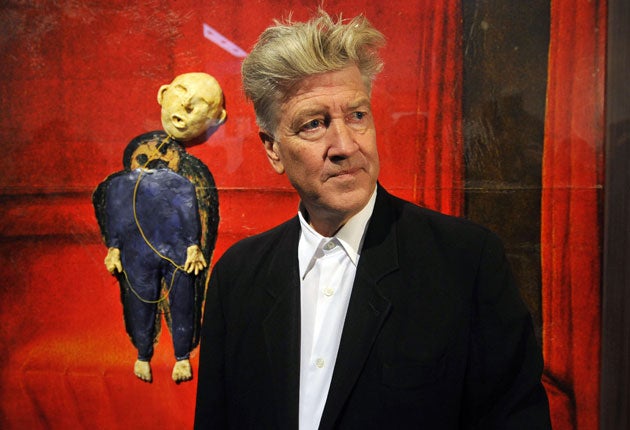
The latest high profile director to sign up to this method is David Lynch, famed for such cult films as Eraserhead and Mulholland Drive. Lynch, who was a trained artist before he turned to making films, has produced a self-portrait which any fan who is willing to donate $50 (£33) to a documentary about his life and work, will be sent as a gift.
Jon Nguyen, the producer for the film, Lynch Three, said he wanted to "give something back" to the fans who were being asked to donate money.
"A film can take a long time to finance so we had this crowd-funding idea. We went to David Lynch for his seal of approval and he was up for it. He ended up making an abstract self-portrait and we're going to give an original print of it to anyone who chooses to donate $50 towards the film, or a T-shirt featuring the print. We hope to raise part of the money in this way," he said.
The film will form the third documentary in a trilogy following Lynch's career and the making of his 2006 psychological thriller, Inland Empire, starring Laura Dern and Jeremy Irons.
As well as receiving the print, the online donators will have the chance to influence the content of the film, including the questions they would like documentary-makers to put to Lynch about his life and work.

Watch Apple TV+ free for 7 day
New subscribers only. £8.99/mo. after free trial. Plan auto-renews until cancelled.
ADVERTISEMENT. If you sign up to this service we will earn commission. This revenue helps to fund journalism across The Independent.
Watch Apple TV+ free for 7 day
New subscribers only. £8.99/mo. after free trial. Plan auto-renews until cancelled.
ADVERTISEMENT. If you sign up to this service we will earn commission. This revenue helps to fund journalism across The Independent.
"Not only are we looking for financial support, but we're also very interested in connecting with his fans for feedback and input. There are so many questions that we would like to ask David and building a network of his fans enables us to reach out to them and hear what his fans would like to ask him if they could hold the camera," added Nguyen.
Meanwhile, at a time when film financing is facing increasing budgetary constraints, even the most powerful directors are harnessing the power of the web to attract investment (financial or artistic) for their latest projects.
Ridley Scott, the director of Robin Hood – which opened the Cannes Film Festival this year – is producing a film that asks people to upload videos of themselves on to YouTube, which will in turn, form the basis of a documentary to be premiered at the Sundance Film Festival.
A growing crop of websites offer anyone willing to donate money to film projects an "executive producer" credit at the end of the film. One example is the collective effort in fundraising for the big-budget Spanish film, The Cosmonaut, a sci-fi movie that used online crowd-funding methods.
Rob Fletcher, a British film producer who is in the process of making a documentary called Driven, is employing a "people powered" form of funding. The film focuses on a couple who first fall in love in the 1950s, travel around the world in a black taxi cab and have a son, only to separate and reunite decades later. The film focuses on an eccentric 2,500-mile trip that the man, now in his 80s, makes with his estranged son. Fletcher said his production team was offering film credits for donations received in the shape of miles, so for $25 (or one mile), donors are given a film credit; for $100, they are given a credit and a T-shirt.
"Documentary films always struggle to find financing from the usual sources and this economy is making it even more challenging for us.... The normal paradigm of distribution is not working so producers are having to think of other ways," said Fletcher.
In 2008, the film Faintheart, partly funded by Vertigo Films and Film4, was hailed as the first to make use of online imput by selecting several cast and crew members from the web.
Anyone wishing to make a donation can go to www.lynchthree.com
Join our commenting forum
Join thought-provoking conversations, follow other Independent readers and see their replies
Comments