Angels & Demons (12A)
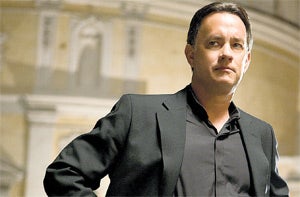
There is a scene about halfway through this sequel to The Da Vinci Code when the scholar-hero, played by Tom Hanks, is locked inside a glass-walled library vault whose oxygen supply has just been treacherously cut off. We are meant to be horrified as he staggers along the precious book-lined corridors, surrounded on all sides by arcane knowledge, yet unable to draw breath into his lungs. There could be no more perfect metaphor for this movie, a see-through construct packed to the rafters with complex information but peopled by characters denied the simple oxygen of credibility. How can we possibly care about a man being starved of air when he has nothing of real life about him in the first place?
It's been three years since The Da Vinci Code, perhaps long enough for the filmmakers to get away with what is virtually a remake of it. Dan Brown, the man responsible for the bestsellers on which they are based, has limited the action here to a single city, on a single night, but it doesn't help in limiting the verbosity or in streamlining the plot: Angels and Demons proves every bit as swollen and portentous as The Da Vinci Code. It is, however, nine minutes shorter than that film, so there's something to be grateful for. Robert Langdon (Hanks), the Harvard symbologist "who cracked history's most controversial code", has come to Rome at the invitation of the Vatican. The Church is already reeling from the death of a "progressive and beloved Pope" – a reminder that we are in a fantasy – and now it seems that the four top Cardinals in the running to succeed him have been kidnapped. Each one will be executed, an hour apart. Aaagh! It's apparently the work of a nutso breakway sect named Opus Dei – sorry, the Illuminati – who are very antsy about the Catholic faith's embrace of science and enlightenment. This doesn't mean the use of condoms, alas, but something called "the God particle". This is the super-secret anti-matter that's been hijacked from a Swiss laboratory and is now primed to explode over Rome at the stroke of midnight.
So Langdon, using his vast erudition, must delve into the arcana of Catholic doctrine and iconography to help the Vatican police avert disaster. This mostly involves a lot of dashing via car to various churches around the capital, just in time to find a poor old cleric expiring from some horrible ritualistic death. I haven't read Brown's source novel, but from the sound of it he's cut-and-pasted his entire Rome guidebook for this. In the course of Langdon's manhunt the script (by Akiva Goldsman and David Koepp) keeps scattering gobbets of historical detail, like one of those paddle-wielding tour guides who lead flocks of uncomprehending tourists around the sights. The Pantheon is the oldest Catholic church in Rome. Papal autopsy is forbidden by Vatican law. Bernini designed St Peter's Square. Peter, the first Pope, was crucified upside down. Well, thanks for the information, but it doesn't raise the excitement level of this film one iota. In fact, it actually slows the whole thing down, obliging characters to append little spoken footnotes every time they mention something else we haven't heard of. It's a murky, dispiriting festival of pedantry, a way for Dan Brown to gussy up his non-thrilling thrillers and persuade his readers that they're getting something, like, really deep. But research only becomes interesting when it's been integrated into the story, and sometimes not even then. It doesn't make the story interesting per se.
That last bit is Latin, by the way, a language this film uses to kid us we're into something very posh and abstruse. Langdon is aided on this score by Vittoria (Ayelet Zurer), a foxy scientist and Latinist who thinks nothing of ripping pages out of a priceless church manuscript if it might contain a clue. Not that Langdon shows himself lacking in the European tongues. "How you say – form-i-da-bile?" says a police chief. "Formidable", replies our hero, exhibiting that famous erudition. Zurer, by the way, makes a more agreeable companion to Hanks than pouty Audrey Tautou did in the first movie, though she has to take her chances against an all-male cast of exceptional dreariness. Stellan Skarsgård and Armin Mueller-Stahl provide the requisite hints of sinister duplicity, while Ewan McGregor has been recruited, in a casting decision of hilarious ineptitude, to play the late Pope's Irish-born confidant and spokesman. It's yet another in McGregor's roster of fakes, just behind his plummy-voiced Obi-Wan in Star Wars and his pathetic cockney crim in the Woody Allen film Cassandra's Dream.
Ron Howard, who directs, calls Dan Brown's book "incredibly original, thought-provoking and, on a cinematic level, irresistible". This sheds a dismaying light not only on his reading habits but on his ideas about cinema. What exactly is irresistible about Tom Hanks furrowing his brow, hurrying down gloomy passageways and spouting Vatican history? The pomposity of Angels and Demons is astonishing, or would be if we didn't already have lavish evidence of the same from The Da Vinci Code. You can even hear it in the thundering percussive score by Hans Zimmer, overlaid with the kind of swooping choral voices that seem to announce apocalypse. It makes a commotion, it dabbles in mystery, but nobody should trouble to wonder whether it actually means anything – not even Ron Howard.
Join our commenting forum
Join thought-provoking conversations, follow other Independent readers and see their replies
Comments
Bookmark popover
Removed from bookmarks