Avatar, James Cameron, 163 mins, (PG)
James Cameron's extraordinary allegory of US adventurism in the Middle East inspires shock and awe but fails to win hearts and minds
James Cameron once declared himself king of the world. Now he has his eye on bigger things – he wants to rule the universe, the future and your brain.
His long-awaited Avatar is digital epic as attrition – you can't escape being overwhelmed by it, but it doesn't leave you much thinking space. I saw the film in 3D on a relatively small screen rather than in the colossal Imax format in which it's also being released. See it on that scale, and no doubt you'll feel totally engulfed by the experience, but even in a Soho Square basement, Avatar was immersive enough for me.
What I do feel overwhelmed by is the ocean of publicity telling us that Avatar is the ultimate this, the ultimate that, one of the most expensive films ever made (at a reported $230m or £143m – and you don't have to be a killjoy to find that obscene) and, most worrying, that it is the future of cinema.
Well, perhaps it is, although I wouldn't trust pronouncements on the future from anyone called Cameron. But you certainly should not believe claims that Avatar is unlike anything you've ever seen. It isn't: not if you've seen 2001, Star Wars, Apocalypse Now, Jurassic Park, Minority Report, Apocalypto or any of several Westerns that come to mind. Everything in Cameron's film – whether it's the future-tech stuff or the planetary faeryland – is oddly familiar. What is new in Avatar is the degree to which it uses CGI artifice: this is about as far in the direction of animation as cinema can go while still retaining any claim to human presence.
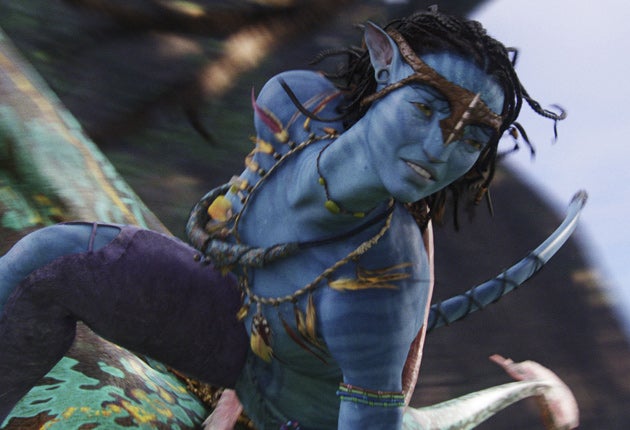
The film's central creations are towering athletic blue-skinned aliens, the Na'vi; they resemble stretched humans, with tails and feline faces, like lynxes genetically altered to play basketball. They are created by the same motion-capture technique that film-makers including Robert Zemeckis and Peter Jackson have been using for some years, encoding actors' faces and movements into digitally drawn beings. Cameron, however, has made his creatures so lithe and expressive that he raises the bar; in his hybrid beings, the join between live and "programmed" is harder to detect than ever, successfully pushing digital imagery towards something approaching the organic.
Avatar also creates a jungle-planet environment in astonishingly dense detail: every leaf, every droplet of water, every scale and hair on every bizarre creature is manufactured to order. The film is like an anti-Darwinist's wet dream of intelligent design, with Cameron as God with a Bible full of algorithms.
The story is set in a far future, when humanity has screwed up Earth and is looking for other worlds to despoil. The Na'vi planet Pandora happens to be rich in a miracle mineral called (Avatar's only sign of humour) "Unobtainium". But to get at this stuff, the humans must displace the peace-loving Na'vi, and so an Earth army is moving in under the command of Quaritch (Stephen Lang), a colonel who loves the smell of napalm at any time of day.
Joining the human task force is Jake Sully (Sam Worthington), a wounded marine in a wheelchair, who signs up for the avatar programme run by scientist Grace Augustine (Sigourney Weaver). Avatars are artificially grown Na'vi bodies into which human consciousnesses are implanted. With his mind in an avatar, Jake will perhaps persuade the Na'vi to co-operate before the army uses its own methods – for which the terms "shock and awe", "hearts and minds" and "fight terror with terror" are variously used. But Jake falls for a lissom blue female (Zoe Saldana) and, moved by Na'vi eco-wisdom, goes native from the blue skin inwards.
Yes, Avatar swipes at US policy in the Gulf – but this dimension of the film comes across merely as a sop to anyone who's accidentally brought their brain along and, frankly, $230m seems a lot to spend on a political parable. Ultimately Avatar isn't about that at all – nor is it really "about" the phenomenology of digital cinema, although the legions of academics who've been theorising about CGI since Cameron's The Abyss will want, like him, to take their game to the next level. For what it's worth, Avatar offers its own metaphor of immersive cinema: the avatar inhabited by Sully is at once living being and simulation (part Worthington, part pixel), and allows him simultaneously to move around the planet Pandora and lie in a pod at HQ. A bit like cinema, then, where you're at once in your seat and out of your body, carried away on the thrill ride.

Watch Apple TV+ free for 7 day
New subscribers only. £9.99/mo. after free trial. Plan auto-renews until cancelled.
ADVERTISEMENT. If you sign up to this service we will earn commission. This revenue helps to fund journalism across The Independent.
Watch Apple TV+ free for 7 day
New subscribers only. £9.99/mo. after free trial. Plan auto-renews until cancelled.
ADVERTISEMENT. If you sign up to this service we will earn commission. This revenue helps to fund journalism across The Independent.
But just how fascinating is it to be immersed in Avatar? Barely at all, if you're looking for narrative intelligence. The characters are barely D: militaristic baddies, plucky tough cookies, noble and vaguely African embodiments of life force. As for the dialogue, Cameron's script budget must have run out at first-draft stage.
Visually, the motion capture is seamless; the clarity of the 3D is remarkable, and it's all undeniably dazzling. Big Jim's Rainforest Adventure is like David Attenborough's Life on acid – and pardon the cliché, I do mean on acid. This is a neo-hippie experience par excellence: Pandora's fauna and landscapes, especially its extraordinary airborne mountains, will look oddly familiar to anyone who remembers the LP sleeves of Seventies prog-rock illustrator Roger Dean.
Magnificent as Avatar often is, it comes across as kitsch, somewhat pious, and altogether a corporate production rather than one with any human personality: essentially, the CGI equivalent of Cirque du Soleil. What the film doesn't offer is any real imaginative leap. Think of any fiction set in a fantasy Eden, and you're likely to have dragon-like dinosaurs, massive awe-inspiring trees, the odd bizarre insect. They're all here, but rarely to surprising effect. The film has a much narrower and more conventional visionary palette than Peter Jackson's Rings trilogy which, tedious as it finally was, represented a genuine feat of imagination in visualising Tolkien's encyclopaedic world in all its range.
And ultimately, for all its superficial right-on-ness, Avatar is patronising in its cod-ethnic mythologisation of the Na'vi, who are forever lifting their arms and chanting to sacred trees like the chorus in a Sixties tribal musical. And of course it's a white man – in digital blueface, as it were – who is the real hero of the Na'vi victory.
Is this the shape of cinema to come? Well, no doubt many staggeringly expensive digital spectacles will follow, some better, many considerably worse. Avatar's real significance is probably as a Research and Development testbed for new generations of immersive videogames, but it doesn't have much to offer narrative cinema. Avatar is a phenomenon you can't ignore, monumentally imposing and done with extraordinary expertise – but the same could be said of the Dubai skyline, and I'm not sure that represents any future worth investing in.
Join our commenting forum
Join thought-provoking conversations, follow other Independent readers and see their replies
Comments
Bookmark popover
Removed from bookmarks