Charlie Bartlett (15)<br/>Heartbeat Detector (12A)
Lost in a moral maze

Get our free weekly email for all the latest cinematic news from our film critic Clarisse Loughrey
Get our The Life Cinematic email for free
My very first thought, on emerging from Charlie Bartlett into the sunshine, was how much my children would enjoy this film; and I was puzzled to realise that they wouldn't be able to – what on earth was such a sunny film doing with a 15 certificate? It took a while for the reason to filter through: I suppose, looked at censoriously, Charlie Bartlett could be taken to imply that dealing drugs to your school chums is a reliable route to popularity, and we don't want our children picking up that sort of lesson in the cinema. So they'll just have to wait for it to come out on DVD, and pick the lesson up at home.
Charlie (Anton Yelchin) is a rich kid from the kind of family that has its own psychiatrist permanently on call. Having been thrown out of every possible private school, he now has to take his chances at the local high school. Having made a disastrous first impression, Charlie needs to find a way of gaining acceptance: he stumbles on the notion of dealing prescription drugs, in which his household is rich, to his fellow pupils.
At first, he's just interested in getting them high; but then he realises these kids have real problems that aren't being treated. Soon he's established as the school's unofficial psychiatrist, holding consultations in the toilets, and then mimicking his clients' symptoms to a succession of shrinksto get the pills they need. Popularity, influence, and loss of virginity to a nice girl soon follow.
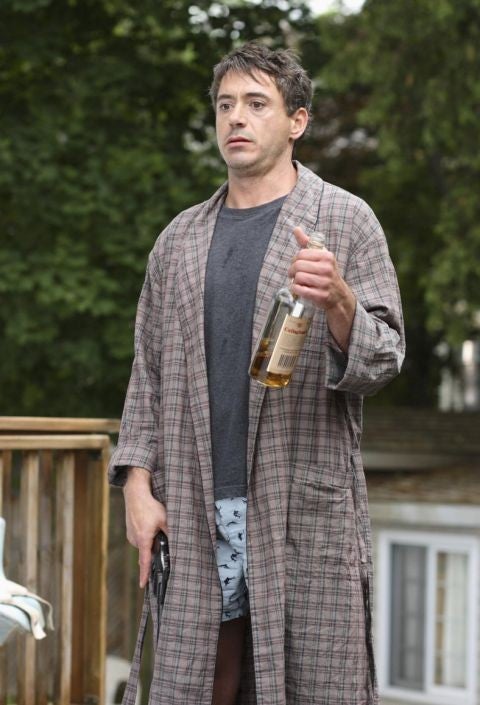
It comes as no surprise when Gustin Nash's script feels the need to backtrack, and Charlie has to learn that Selling Drugs Is Bad – Kip, the alienated loner who first started him on the psychiatry shtick, takes an overdose. Nothing can be pinned on Charlie, but he's being eyed up suspiciously by the head, Principal Gardner (the ever-lovely Robert Downey Jr – and look, he's playing a character with a drink problem again!), who is his girlfriend's dad. Charlie decides to get out of the pharmaceutical business; instead, he offers his clients conversations only, free of charge, and is soon more popular than ever. You see, kids are decent at heart, if only someone would listen to them. Even the most hardened offender, after a couple of minutes' chat with Charlie, starts combing his hair and talking like a gentleman.
As the film progresses, so it succumbs more and more to the urge to slip over moral messages: Charlie has to learn that popularity isn't everything – "It's what you do with it" – and make a toe-curling speech telling his fellow students not to rely on him for guidance but just be themselves. This triteness, though, is at odds with Charlie's character; what makes him, and the film, appealing is a contempt for rules and morals as poor substitutes for cheerfulness and good intentions. Yelchin's exuberant performance gets the optimism perfectly – hinting, in a couple of particularly florid scenes, that he's holding a few gears in reserve, in the interests of realism; I'm looking forward to seeing him really let rip.
In a quiet way, the film is clear-eyed about the difficulties of Charlie's outlook: institutions, including schools, demand obedience, and, more than that, submission. At one point, Charlie disperses a protest by his fellow pupils, who are upset at a proposal to install surveillance cameras in the student lounge: "There has to be a better way," Charlie mutters, as though this was a matter of flag-burning and baton rounds, rather than a bunch of unrowdy teenagers waving banners. But the authorities aren't interested that he's using his influence for good: the fact that he has influence at all makes him a threat. This would be the core of Charlie's tragedy, if the film wasn't so darn soft-hearted. But it does have one stern message that sticks in the mind afterwards, uttered by Principal Gardner after a dramatic poolside confrontation: "Never attack a drunk guy with a gun."
It's hard to imagine a more strongly contrasted film, in terms of mood, message and technique, than the French film Heartbeat Detector – the English title is feeble, by the way, compared with the big Zola-esque thrust of the original, La Question Humaine. The not entirely spurious connection is that both films are approaching the problem of staying human within an institution – in this case, a big industrial multinational. The film starts with images of suited executives, unspeaking at the company urinals; and an air of impersonality pervades the whole film. It is set in Paris, but a Paris wiped clean of any recognisable landmarks; and the central character, a corporate psychologist called Simon Kessler, is played by Mathieu Amalric, an actor remarkable for his ability to convey, when necessary, an almost complete absence of feeling. Kessler is called in by a senior executive to investigate the erratic behaviour of the chief executive, Jüst – played by the leonine, magnificent Michael Lonsdale.
His enquiries lead him to a string quartet, consisting of company employees, in which Jüst once played, but which split up mysteriously; and to the discovery that the company got its hands very dirty during the Second World War, manufacturing equipment for the death camps; suddenly, those smoking chimneys seem to allude to something much nastier.
The film doesn't just imply an inherited guilt; rather, it seems to argue, there is a thread connecting Nazism with modern corporate capitalism – both are processors of souls, reducers of human beings to units of utility, or inutility. I don't think the story earns this heavy-duty moral; but it is a mysterious, gripping film, patiently paced but packed with intriguing images, half-understood conversations, scenes that relate to the story in obscure ways. I left it with a sense of having missed something important, but I'd gladly go back to find out what it was. 12A, by the way, but I wouldn't take the kids.
Anthony Quinn is away
Subscribe to Independent Premium to bookmark this article
Want to bookmark your favourite articles and stories to read or reference later? Start your Independent Premium subscription today.
Join our commenting forum
Join thought-provoking conversations, follow other Independent readers and see their replies