Drive, Nicolas Winding Refn, 100 mins (18)<br/>Crazy, Stupid, Love. Glenn Ficarra, John Requa, 118 mins (12A)
He can do nasty and he can do nice, and Gosling shows a different side in each of his two films this week. But only the tough guy gets to put his foot to the floor...

Get our free weekly email for all the latest cinematic news from our film critic Clarisse Loughrey
Get our The Life Cinematic email for free
Having two films out in one week is as close as a film star gets to ubiquity – I suppose we can take it that Ryan Gosling is now a fully fledged golden goose.
I hope that Gosling isn't about to settle into stardom too cosily: this is, after all, an actor who first made his mark playing a Jewish neo-Nazi (The Believer) and a drug-addicted teacher (Half Nelson). Only one of his two films this week suggests that Gosling might get too fond of being liked, and in both – even the cosier one – there's a hard, indeed nasty, edge to his presence.
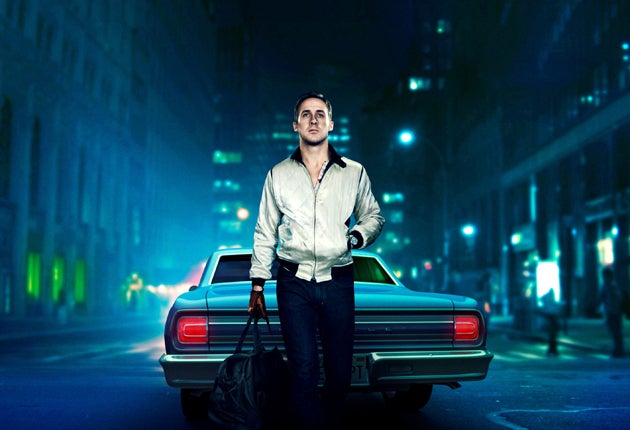
Yet, even when Gosling is playing it on the dark side, he shows a delicate vulnerability that he's not averse to milking. In LA thriller Drive, he's a movie stunt artist and part-time getaway man. The consummate Man with No Name (credited as "Driver", referred to by associates as "the kid"), Gosling's character is a solitary figure who wears a scorpion-emblazoned gold satin jacket like knightly livery and rarely speaks, except to give his criminal contacts a curt terms-and-conditions spiel that he could have memorised from another heist movie. He's an ice-cold operator, prone to startling violence, yet a man of unbending honour and weirdly gentle and childlike: when he befriends the nice young mum next door (Carey Mulligan), you sense he's happiest watching cartoons on TV with her son.
This character, who's glaringly contradictory whenever the film needs him to be, could have been downright ludicrous, except that everything in Drive – beginning with the 1980s-style pink lettering of the credits – reminds us that this is a movie, and one made of other movies. Danish director Nicolas Winding Refn is paying homage to 1970s and 1980s Hollywood action pictures – to early Michael Mann, and especially Walter Hill's magisterial 1978 getaway thriller The Driver, also about a glacial wheelman, also played by a Ryan (O'Neal). Drive is an American movie to the core, luxuriating in Hollywood style in a way that actual American films rarely do. One of Drive's heavies, played by director-comic Albert Brooks, says that in the 1980s he was a producer of action movies – "one critic called them European". But sometimes the most American films are European at heart – The Driver was a quasi-remake of Jean-Pierre Melville's 1967 Le Samouraï, itself a French take on US noir.
All this might suggest that Drive is a movie-buff affair. It is – and that's its strength, and its weakness. The 1980s elements – gliding aerial shots, moody nightscapes, ballad-laden montages, the Moroder-style electro throb that underscores the tension – all make Drive a sleekly tooled, highly efficient machine. The self-conscious gloss is offset by the crispness of Hossein Amini's script (from the novel by James Sallis) and nice rough edges in the acting. Bryan Cranston, as Gosling's seedy mentor, has a raspy, shambling touch of Peter Falk, while Albert Brooks and Ron Perlman are a mesmerisingly foul pair of plug-ugly hoods, resembling ancient primal gods of sleaze. Set against this is a curious pristine innocence, incarnated by the Driver and by Mulligan's almost angelic love interest.
Drive is a terrific film for the first hour – and then, I confess, I turn off this particular freeway. When Gosling does something exceptionally grisly to a goon's head in a lift, the splatter-style violence (though largely suggested) is so excessive that Refn seems to be doing it not because it makes real sense, but because, in a fanboy way, he just can. I felt as bad about the treatment of Christina Hendricks, Mad Men's sublime Joan, who has three lines before she's dispatched messily: now that's plain ungentlemanly. When the Driver gets vicious with a thug in a strip club, glassy-eyed odalisques loll around, bored: hard-boiled is one thing, but such scenes reveal a colder, crueller touch than the film really needs. They dispel the taut, nervy clarity of Drive's first hour.
Refn – who made the superb Pusher trilogy of Copenhagen low life, and the brazenly oddball Bronson – won the Best Director award in Cannes for Drive, and his command and intoxicated cinephilia are undeniable. The no-seatbelt action is nifty, but what's really special is the cool fetishistic stuff, like the slo-mo shots of the Driver driving, hands gliding round the wheel. If it's not a great movie, Drive is a great idea of a movie. They should find room for it at the V&A's new Post-Modernism show.
In Crazy, Stupid, Love., Gosling's character is even more a fantasy figure than the Driver – Jacob, a seamlessly glossy lothario who befriends middle-aged, suburban Cal (Steve Carell), whose marriage has fallen apart. Jacob appoints himself Cal's guru, instructing him in the ways of masterful masculinity and pulling in bars. His teachings include drinking the right cocktails, wearing the right collar size, shopping anywhere other than Gap. (One suspects some product anti-placement deals behind the scenes.) The film is directed, but not written, by Glenn Ficarra and John Requa, the duo who made the manic gay romcom/true-crime comedy I Love You Phillip Morris. In fact, Crazy, Stupid, Love. is again a gay romance at heart. There's much adoration of Gosling's buffed torso (digitally buffed, perhaps: a seducee gasps, "You look like you've been Photoshopped!") and gags about Jacob having his shvantz (yes, shvantz) in Cal's face at the sauna.
Gosling sends up his burgeoning sex-god status, as far as the film will let him. Jacob is pure cartoon, a Uomo Vogue supplement on Alexander McQueen-clad legs, but where the film could have had fun dismantling this narcissistic cod-icon, it does something much less interesting – it humanises him, making Gosling drop the strut for bashful I-love-you-guys grins at the end. The film features some of Hollywood's most watchable – a likeably on-autopilot Carell, Julianne Moore, Marisa Tomei, Kevin Bacon, Emma Stone – and squanders them something rotten. The one intriguing off note is a tale of frustrated passion involving a 13-year-old boy and his gauche 17-year-old babysitter (Analeigh Tipton, all googly eyes and pipe-cleaner limbs), which suggests a promising germ of perversity, as if Ficarra and Requa had really wanted to take the film into Todd Solondz territory. In the end, the most perverse thing about Crazy, Stupid, Love. is its punctuation.
Next Week:
Jonathan Romney prepares for Doomsday in the latest Lars von Trier
Subscribe to Independent Premium to bookmark this article
Want to bookmark your favourite articles and stories to read or reference later? Start your Independent Premium subscription today.
Join our commenting forum
Join thought-provoking conversations, follow other Independent readers and see their replies