Helen, Christine Molloy & Joe Lawlor, 79 Mins, (PG)
Molloy and Lawlor’s haunting, ‘missing-person’ study shows that homegrown art-house cinema is back from the dead
The past year has been an odd one for British film, suggesting that we might actually have a modest art-cinema revival in the works. Steve McQueen’s Hunger, Joanna Hogg’s Unrelated, Duane Hopkins’ underexposed Better Things have all proved that there are new voices in Britain clamouring to make films outside the tired commercial template. Now here’s another, and it’s arguably the most alluring of the crop.
The distinctive strangeness of Helen comes partly from the fact that its makers – Irish duo Christine Molloy and Joe Lawlor, who have long worked under the banner “Desperate Optimists” – come from a non-cinema background, their previous shorts closer to video art than narrative film. In its precision and cool detachment, Helen feels rather like an exceptionally polished art video. But, in its realist matter-of-factness and its vestiges of police procedural drama, the film isn’t remotely abstract: you could almost be watching an unusually conceptual episode of The Bill.
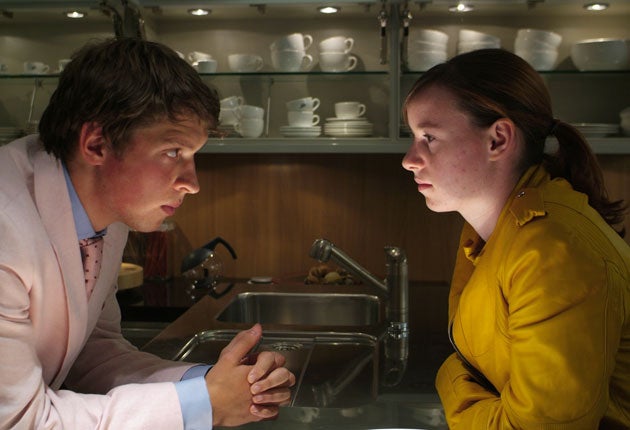
The film opens with a slow-motion shot, as a teenage girl in a yellow leather jacket parts from her friends and walks across a park. Soon after, police comb a nearby wood: the girl, Joy, has gone missing. At her college, police recruit students for a reconstruction of Joy’s last known moments. A girl named Helen (Annie Townsend) gets the main part, and is given Joy’s yellow jacket to wear. From that moment, Helen seems to become Joy – at least, to identify with her – and undertakes a personal investigation of the missing girl’s life. Helen is effectively adopted by Joy’s parents, then starts a tentative relationship with Joy’s boyfriend, estate agent Danny (Danny Groenland).
Among other things, Helen is an inquiry into identity: into the question of who we are, who other people think we are, what we might make of ourselves. Seeming at first a blank, a personality not yet formed, Helen is a girl without a past or a future: living in a care home, she has never known her parents. A new possibility suggests itself to Helen: why not reinvent herself from scratch?
Helen is a mysterious film, but not an enigmatic one. The only riddle is Joy’s disappearance, but that’s not what concerns the film-makers. More pressing is Helen’s exploration of the space that Joy has vacated. The film is ambivalent, but implicitly generous, about Helen’s motives: rather than depict her as opportunistic, Molloy and Lawlor show her as walking into Joy’s life as if in a conscious dream. Helen emerges as a strong, quizzical intelligence, newcomer Annie Town-send bringing her a quiet, vulnerable determination that’s all the more affecting for being downplayed.
The haunting mood makes Helen far more affecting than its premise would suggest. The setting is a hybrid nowhereville (actually an amalgam of Dublin, Liverpool, Birmingham and Newcastle), composed of shiny offices, civic spaces, hotel rooms. Even private places are impersonal: Joy’s home is as emotionally uninhabited as the display flat that Danny shows his customers. Ole Birkeland’s photography is richly coloured but knowingly clinical, giving this elegant micro-budget film that eerie quality characteristic of a certain chilly lineage: Michael Haneke, Atom Egoyan, Antonioni (this park mystery being a direct descendant of Blow-Up).
In addition, there's something extremely distinctive about the casting. Molloy and Lawlor's long-standing practice is to advertise locally for members of the public who fancy being in a film. The result in Helen is to give the cast a subliminally nagging stamp of arbitrariness: we're aware of ordinary people filling roles, rather than the usual sense of non-professionals playing characters. In fact, that's one of the film's themes: Annie Townsend happens to have been chosen as Helen, just as Helen happens to have been chosen as Joy. Yet this somehow makes for an intense effect of reality: paradoxically, the fact that anyone might have ended up in a particular part makes the person seem not just an ideal fit, but an inevitable one.
The directors' favoured style of non-acting is so affectless that it makes David Mamet look like Emir Kusturica. Yet the approach pays off strikingly. In an otherwise glacial dinner table scene, Joy's father (Dennis Jobling) suddenly breaks down while explaining a maths problem: the emotional release is all the more powerful because of the surrounding flatness of mood.
This thematically rich film is, among other things, a contemplation of the art of acting: how much does an actor need to resemble, or to become, the person she's playing (or will just borrowing their jacket do the trick)? Yet for all the theoretical undercurrents, Helen is utterly approachable. It is, after all, a narrative of the kind that audiences instinctively warm to: a police story, and a story of a young girl discovering new possibilities ahead. And there's a nicely level-headed sense of life's ordinary flow: Joy has vanished but meanwhile, a boy practises his guitar, students rehearse a production of Brigadoon, a security guard plans a pirate-themed children's party.

Watch Apple TV+ free for 7 day
New subscribers only. £8.99/mo. after free trial. Plan auto-renews until cancelled.
ADVERTISEMENT. If you sign up to this service we will earn commission. This revenue helps to fund journalism across The Independent.
Watch Apple TV+ free for 7 day
New subscribers only. £8.99/mo. after free trial. Plan auto-renews until cancelled.
ADVERTISEMENT. If you sign up to this service we will earn commission. This revenue helps to fund journalism across The Independent.
Helen is at once enigmatic and lucid, even transparent: there's a sense of mystery without mystification. At one point Helen, playing detective, hands Danny a photograph: "Can I ask you to describe what you see in this picture?" This fascinating film asks us pretty much the same question. And I suspect that every viewer will have a different answer.
Join our commenting forum
Join thought-provoking conversations, follow other Independent readers and see their replies
Comments