Lourdes, Jessica Hausner, 99 mins, (U)
What's indisputable is the power of cinema in this slippery story of a disabled young woman's pilgrimage to Lourdes
God moves in mysterious ways – and so, as often as not, do Austrian film-makers.
Jessica Hausner shot Lourdes in the Pyrenean town it's named after, among crowds of real-life pilgrims and with the permission of the Catholic authorities. That would imply a serious religious inquiry – which Lourdes may well be. But it's also something much more provocative, and certainly less pious, than that suggests. In the end, you can't easily pin down Hausner's take on her subject – is it compassionate, ironic, slyly condemnatory, all of the above? Put a Catholic and an atheist in the same screening, and they'll see two different films. All you can be certain of is Lourdes' slippery, unsettling brilliance.
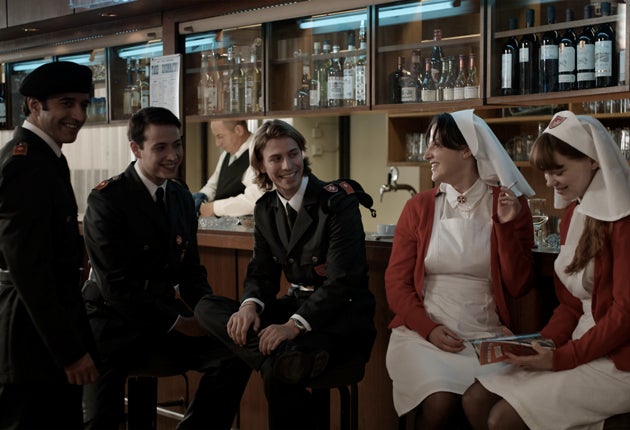
This French-language drama follows a group of pilgrims, in particular Christine (Sylvie Testud), a young quadriplegic woman with multiple sclerosis. The laconic Christine is initially our eyes and ears on a world that, it seems, she doesn't entirely believe in: she's visiting, she says, because it's the only way she gets out. She's attended by Maria (Léa Seydoux), a young nurse in the red-and-white livery of the Order of Malta. The officers of that Order, kitted out like militia in tunics and berets, are dashing specimens – the younger ones resembling boy band candidates, while the older Kuno (Bruno Todeschini) is a matinee idol of saturnine charm.
Most of the pilgrims want a physical cure, but some are after other things besides. The elderly able-bodied woman who shares Christine's room is essentially a disability groupie, latching on to Christine as her personal ward and none too happy when she shows signs of independence. As for Christine, it's not clear that she's religious at all: when she goes to confession, we sense that it's largely because this is what one does in Lourdes, part of the local protocol. Nor does Maria seem terribly pious: she increasingly resents every moment that keeps her from flirting.
Much of the film has a semi-documentary flavour, showing us life in a world that Hausner depicts as part Butlin's, part conference centre. On one hand, we get the bizarre pomp – torchlit gatherings, crowds queueing at the Gothic-Ruritanian basilica, a dead ringer for the Disneyland castle. On the other hand, Hausner shows us the mundane business of spa life: the pouring of holy water behind clinical curtains, the drab offices where you have to apply to get a miracle recognised.
There are also some startling and enigmatic narrative turns. The first comes when a leading character is abruptly pulled out of the action. The other, more delicately presented but no less a bombshell, comes when someone else seems to benefit dramatically from the Lourdes effect.
But it's typical of Hausner's discreet approach that the apparent miracle isn't treated as we'd usually see it in cinema – no crowds raise their hands in tearful hosannas. Instead, the miraculee wins a round of polite applause from some café waiters, and assorted wry or undisguisedly bitter looks from everyone else.
Hausner films it all with rigorous detachment, cameraman Martin Gschlacht using HD video to provide images of superbly organised clarity. Some compositions resemble the highly artificed tableaux of art photographer Jeff Wall, touches of red (the nurses' uniforms and, particularly, Christine's jaunty hat) leading our gaze through the complex images.
Hausner casts superbly, with a keen eye for suggestive faces. Léa Seydoux's Maria has a sullen, pouty fleshiness, contrasting with Elina Löwensohn's forbidding head nurse, gaunt as a medieval penitent (Löwensohn was the Eurovamp in Hal Hartley's 1990s comedies, and her striking performance here is a major self-reinvention). As for Sylvie Testud, long a well-kept secret of French cinema, here she transcends those gamine roles to which her impish features suited her. On one level, she's doing a My Left Foot, brilliantly evoking the physical condition of paralysis. But she also communicates with extraordinary delicacy the inner life of someone about whom we otherwise know next to nothing.
We don't know who Christine is or what her past has been, yet Testud's almost subliminally eloquent features – variously suggestive of fragility, strength, quizzical doubt and longing – make for an intensely nuanced characterisation.

Watch Apple TV+ free for 7 day
New subscribers only. £9.99/mo. after free trial. Plan auto-renews until cancelled.
ADVERTISEMENT. If you sign up to this service we will earn commission. This revenue helps to fund journalism across The Independent.
Watch Apple TV+ free for 7 day
New subscribers only. £9.99/mo. after free trial. Plan auto-renews until cancelled.
ADVERTISEMENT. If you sign up to this service we will earn commission. This revenue helps to fund journalism across The Independent.
Clearly Testud and Hausner have seriously done their homework, both on disability and religion, but ultimately it's hard to pin down what Lourdes is really about. You could certainly see the film as a theological enquiry, but it's as much a sociological study of the bonds between Lourdes pilgrims and of their attitudes and needs. There's precious little solidarity to be found among Hausner's characters. In fact, the place is a hotbed of resentments, whether it's sexual competition over the handsome officers, or jealousy between the ill – because someone else is getting cured or has a more impressive disability.
Lourdes is sober, but mischievous – there's even a choice joke about Jesus, Mary and the Holy Ghost deciding where to go on holiday. The final sequence is set at a party, complete with white-suited cabaret singer, but despite this dash of cheesiness, Hausner doesn't overplay her hand. The closing shot – extended, enigmatic and carrying a charge of bitter irony – is quietly devastating. Jessica Hausner's tour de force of ambivalence, intelligence and invention will make you believe in cinematic miracles, at least.
Next Week:
Jonathan Romney sees Aboriginal drama Samson & Delilah and dips into the double life of Alfred Hitchcock
Join our commenting forum
Join thought-provoking conversations, follow other Independent readers and see their replies
Comments