Milk, Gus Van Sant, 128 mins, 15
Sean Penn's portrayal of America's first openly gay man in public office is full of exuberance and joy
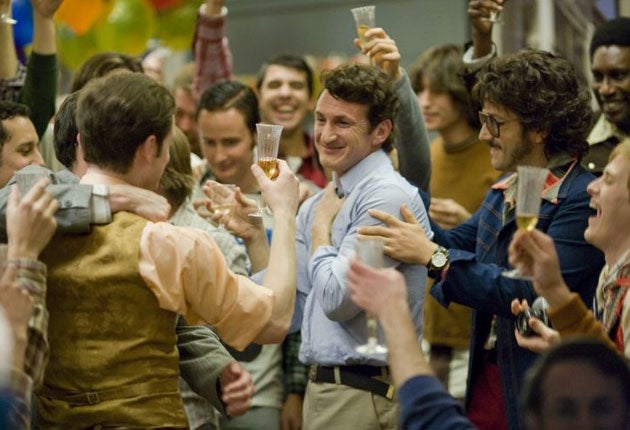
Funny, there must be something in the air in America: suddenly, there's exuberance where you wouldn't expect to find it.
You don't often see a smile cracking the features of Sean Penn, who usually looks as if he's grappling with the very conscience of a nation. But in Milk, his face is creased with euphoric mischief throughout. And look at director Gus Van Sant. His last three films – Elephant, Last Days, Paranoid Park – were introspective, formalist essays on youth and sudden death. By contrast, Milk is convivial – about an energetic, articulate social creature – and brimming with political optimism. Like last week's inauguration ceremony, Milk is that rarity, a big affirmative American statement that you don't have to feel embarrassed about being carried along by.
Joyous though Milk is, it recounts a tragedy. Oscar-nominated Penn plays Harvey Milk, who was the first openly gay man to be elected to major public office in the US; Milk become a San Francisco city supervisor in 1977, but the following year he was shot dead, together with Mayor George Moscone.
An essay in that quintessentially American genre, the great-man biopic, Milk unapologetically celebrates its subject. The story is narrated by Milk himself, a tape recorder on his kitchen table, reviewing his career in case of assassination. This may seem a clunky structuring device, but it becomes a rather poignant one when you learn that Milk actually made such a recording.
Impish, excitable, drolly self-deprecating, the Milk we meet here is a true performer – wielding a megaphone on street corners; fencing wittily with opponents; never able to resist a tart one-liner. His story starts in 1970 in New York as Milk, about to turn 40, picks up a young hippie, Scott Smith (James Franco); soon, the pair are moving to San Francisco's Castro district. How Castro became a gay capital isn't entirely evident – it's hard to know whether the film is suggesting that Milk made the neighbourhood, or just that he astutely rode its ascent – but he becomes San Francisco's leading gay voice, then fights his way into mainstream politics.
Scripted by Dustin Lance Black, the film makes it clear that while Milk is the man on the podium, he's also the representative of a community and leader of a team; his achievements are shared by the likes of Cleve Jones (an ebullient Emile Hirsch), a young cynic who at first gives Milk the brush-off, then returns to join up with a vengeance.
Despite the retro dressing, the 1970s San Francisco gay comes across as determinedly unspectacular. There's no allusion to the scene's more hardcore aspects, but that's clearly a choice: Milk sells itself to the mainstream for the same tactical reason that the real Milk chose to wear a sober three-piece suit.
The film is out to project an image of gay life that's less about sex than about the pleasure of community. Milk achieves the near-impossible in making political activism seem like huge fun.
The film's second half covers Harvey Milk's struggle against various threats to gay rights – notably the notorious Proposition Six, spearheaded by Anita Bryant, the Florida orange juice spokeswoman who became better known for her fundamentalist anti-gay rights campaigning. Wisely, Van Sant doesn't have Bryant played by an actor (although Julianne Moore would have been a shoo-in), he simply shows her incontinent rhetoric in the cold light of archive footage.

Watch Apple TV+ free for 7 day
New subscribers only. £9.99/mo. after free trial. Plan auto-renews until cancelled.
ADVERTISEMENT. If you sign up to this service we will earn commission. This revenue helps to fund journalism across The Independent.
Watch Apple TV+ free for 7 day
New subscribers only. £9.99/mo. after free trial. Plan auto-renews until cancelled.
ADVERTISEMENT. If you sign up to this service we will earn commission. This revenue helps to fund journalism across The Independent.
As for Milk's killer Dan White, the film is tantalising about his motives. White is subtly played as an embittered, confused man by Josh Brolin: homophobic he certainly is, but a question mark is placed over the scope of White's apparent madness. We're left to speculate on the part played by White's political jealousy, and on the theory – apparently entertained by Milk – that White may have been a troubled closet case. In the film's one substantially stylised episode, Van Sant reprises Elephant's long takes, as White strides with murderous intent along City Hall's corridors.
Despite its grim denouement, the film remains intensely positive: the closing documentary footage of the real Harvey Milk is not only moving, it makes you realise how bang-on the lead performance is. Penn extends his capture of Milk's vivacity right down to the way his face creases as he laughs: he plays Milk as an ostensibly shy man who nevertheless can't help emoting with his whole body once his political dander is up. And Harvey Milk's energy is catching: for once, you feel that Penn is enjoying himself.
True, this portrait is low on warts. It could, for example, have pushed further when it touches on Milk's contentious advocacy of outing. And the film offers a very partial view of San Francisco gay life, with only one significant female character, campaign manager Anne Kronenberg (Alison Pill) – although this may accurately reflect the make-up of Milk's circle at the time.
Clearly, Milk is as much about now as about then: its vision of an inclusive America makes this a manifesto, looking ahead to Obama's nation as much as it looks back on Milk's. But the film also implicitly reminds us that the battles of the 1970s are still being fought: a new Proposition 8 in California currently challenges same-sex marriage. Milk used to begin speeches with the knowing provocation, "My name is Harvey Milk, and I want to recruit you." There's no doubt that this film wants to recruit its audience too, to the cause of tolerance. Formally Van Sant's most conventional film in ages, Milk has something of the quality of a public monument, but it's also intelligent agitprop made con amore: passionate, generous and rather magnificent.
Join our commenting forum
Join thought-provoking conversations, follow other Independent readers and see their replies
Comments
Bookmark popover
Removed from bookmarks