Revolutionary Road, Sam Mendes, 119 mins, 15
A wonderfully petulant DiCaprio can't shift this Fifties lifestyle drama off the sofa and in your face
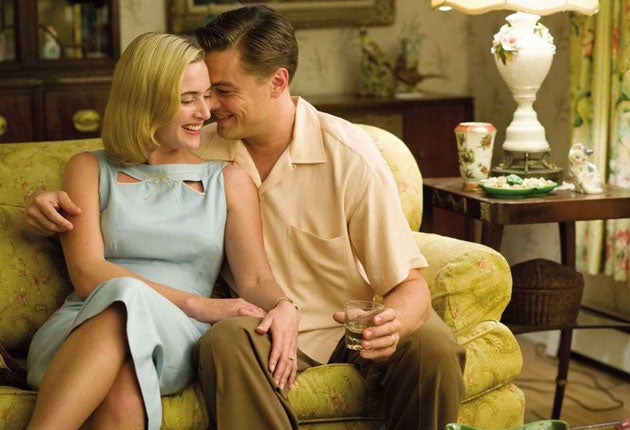
It's sometimes said that films kill the novels that inspire them – that once a book is adapted, it can never shake off the visuals imposed on it. Adoration is forever burdened with memories of that long tricky tracking shot; Doctor Zhivago can never emerge from the shadow of Omar Sharif's moustache.
I suspect, though, that the latter problem will not apply when you read Revolutionary Road, the 1961 Richard Yates novel now filmed by Sam Mendes. You may find distracting traces of Leonardo DiCaprio and Kate Winslet hovering about the characters, but otherwise, Mendes's film simply doesn't have a strong enough identity either to taint or supplant its source material.
Set in 1955, Yates's trenchant and heart-rending book has been characterised as the Madame Bovary of Eisenhower's America. Frank and April Wheeler are a young couple living in a model Connecticut suburb: April stays at home keeping up shiny appearances, while Frank commutes to a routine job in a Manhattan business-machine company.
The couple's life wasn't always so, as we see in the film's brief prelude. At a jazz-steeped hipster gathering, these two young glamourpusses lock eyes: she with her glassy touch of Grace Kelly, he knowingly carrying off his Kerouac-styled swagger.
A few years on, the couple have swallowed a stiff, sobering draft of normality. Then April gets the idea that their lives can be saved if they throw it all in and move to Paris: she'll work, he'll pursue whatever undiscovered talent is currently stifled. The dream may not seem that far-fetched, yet in the Wheelers' world, the plan strikes friends and colleagues like a move to Mars, at once insanity, arrogance and betrayal. We, too, can't help thinking the idea smacks of delusion, and indeed, everything is changed by two accidents: April's pregnancy, and Frank's sudden success at the job he feigns to regard with lofty cool-cat irony.
The essence of the Wheelers' tragedy is that everything is defined by mundanity. Both have affairs: Frank a cynical liaison with a gauche secretary (an affectingly gawky turn by Zoe Kazan), April a crushingly offhand tumble with Shep (David Harbour), her lunkish and besotted neighbour.
Scripted by Justin Haythe, the film certainly has its feet on the ground: avoiding phoney nostalgia, it scrupulously captures the ordinariness of its world. In a roadhouse jazz joint, the atmosphere is anything but stylised retro: it looks just as cheaply cheerful as in Yates's description. Yet the emphasis on oppressiveness can feel overstated. One sequence shows Frank commuting, lost in a crowd of identically fedora'd men, a river of lost souls at Grand Central. Not only clichéd, this image of conformity is smugly flattering to the present-day viewer: see how far we've come, how fortunate we are that we don't have to cover up our Gap-generation individuality.
Mendes must be sick of hearing that his film has been pre-empted by Mad Men, but there's no doubt that the slicker TV series achieves a more complex sounding of its era. Mad Men captures the conformity, the materialism, the reactionary sexual politics, yet it also conjures up the style, the excitement, the newness that affluent 1950s-60s Americans embraced even while they were cracking up.
Mendes's film gives us only the deadness of its world. We get long stretches of suburban Bergman: scene after scene of the Wheelers raging at each other magnificently but so repetitively that you want to get up and make excuses about not keeping the babysitter waiting. The novel is similarly structured on a chain of confrontations and moments of truth, but then you're unlikely to read the book in a single two-hour sitting.

Watch Apple TV+ free for 7 day
New subscribers only. £9.99/mo. after free trial. Plan auto-renews until cancelled.
ADVERTISEMENT. If you sign up to this service we will earn commission. This revenue helps to fund journalism across The Independent.
Watch Apple TV+ free for 7 day
New subscribers only. £9.99/mo. after free trial. Plan auto-renews until cancelled.
ADVERTISEMENT. If you sign up to this service we will earn commission. This revenue helps to fund journalism across The Independent.
The film's real energy comes from DiCaprio, his spoilt-kitten physiognomy filling out into shades of Mickey Rooney pudginess: he's perfect as a cocky kid who is further than he thinks down the road to stolid middle age. DiCaprio is extremely good at Frank's histrionics and excruciating lack of self-knowledge, and his body language seems impeccably of the period.
By comparison, Winslet's peeved lucidity as April is nowhere near as compelling. She can muster a fine tremor of despair at the dressing table, yet somehow never catches the shaded trouble of April's personality. And somehow Winslet is the only person in the film who, doesn't quite belong in the 1950s. This is a problem since every other face on screen looks as utterly vintage as the cars and sofas. Kathy Bates is brilliantly bustling as estate agent Mrs Givings, whose reassuring ways are the very embodiment of terrified denial; the same impulse is readable in the face of the excellent Kathryn Hahn, her very smile pure 1955, pure Barbara Bel Geddes. David Harbour and Jay O Sanders, the latter as Frank's boss, are similarly perfect in their corn-fed bullishness.
Yet the film's thoughtful exactness finally lacks life – which is why you so appreciate DiCaprio's petulance, and the stormy abrasiveness offered by Michael Shannon, as Mrs Givings' mentally disturbed son, cutting through the crap with every utterance. Otherwise, the film feels airlessly solemn in its respect for the material, in its modestly muted recreation of the Wheelers' home, in Thomas Newman's leadenly compassionate score.
What Mendes gives us is less interpretation of the book than a diligent transcription. Scene by scene, this is almost exactly the film that you imagine from reading Yates's novel. Revolutionary Road feels as if it was made less to be watched than to be discussed on arts programmes – Dinner Party Cinema par excellence. You can imagine a contemporary Frank and April going to see it, but it's unlikely to spark any decent rows on the way home.
Join our commenting forum
Join thought-provoking conversations, follow other Independent readers and see their replies
Comments
Bookmark popover
Removed from bookmarks