Telstar, Nick Moran, 118 mins, (15)
The story of Sixties pop producer Joe Meek and his north London hit factory is told not as tragedy, but as farce
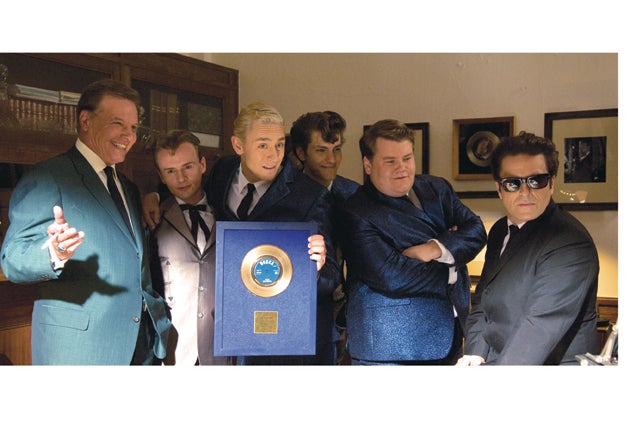
British record producer Joe Meek did not inherit the earth, although he did have a No 1 hit on both sides of the Atlantic with the Tornados' instrumental "Telstar". (You know the one – oo-OO-wee-oo twang twang ...) Meek is often hailed as a pioneer of sound recording, but he could also be seen as British pop's quintessential yesterday man, a figure entirely of his brief moment, whose style went out overnight when the Beatles – whose demos he notoriously rejected – came in.
You don't get a very clear picture of Meek's status from Nick Moran's Telstar – a portrait of the artist as boffin, tragic artist and cloth-eared jester. I doubt this last image of Meek is one that Moran and co-writer James Hicks really wanted to create: Telstar is, if nothing else, a heartfelt testament to its makers' fascination with the early Sixties era of primitive UK pop. But more than anything, the film comes across as a fond celebration of that equally disparaged and lionised British quality: plucky, well-meaning shoddiness.
Revealing its origins as a stage play, Telstar is set in Meek's subsistence-level hit factory, a cobbled-together studio over a north London handbag shop. Brylcreemed hopefuls shuffle up and down the cramped staircase of Meek's domain, an eggboxes-and-gaffer-tape empire where sound insulation is provided by pouring gooey black stuff through the floorboards.
Telstar is less a celebration of pop brilliance – to which Meek could only tenuously lay claim – than of make-do backroom-boy invention. The film pays credit where it's due: Meek's achievements owed much to his long-suffering musicians, including a future guitarist of Deep Purple; half of Chas and Dave (played by an affably gangling Ralf Little); and bullishly no-nonsense drummer Clem Cattini (James Corden, presumably filmed before overexposure did for him, and all the more likeable for it).
Other inmates of Meek's world were as odd as he was. His backer was an ex-army man and future wheelie-bin magnate – a sore-thumb performance by Kevin Spacey as a parade-ground martinet, cartoonish and literally barking. The best acting here, giving his part a genuine tragic dimension, is from JJ Feild as Heinz, a clueless bacon slicer chosen by Meek as his golden boy: the quintessential one-hit wonder, fated to have baked beans slung at him by audiences amused by his name. He also becomes Meek's lover, letting him wildly bolster his ego, only to lament in the end that he's been taken in by all his promises: just another boy Trilby with a Svengali who can't deliver.
One of Meek's hits was "Johnny Remember Me" – hyped as being dictated from beyond the grave by Buddy Holly. That's the remarkable thing about this period of British pop. On the one hand, it's unashamedly ersatz in its adulation of America. On the other, it's mired in kitchen-sink domesticity: "Johnny" singer John Leyton was best known for a supporting role in an ITV Biggles. ("He's Ginger, isn't he?" goes one of the script's better bits of innuendo.) Meek's story came to a grim end, captured in an overblown Grand Guignol climax. In 1967, he shot his landlady (a cheerful, simpatica Pam Ferris), then killed himself. But while Telstar drifts towards tragedy, it's mostly angled as farce, in a succession of blustering rages and misbegotten pranks. (Did a Screaming Lord Sutch publicity stunt really earn the headline "Idiot Annoys Locals"? I hope so: that's the story of British pop and the tabloids in a nutshell.)
As a character, Meek is framed as tragic one minute, grotesque the next. The trauma of his life as a gay man in the early Sixties is conveyed in a standard vignette in which he's caught cottaging, but elsewhere he's a pantomime figure of almost Julian-and-Sandy campness. While Con O'Neill's Meek, bullish and squat with a flapping cowlick, might have been magnetic on stage, here the largeness is distracting as he veers monotonously between sitcom fussiness and Hitlerian rage.
The whole life, despite the operatic resonance of its last act, finally comes across as tawdry and amateurish. Moran's direction doesn't help: the film feels messily assembled, flashbacks and skit-like inserts tossed in any old how. The worst gaffe, a crass insert of Meek in bed with Heinz, reduces a potentially complex relationship to a sweaty bunk-up in the Holloway Road.
Their doomed affair could have been the centre of a much more serious and involving film: Telstar's tale of disturbance, delusion and equivocal talent suggests that Meek was a split soul, effectively Kenneth Halliwell, lover and killer, to his own Joe Orton. If only Telstar had been that bit better, it would have made a great double bill with Prick Up Your Ears, Stephen Frears' 1987 film about that other ill-starred north London couple.
Join our commenting forum
Join thought-provoking conversations, follow other Independent readers and see their replies
Comments