The Baader Meinhof Complex, Uli Edel, 149 mins, 18
A German terror tale that suffers from too much fashion and not enough politics
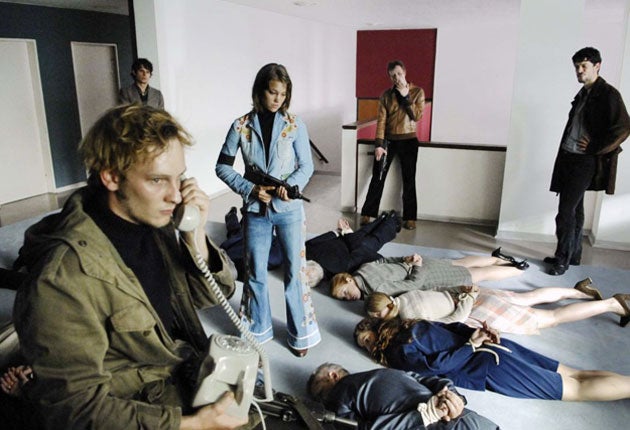
One really hates to stereotype people, especially German terrorists. Still, you won't be surprised to learn that there's very little humour to be found in The Baader Meinhof Complex, either in the film itself or its protagonists. One line, though, might provoke a titter. It follows the shooting of a banker by members of the Red Army Faction (RAF), including a young relative of his. In the getaway car, the young woman in question simpers about things getting out of hand: "How will I explain this to my parents?"
You might think that humour would be out of place in a film about the wave of extreme-left terrorism that swept West Germany in the late Sixties and Seventies; in which case, take a look at Rainer Werner Fassbinder's blackly satirical The Third Generation (1979), which contributes far more to the understanding of the RAF and its contradictions than The Baader Meinhof Complex. This earnest, decidedly mainstream epic is directed by Uli Edel (best known for Last Exit to Brooklyn and the Berlin-set Christiane F), and produced and written by Bernd Eichinger, who did the same honours on the Hitler drama Downfall.
Covering a period of about 10 years, the film seeks to document the acts of the Baader-Meinhof Group and their acolytes. The story's not easy to follow: there are some 20 principal characters, not all identified. You quickly get confused by the proliferation of shaggy-faced, leather-jacketed men and intense women, many of the latter weirdly stuck in mid-Sixties Carnaby Street drag, as if they'd pulled a heist at Granny Takes a Trip before clocking in for duty. In Germany, Edel and Eichinger have been accused of glamorising their subjects. Pillaging the Radical Chic dressing-up box doesn't itself constitute an apologia for the RAF's crimes, which are hardly whitewashed; but it does make their members look very dashing.
The key figures are Baader, Meinhof and Gudrun Ensslin. Ulrike Meinhof (Martina Gedeck) was a journalist who became the RAF's den mother and resident ideologue, and it's her radicalisation that is most meaningfully evoked here. The film is particularly effective early on, tracing Meinhof's apprenticeship, beginning with a dynamically re-enacted 1967 demo against the Shah of Iran, with German police launching a bloody attack on protesters. Gedeck's troubled Meinhof, her increasingly callous communiqués heard in voice-over, is the closest thing to a real characterisation.
Her comrades, however, come across as strident hipsters, or as cartoons. Johanna Wokalek's Ensslin is seen lolling in a hot bath, a volume of Trotsky in hand, looking like the centrefold in the May '68 issue of Anarcho-Syndicalist Babes. Equally glamorous is Andreas Baader, played by Moritz Bleibtreu as a Belmondo-style master of fag-in-mouth insolence. On trial, Ensslin and Baader bewitch the courtroom, slipping on aviator shades to taunt the judge. Even so, the film is at pains to depict Baader as a petulant jerk. At a Jordanian training camp, he complains at having to shin his way through sand and rocks: "We're urban guerillas – we don't have any fucking deserts."
As the film progresses, individual militants – ever more numerous and hazily defined – become less important than their actions. The robberies, bombings and summary executions are strung out in a series of caper-movie vignettes, while an odd leitmotif has German citizens, mostly elderly, cautiously peering out of curtained windows. Essentially, the film sets a group of sexy outlaws, however misguided, against the authorities, represented as violent, faceless militia or as bumbling, flabby middle-aged men. It is made clear that RAF's extremism was a response to international right-wing repressions, and to the brutality of the West German police and their political masters. But the makers are at pains to present some sympathetic "parent" figures. In particular, Bruno Ganz, of the lovely folded face, plays police chief Horst Herold as a gentle, pensive man who plies his aides with lobster soup. He gets the worst, wordiest scene, musing that maybe it's time to be less rigid, to try and understand the RAF's motives: after all, these young people are protesting against the problems in the world, and "these problems exist objectively".
But The Baader Meinhof Complex barely gives itself time to think in any depth about the context that spawned the RAF, or the reasons why their motivations became so horribly distorted. It makes little of its gestures at present-day resonance: there are hints at a parallel between the RAF and contemporary Islamist terrorism, but it goes no further than that. It would take a much more measured, analytical approach to properly pursue such themes. Instead, Edel and Eichinger zip with Bond-film breathlessness between glamorous locations (Jordan, Sicily, Rome, Baghdad), and rely for historical context on clumsy newsreel montages cramming together Martin Luther King, Nixon, Vietnam, Prague, Paris, the 1968 Mexico City massacre (now that's what I call Sixties unrest). There's also an intriguing theme being squandered, in the suggestion that Herold's enthusiasm for computerised detection methods signals the advent of the modern surveillance state. Herold comes across as a figure right out of Fritz Lang, and you only wish that German old master had been around in the Seventies: he really could have done this story justice.
Join our commenting forum
Join thought-provoking conversations, follow other Independent readers and see their replies
Comments
Bookmark popover
Removed from bookmarks