The Headless Woman, Lucrecia Martel, 87 mins, (12A)
One woman's driving accident is at the core of this mysterious exploration of Argentina, destined to become a classic
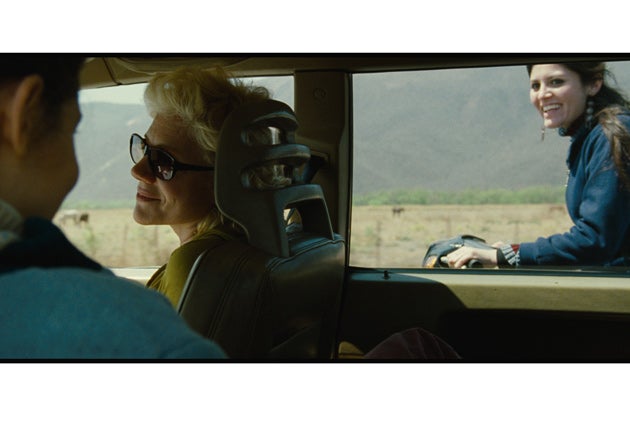
It hardly ever happens at film festivals that people take time out to see something twice. But when I first caught Argentinian film The Headless Woman at Cannes in 2008, several critics were already on a second viewing.
Some hadn't chosen to go back: at its first screening, The Headless Woman drew as many catcalls as cheers. And many people – for, against or undecided – left the film bewildered. The Headless Woman probably mystified as many viewers in Cannes as any premiere since Antonioni's L'avventura in 1960 – and I suspect that Lucrecia Martel's film too will go down in history as a classic.
That a film should be perplexing needn't be a turn-off: look how popular Michael Haneke's Hidden was. Martel, the hugely original director of La ciénaga and The Holy Girl, doesn't set out to baffle in quite the same way as Haneke:The Headless Woman is mysterious because it places us in the same foggy, dislocated frame of mind as its traumatised heroine.
That heroine is Veronica (Maria Onetto), a middle-aged woman with peroxide blonde hair and a placidly distracted look. Early on, we see her at the wheel of her car. The camera holds on her as she drives along, an ancient Nana Mouskouri hit playing on the radio, and it stays on her as there's an almighty bump: Veronica has apparently hit something, but after stopping for a moment, she drives off, the music still pumping away.
Her rear-view mirror shows a dog lying in the road, but do only we see it, or does Veronica? Does she know what's happened?
What she knows, and how she feels, remain moot throughout. We see her at the local hospital, being checked for injuries, and framed by cinematographer Barbara Alvarez to look disconnected from everything around her; in one shot, a scanning machine hides her face, making her literally headless. She forever seems to be looking the other way from everyone else, moving at a different speed to the world.
Veronica takes shelter in a hotel room, where she's visited by a solicitous male acquaint-ance: they sleep together, but it's only later that we realise he is married to Veronica's cousin. When Veronica's husband comes home the next day, he barely seems surprised by her spacey silence: could it be that she is always like this?
Meanwhile, the question remains: what actually happened on the road? Veronica eventually announces that she thinks she killed someone, but no one will entertain the thought seriously. Meanwhile, police have found something in the nearby canal and, at the local garden centre, a boy has failed to show for work. He's one of the background people in the film, one of Argentina's indigenous poor who work in Veronica's world as labourers, gardeners, cooks, but who don't seem to be perceived as real people by the bourgeoisie. Yet Martel makes us acutely aware of this background world, and of the way that Veronica's circle ignores it.
In one scene, Veronica drives to a shanty settlement outside town: it remains a blur outside her car window, neither visited nor seen. Martel plays teasing games with our perceptions. When Vero visits an aunt, the old lady talks of her house being full of the dead; then the silhouette of a boy, out of focus and unexplained, quietly slips out of the room. A phantom? Veronica's accidental victim? He turns out to be real, the cook's son. But he's no less invisible for that – one of the ghosts that haunt Veronica's class, just as the "disappeared" of the dictatorships of the Seventies and Eighties haunt Argentina today.

Watch Apple TV+ free for 7 day
New subscribers only. £8.99/mo. after free trial. Plan auto-renews until cancelled.
ADVERTISEMENT. If you sign up to this service we will earn commission. This revenue helps to fund journalism across The Independent.
Watch Apple TV+ free for 7 day
New subscribers only. £8.99/mo. after free trial. Plan auto-renews until cancelled.
ADVERTISEMENT. If you sign up to this service we will earn commission. This revenue helps to fund journalism across The Independent.
The film can be read as a political parable, alluding not only to the denials of the past, but to the bourgeoisie's present denial of its sheltered privilege. But these issues are never raised explicitly. Martel is in the first place interested in making us feel what it's like to inhabit her characters' sealed world – a series of fishtank spaces such as the dining room where Veronica's family finally gathers behind glass doors.
Martel immerses us in the dislocated, stunned consciousness of a woman so out-of-focus it is as if she's barely there. Veronica seems less a person than an image, the distant echo of a Hollywood melodrama heroine. With her blonde hairdo, she's a near relation of those haunted women (older than femmes fatales, younger than matrons) in the films of Pedro Almodovar, who is among Martel's producers. Mesmerisingly played by Maria Onetto – a sort of performance in negative – Veronica is an oddly magnetic void, attracting the film's energies and our fascination, not to mention the fascination of all those, especially men, who dance attendance on her. (Would it be going too far to see her artificial blondeness as an echo of the once idolised Eva Peron?)
Watching the film again, the narrative struck me as actually more or less straightforward – but even then, there are gaps, loose ends, patches of narrative haziness, and that's just as it should be. The Headless Woman is no wilfully opaque puzzler designed to alienate; Martel is out to confound and bedazzle us, and to worry us too. You'd have to be headless or heartless yourself not to let this extraordinary, eerie film get under your skin.
Next Week:
Jonathan Romney watches Michael Moore set the world to rights once again with his documentary Capitalism: A Love Story
Join our commenting forum
Join thought-provoking conversations, follow other Independent readers and see their replies
Comments