
Get our free weekly email for all the latest cinematic news from our film critic Clarisse Loughrey
Get our The Life Cinematic email for free
There will be other challengers in time, but so far The Hurt Locker is easily the best film to come out of the Iraq war.
That's not necessarily the same thing as a film "about" the Iraq war. Kathryn Bigelow's intense, jittery drama doesn't deeply consider the whys and hows of the conflict, and good job, too, if the ones that do are anything like Lions for Lambs. This is less about the War on Terror than the terror of war, a ground-level investigation of the way three different soldiers respond to the everyday peril of keeping the peace in occupied Baghdad. What's more, the soldiers of Bravo Company are engaged in the scariest arena – bomb disposal.
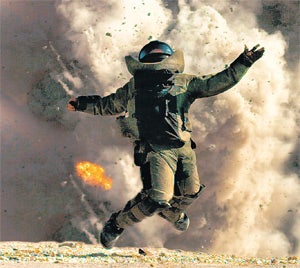
That much is made sickeningly clear in a set-piece prologue where the company's chief bomb "tech" is killed by an IED (improvised explosive device) on a deserted roadside. The dead man's colleagues, Specialist Owen Eldridge (Brian Geraghty) and Sgt J T Sanborn (Anthony Mackie), don't know what to make of his replacement, because Staff Sgt William James (Jeremy Renner) isn't like any soldier they've met. James is both expert and maverick, a cool-headed fatalist who takes risks in a field already primed with risks. He discards the protective suit of techs who go into the kill zone – "If I'm gonna die, I'm gonna die comfortable" – and he disregards procedure. He has ridden his luck, with nearly 900 bombs successfully defused. Sanborn is far more cautious, and bitterly rebukes James for putting his life, and by extension their lives, on the line. Eldridge, the youngest of them, is a heartbreaking bundle of nerves and twitches, longing for the day he comes out of the line.
What sane person would not? Sanborn and Eldridge both realise the near-hopelessness of the army's situation, being in a country they don't understand among a people whose language they don't speak. Bigelow conveys their disquiet quite brilliantly; nearly every scene in which they patrol the streets crackles with tension and foreboding. She mixes long shots with sudden close-ups to tremendous effect. Whose faces lurk at those open windows above them? Why is that man training a videocam on their movements? How to distinguish between hostility and simple curiosity? Her technique, the opposite of rubbish like Tony Scott's The Taking of Pelham 123, is to build a scene over long minutes, probing and exploiting our doubts instead of clouting us over the head with whippy, rock-video edits. At times we are right there in the middle of the madness, listening to the breathing of a tech beneath his huge protective helmet (which will be no protection at all in the event of a blast), or watching the dusty, dead-tired face of Sanborn as he lines up a rifle-shot down the crosshairs.
The movie represents a personal triumph for Bigelow. Having proven her hotshot action credentials nearly 20 years ago in Point Break, she has never really delivered since, crashing between the millennial hysteria of Strange Days (1995) and the dour submarine heroics of K-19: The Widowmaker (2002). This time she has assembled an elite team of her own, starting with screenwriter Mark Boal, a journalist who was embedded with a US bomb squad in Baghdad. Boal's script is notable for making character the priority; everything these soldiers say derives from individual sensibility rather than the manual of tough-guy dialogue. The director of photography, Barry Ackroyd (United 93), shoots with multiple cameras to create a sense of menace from all sides; no recent action movie has better expressed the critical importance of space.
Unusually, the most famous contributors here – Ralph Fiennes, Guy Pearce – are granted shockingly brief screentime, almost as if Bigelow were trying to invert the star system and lift the minor actors to prominence. Jeremy Renner seems vaguely familiar, though his blunt, froggy countenance is not that of a hero, or a leading man. Perhaps that's the point: coolheadedness and courage, pace Hollywood, can reside within quite ordinary-looking types. The screenplay suggests a pathological strain to his heroism: whereas for most men war is a drag, for the likes of James it's a drug. This bomb specialist gets his kicks from being as close to obliteration as humanly possible. James's tragedy is his inability to live "normally"; back at base he enjoys violent horseplay with his buddies, while at home with the wife and kid he looks quietly wretched as he trails up and down the supermarket aisles.
Some might criticise the film for not taking an overview of the Iraq intervention, though the implications of the soldiers' presence is hardly ambiguous. Their government has put them in this mess; all they can do is try to survive it as best they can. Bigelow is animated by a more universal impulse: she wants to convey how men manage to cope under the intolerable pressures of conflict. In that sense it could be about any war. The Hurt Locker is really a study in fear, and how certain individuals go beyond that fear to a kind of grace. That's the feeling behind Bigelow's haunting final shot of a bomb technician, walking away from camera down another dust-blown Baghdad street. In his cumbersome suit and helmet he looks like a spaceman, heading for who on Earth knows what.
Subscribe to Independent Premium to bookmark this article
Want to bookmark your favourite articles and stories to read or reference later? Start your Independent Premium subscription today.
Join our commenting forum
Join thought-provoking conversations, follow other Independent readers and see their replies